NATO MULTIMEDIA ACCOUNT

Access NATO’s broadcast-quality video content free of charge

Register

Create an account

Create an account

Check your inbox and enter verification code

We have sent a verification code to your email address. . Enter the code to verify your account. This code will expire in 30 minutes.
Verification code

Didn't receive a code? Send new Code

You have successfully created your account

From now on you can download videos from our website

Subscribe to our newsletter

If you would also like to subscribe to the newsletter and receive our latest updates, click on the button below.

Reset password

Enter the email address you registered with and we will send you a code to reset your password.

Reset password
Check your inbox and enter verification code
We have sent a verification code to your email address. Enter the code to verify your account. This code will expire in 30 minutes.
Verification code

Didn't receive a code? Send new Code

Create a new password

The password must be at least 12 characters long, no spaces, include upper/lowercase letters, numbers and symbols.

Your password has been updated

Click the button to return to the page you were on and log in with your new password.

Executive summary

The Alliance is navigating a rapidly evolving security landscape shaped by technological disruption, strategic competition, and the imperative for speed and agility in decision-making. To preserve its strategic edge and ensure the security of its over one billion citizens, Allies committed to increased investments that will ensure the availability of required forces, capabilities, resources, infrastructure, warfighter readiness and resilience to deter and defend in line with NATO’s three core tasks.

The Alliance Digital Strategy provides the direction for NATO’s digital transformation and sets out a high-level vision to empower Allied leaders and warfighters with information and decision superiority for multi-domain operational dominance, through rapid integration of secure, resilient and interoperable digital capabilities that harness data-driven, human machine collaboration.

A common set of strategic principles provide a consistent foundation for decision making, investment, and governance across the Alliance and the NATO Enterprise. They serve to cohere diverse stakeholders’ actions, ensuring that digital transformation efforts are guided by common values, standards, and operational imperatives, even as technological and geopolitical conditions continue to evolve.

To promote coherence across the NATO Enterprise and Allied efforts, and to foster unity of purpose within the broader Alliance ecosystem, this Strategy is underpinned by a set of strategic objectives: mission-driven Digital Transformation, interoperable and secure-by-design infrastructure, data-centric operations, accelerated innovation adoption and digital workforce enablement.

As the strategic compass for NATO’s Digital Transformation, the Strategy plays a central role in driving implementation by aligning governance, investment, capability development, and cultural adaptation across the Alliance. The Strategy’s implementation is anchored in the Digital Transformation Implementation Strategy and its progress will be assessed and benchmarked across organisational, technical and cultural dimensions, through a combination of qualitative and quantitative indicators.

This Strategy positions NATO to lead in the digital age, ensuring mission superiority, information advantage, and readiness across all domains. Through coherent integration of national advances and Allied ambitions, the Alliance will be optimally postured for future challenges, resilient, and digitally decisive. NATO’s digital transformation is not only a technological upgrade but a shift in culture, posture, and operational agility.
Strategic context

  1. The international security environment is in a period of pronounced and persistent erosion of strategic stability. Authoritarian nations are aggressively seeking to expand their influence across the globe and constrain the freedom and security of Alliance member-states. These trends challenge the Alliance’s core values and threaten the integrity of the rules-based international order.
  2. In response, NATO has adopted a comprehensive 360-degree approach to deterrence and defence, reinforcing its vigilance and preparedness. At the Hague Summit, Allied Heads of State and Government committed to increased investments by 2035 to ensure the availability of required forces, capabilities, resources, infrastructure, warfighter readiness and resilience to deter and defend in line with NATO’s three core tasks1.
  3.  The 2022 NATO Strategic Concept reaffirmed Allies’ commitment to expedite NATO’s Digital Transformation and adapt the NATO Command Structure for the information age by enhancing cyber defences and digitizing information networks, and infrastructure. In that regard, the Alliance shall pursue the following coherent set of priorities that enable digital transformation at scale and pace: promoting innovation and accelerating the adoption and integration of modern digital technologies, including those that are considered emerging and disruptive; deepening cooperation with the private sector; adhering to principles of responsible use; and ensuring the timely implementation of agreed standards. These efforts will be further driven by the direction set in Political Guidance 2027 and the associated NATO Defence Planning Process capability targets, contributing to the operationalisation of Digital Transformation across the Alliance.

Purpose

  1. In this renewed strategic context, the Alliance Digital Strategy (henceforth referred to as the Strategy) provides the strategic direction for NATO’s digital transformation and affirms a shared commitment for delivering interoperable digital capabilities and resilient networks. It promotes integration of digital enablers and information superiority to enhance NATO’s decisive military advantage. The Strategy supports the implementation of NATO’s DDA2 Family of Plans, while advancing the Warfighting Capstone Concept and its associated Warfare Development Agenda (WDA). The Strategy serves as the capstone document for digital governance (see Appendix 1).

Vision for 2035

  1. The Digital Transformation (DT) Vision continues to serve as a foundational framework through 2030. Building upon this cornerstone, the Strategy articulates an expanded  and  forward-looking  trajectory  extending to 2035,  reaffirming  ourommitment to the Hague Summit Declaration and aligning NATO and national priorities with broader multilateral ambitions.
  1. To empower Allied leaders and warfighters with information and decision superiority for multi-domain operational dominance, through rapid integration of secure, resilient and interoperable digital capabilities that harness data-driven, human-machine collaboration.

Scope

  1. The Strategy applies to Information and Communications Technology (ICT) Services3 and associated digital capabilities provided in support of NATO’s core tasks.
  2. The Strategy has a regulatory and an advisory function, as follows:
    • NATO Enterprise entities shall strive to achieve the vision and the strategic objectives and apply the principles set in the Strategy;
    • NATO Nations, Federated Mission Networking (FMN) Affiliates and prospective federation participants are advised and strongly encouraged to align with the strategic principles and objectives of the Strategy in their own activities, where appropriate.
    • It is emphasized that the aforementioned advisory framework becomes mandatory for all Nations upon joining federated networks instantiated for strategic political - military consultation and NATO-led operations, in order to ensure the availability of interoperable forces and digital capabilities from the outset. This requirement is a prerequisite for Nations to operate effectively and securely as part of a cohesive NATO formation within the context of a strengthened deterrence and defence posture.

Strategic principles

  1. The successful implementation of the Strategy requires a common set of strategic principles. These principles are organised below into thematic clusters and provide a consistent foundation for decision-making, investment, and governance across the Alliance and the NATO Enterprise. They serve to unify diverse stakeholders’ actions, ensuring that digital transformation efforts are guided by common values, standards, and operational imperatives, even as technological and geopolitical conditions continue to evolve.

  2. Digital Infrastructure and Services
    • Digital capabilities shall be acquired and/or adopted as services by industry or Allied Nations respectively. When service provision is not possible, these capabilities shall be procured in accordance with the “ABC” paradigm (i.e. adopting what is already owned by NATO or Nations4, followed by buying off-the-shelf solutions and only creating new solutions as a last resort, or a combination of the above).
    • The NATO Enterprise users shall be offered the same standardised, fit-for-purpose, fit-for-use and secure-by-design ICT services, for equivalent requirements.
    • National digital capabilities used by forces assigned to SACEUR or forces that are foreseen to contribute to the DDA Family of Plans shall comply with agreed NATO interoperability standards, as per the agreed FMN specifications and the associated implementation timelines.
    • NATO shall adopt a Digital Engineering approach5, ensuring that systems’ architectures, requirements, and design artefacts are digitally integrated, data-driven, and aligned with agreed standards to enable automation, traceability to mission outcomes, interoperability from the outset and lifecycle coherence across the Alliance and the NATO Enterprise. These standards shall include secure software and hardware supply chain practices and cyber security testing.
    • Capability requirements, relevant architectures, and associated interoperability standards shall be data-centric: structured to be machine-readable, interpretable, exchangeable, and testable with minimal or no human intervention.
    • The paradigm of Software Defined Defence shall be incorporated to decouple functionality from hardware, facilitate dynamic capability upgrades and rationalise networks through zero-touch provisioning and dynamic orchestration, enabling automated deployment and rapid mission networks’ instantiation.
    • Federated platforms shall be established to enable collaboration and the controlled sharing of data, digital services, and computing resources, based on Zero Trust and secure-by-design principles.
    • Cloud adoption shall follow a federated, multi-classification, scalable, and hybrid model, seamlessly integrated with tactical edge computing, underpinned by next-generation networks to ensure resilient, high-bandwidth, low-latency connectivity for continuous data exchange, mobility, and mission-critical operations in degraded, contested, and denied environments.
       
  3. Data and Artificial Intelligence (AI) Ecosystem
    • Data constitutes a corporate resource and an enduring strategic asset that shall be integrated in both political and military decision-making processes.
    • The wide use of AI technology in NATO digital services shall be promoted and accelerated, with consideration for the NATO-agreed Principles of Responsible Use.
    • In particular for services at the tactical edge, the deployment of inference AI solutions will improve the warfighter’s situational awareness, support real-time risk-informed decision-making and enhance operational autonomy in contested environments.
    • The implementation of consistent, standardised data labelling, metadata tagging and data access controls in accordance with federated Identity, Credential and Access Management principles shall enable secure, interoperable, and policy-compliant data sharing across federated data spaces6, integrated at the digital platform layer (see paragraph 10.5).
       
  4. Cross Domain Command (CDC) Enablement. The manifestation of the Alliance concept for CDC shall be enabled by the establishment of a segregated warfighting information domain, within the federated digital backbone, that enables data fusion from available sensors7 and integration of sensor-to-effector data flows, with real-time predictive analytics and cognitive decision-making augmentation.

  5. Cyber Defence and Digital Resilience
    • Mission assurance shall be enhanced by embedding Zero Trust principles across all digital infrastructure to strengthen NATO’s cyber defence and digital resilience, ensuring continuous verification, least privilege access, and secure handling of data, users, and systems.
    • NATO shall accelerate the adoption of post-quantum cryptography to ensure long-term protection of sensitive data and communications, mitigating future threats posed by quantum computing and preserving strategic information superiority.
    • Mission critical services shall be identified, prioritised, protected and continuously optimised to ascertain mission assurance and uninterrupted execution of core functions across static, mobile and dispersed warfighting Headquarters. The resilience and survivability of mission critical services shall be ensured through redundant and diversified technical solutions, based on the PACE (Primary, Alternate, Contingency, Emergency) principle.
    • NATO shall leverage robust collaboration with trusted vendors to safeguard its interests in the cyberspace, including scaling-up its capacity to expeditiously respond to cyber incidents.
       
  6. Innovation and Emerging Technology Integration
    • NATO shall further expand its innovation network and collaborate with dual-use and disruptive technology actors through experimentation, prototyping and rapid procurement channels.
    • Mechanisms for “fail-fast, learn-faster” experimentation and prototype fielding shall be preserved and scaled up for use cases that are derived from valid operational needs.
    • Synthetic environments, as well as modelling and simulation services, shall be leveraged to accelerate Research and Development, collective training, audacious wargaming, and mission rehearsal for Multi-Domain Operations (MDO).
       
  7. People and Culture
    • Digital literacy shall be embedded as a core professional competency across all personnel categories, tailored to functional responsibilities and evolving mission needs.
    • Continuous learning and intellectual agility shall be encouraged through training, scenario-based exercises, and access to diverse digital tools that cultivate analytical reasoning and innovation.
    • Leaders shall be equipped and incentivised to promote digital-first mindsets, advocate for data-driven decision-making, and foster a cultural shift towards experimentation, innovation and digital trust.
    • A structured digital proficiency curriculum shall guide training, certification, throughout career progression, ensuring personnel attain and maintain appropriate levels of digital capability commensurate with their roles and grades, thereby strengthening capability development across the Alliance. Such training shall also include effective personnel interaction with AI-enabled systems, ensuring responsible use and trust in machine-supported operations.
    • NATO Civil-Military cooperation mechanisms – upon Allies’ approval – shall be established, leveraging diverse multidisciplinary teams, to enable sustained knowledge exchange and promote a culture of ethical and cross-sectoral collaboration and operational alignment that drives continuous innovation. Furthermore, collaboration with academia and industry from Allies shall be strengthened to exploit relevant research developments and maintain a competitive advantage for the Alliance, with the aim of achieving agile command and control capabilities extending to the tactical edge.
       
  8. Organisational Processes
    • Organisational planning for digital transformation shall adopt agile methodologies and a portfolio management approach, enabling continuous iteration, reassessment, and reprioritisation, based on operational feedback and evolving mission requirements.
    • Internal processes shall be streamlined and, where appropriate, automated to reduce overhead, increase responsiveness, and enhance the organisation’s efficiency and effectiveness. These process improvements shall be complemented by adaptive organisational structures that facilitate cross-functional collaboration and responsiveness to change. Integrating risk management into the decision-making process ensures that actions are aligned with strategic priorities and potential threats are proactively addressed.
    • Mechanisms shall be established to systematically assess regulatory compliance, gather user feedback, operational data, and lessons learned, enabling continuous refinement of the digital regulatory framework in accordance with strategic drivers and digital transformation priorities.

Strategic objectives

  1. To promote coherence across the NATO Enterprise and Allied efforts, and to foster unity of purpose within the broader Alliance ecosystem, this Strategy is underpinned by a set of strategic objectives. These objectives translate the Strategy’s vision into actionable targets, guiding both the development of digital capabilities and the governance of their implementation.
  2. Mission-Driven Digital Transformation: Anchor all digital transformation efforts in the operational needs of warfighters and decision-makers, ensuring that digital technology is a direct enabler of NATO’s three core tasks. Foster outcome-oriented planning and respective roadmaps that translate strategy into actionable digital services – underpinned by modernised processes – synchronised and aligned with the overarching intent to fully enable MDO by 2030 and to further amplify NATO’s competitive advantage in the conduct of MDO by 2035.
  3. Interoperable and Secure-by-Design Infrastructure: Implement interoperable and secure-by-design digital platforms for the Alliance, in accordance with international standards and NATO-agreed reference architectures8 to achieve federated interoperability and reduce vendor lock-in. Foster digital infrastructure convergence and rationalisation of legacy networks through Software Defined Defence practices, allowing greater modularity, programmability, and interconnection between heterogeneous systems.
  4. Data-Centric Operations: Implement a data-centric governance operating model9 that ensures enhanced, real-time situational awareness, strategic foresight, and tactical precision, through persistent access to mission-relevant data at all levels of operation, from strategic political/military down to the tactical edge, thereby accelerating mission-critical decision-making. Leverage federated Alliance data spaces to enhance resilience, enable effective governance, data discoverability and consumption across domains and nations whilst preserving national data sovereignty, autonomy and accountability.
  5. Accelerated Innovation Adoption: Embed agile delivery mechanisms and rapid capability adoption across acquisition and operations. Promote “fail fast, learn faster” approaches and engage operational end-users early to foster a streamlined pathway from innovation to mission deployment, including necessary adaptation/ evolution of extant operational and security accreditation processes.
  6. Digital Workforce Enablement: Cultivate a critically thinking cohort of professionals, capable of navigating, securing, and innovating in a complex digital landscape. Strengthen digital acumen across all levels of personnel, commensurate to their area of responsibility and the stipulated proficiency levels, reinforce civilian-military cooperation on digital expertise, and empower leaders to champion digital-first thinking.

Measuring progress

  1. As the strategic compass for NATO’s Digital Transformation, the Strategy plays a central role in driving implementation by aligning governance, investment, capability development, and cultural adaptation across the Alliance. The Strategy’s implementation is anchored in the Digital Transformation Implementation Strategy, and its subsequent revisions.
  2. A critical element to assess and benchmark progress will be the operationalisation of the approved Digital Transformation Maturity Model. This model will enable governance bodies to identify capability gaps, monitor institutional readiness, assess the broader cultural adaptation and drive continuous improvement through evidence-based decision-making. Progress will be measured through a combination of qualitative and quantitative indicators that track advancement against strategic objectives.
  3. At the Strategy level, some key performance indicators include: the percentage of NATO missions enabled by digital cloud-native services; the operational effectiveness gains attributed to AI adoption and automated assisted decision-making systems; the effectiveness of interoperability measures; the integration of security and privacy controls by design; and the participation in digital leadership programs and workforce certification rates. Additional key performance indicators will be defined and maintained within detailed implementation plans/ roadmaps in the context of future Digital Transformation Implementation Strategy revisions, as well as subordinate governance instruments. Regular assessments against these indicators will enable continuous learning, support adaptive planning, and ensure that the Strategy remains a living instrument that drives coherence and accountability across the digital transformation effort.

Roles and responsibilities

  1. The Digital Policy Committee (DPC) shall apply strategic foresight to continuously monitor the evolving digital landscape and, when warranted by significant changes in the strategic context, update the Strategy to ensure NATO sustains its strategic advantage over its competitors.
  2. The DPC shall ensure an outcome-driven implementation approach by updating – as required – NATO’s Digital Transformation Implementation Strategy to reflect necessary lines of effort for Allies and the NATO Enterprise, with progress systematically measured and reported to the Council.
  3. The DPC shall regularly inform and consult with the Military Committee to align the Strategy’s implementation – through DTIS – with the WDA, reinforcing coherence between political direction, digital transformation and warfare development efforts across the Alliance.
  4. National Representatives in other NATO Senior Policy Committees and Boards shall communicate the broader Alliance perspectives of this Strategy to their capitals and coordinate, as required, to ascertain policy coherence and collectively support the achievement of the strategic objectives.
  5. The Heads of NATO Enterprise entities shall coordinate, in the context of the Senior Executive Group and under the Secretary General’s oversight, to collectively contribute to the achievement of the Strategy’s vision and strategic objectives.

Conclusion

  1. This Strategy positions NATO to lead in the digital age, ensuring mission superiority, information advantage, and readiness across all domains. Through coherent integration of national advances and Allied ambitions, the Alliance will be optimally postured for future challenges, resilient, and digitally decisive. NATO’s digital transformation is not only a technological upgrade but a shift in culture, posture, and operational agility.

Appendix 1: Digital Regulatory Framework

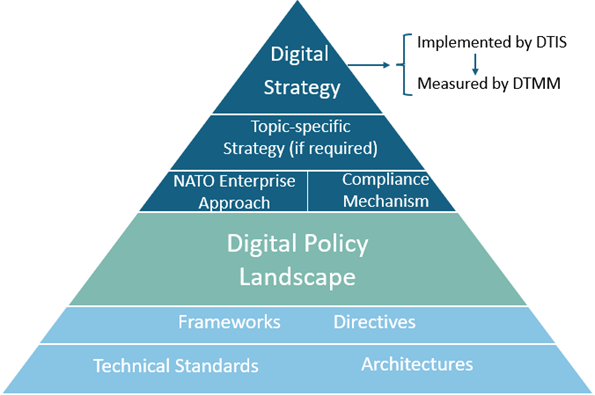
  1. NATO’s digital governance is enacted through the development and continuous refinement of a comprehensive Digital Regulatory Framework (DRF). The DRF is a structured hierarchy of statutory documents and corresponding enforcement mechanisms established by governance bodies. It encompasses the overarching Strategy, underpinned by topic-specific Strategies, the NATO Enterprise approach, a compliance mechanism, and the broader digital policy landscape. This landscape is further supported, as necessary, by relevant frameworks, directives, technical standards, and architectures that collectively enable effective governance.
  2. A comprehensive regular review of the DRF is required to ensure it remains coherent, relevant and constitutes a strategic enabler for the achievement of the Alliance’s core tasks.

1. Deterrence and defence, crisis prevention and management, and cooperative security.

2 Deterrence and Defence of the Euro-Atlantic Area.

3. As outlined in the latest approved Consultation, Command and Control (C3) Taxonomy.

4. For military Community Of Interest (COI) services, due consideration shall be given to adopting modern solutions, already used by Allied forces, provided that they are compliant with relevant NATO-agreed interoperability standards.

5. Digital Engineering is an integrated digital approach that uses authoritative sources of data and models as a continuum across disciplines to support lifecycle activities from concept through disposal.

6 Data spaces are an emerging concept based on decentralised infrastructures that describe the agreements and supporting technical solutions where diverse actors can share and use data in a secure, reliable and trustworthy manner, following common governance, organisational, regulatory and technical mechanisms.

7. E.g. Joint Intelligence, Surveillance and Reconnaissance (JISR), Open-Source Intelligence (OSINT), National Military Internet-of-Things (MIoT).

8. Examples include the Digital Backbone and the Data-Centric Reference Architectures for the Alliance.

9. The data-centric governance operating model shall be in accordance with the Data Strategy for the Alliance.