Close
Back

From now on you can download videos from our website
If you would also like to subscribe to the newsletter and receive our latest updates, click on the button below.
Enter the email address you registered with and we will send you a code to reset your password.
The password must be at least 12 characters long, no spaces, include upper/lowercase letters, numbers and symbols.
Click the button to return to the page you were on and log in with your new password.
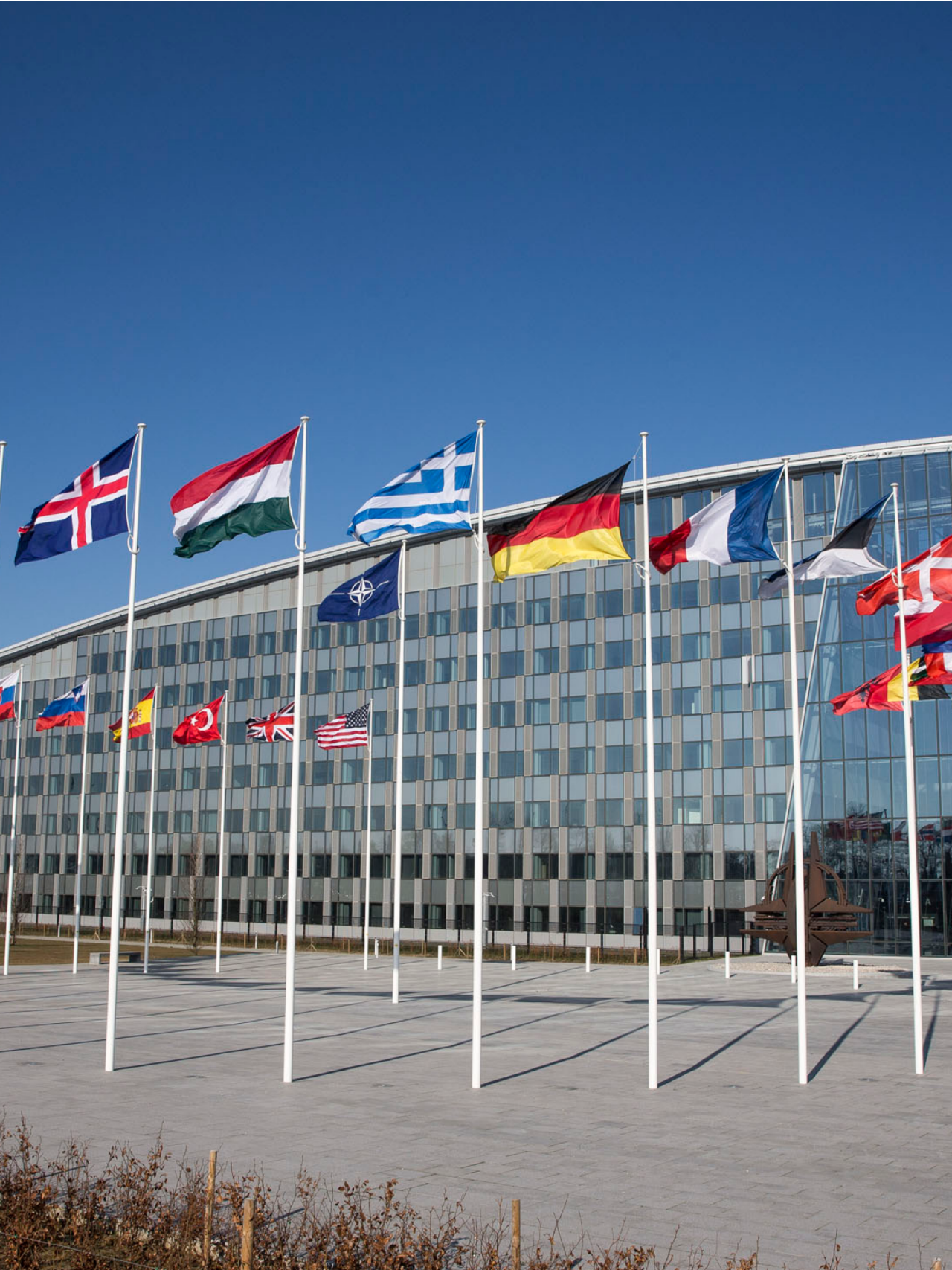
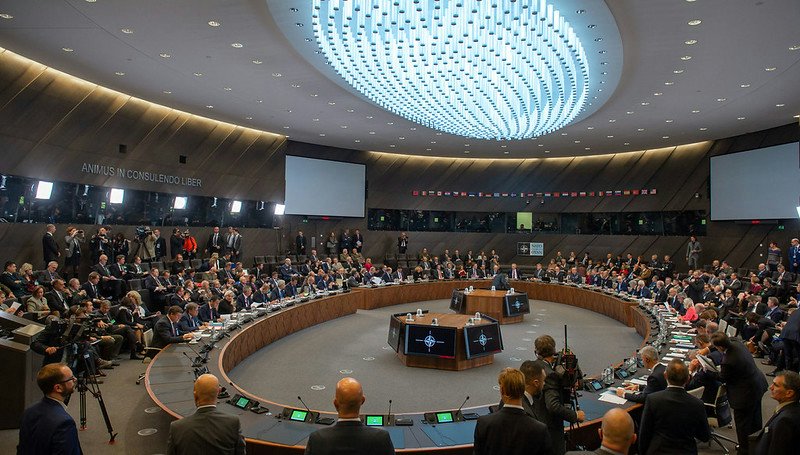
NATO's motto, “animus in consulendo liber”, highlights the importance of consultation among Allies. In English, it translates to “in discussion a free mind”. Open and frank discussion – in the North Atlantic Council and its sub-committees – is one of the most important features of NATO, giving member countries the space to share their views, exchange information, build trust, solve problems and, in the long run, prevent conflict.

The motto on the wall of Conference Room 16 at the old NATO Headquarters in Brussels
NATO's motto was suggested by André de Staercke, who served as Belgium's representative to NATO from the Alliance's creation in 1949 to his retirement in 1976.
During his farewell speech to the North Atlantic Council on 29 January 1976, de Staercke reminded his colleagues of the motto’s peculiar history:
“Many years ago, when the Headquarters of the Alliance was transferred to Porte Dauphine in Paris [December 1959], Mr Paul-Henri Spaak – who was then Secretary General – asked me to give him in Latin – that fine Latin prose that carries out wisdom within it – a maxim reflecting in a few words the collective aim of the Atlantic Alliance and the independence of its members.” (para. 3, p17-18; C-R(76)4.pdf)
De Staercke recounted that he had seen this maxim during his childhood at the Palazzo del Podesta in San Gimignano, Italy. It was engraved on the back of the seat of the city’s chief magistrate.
“Eis fuit domi industria, foris justum imperium, animus in consulendo liber; neque libidini, neque delicto obnoxious.” ("They had industry at home, a just rule abroad, in counsel an independent spirit, subject neither to passion nor to crime”).
These words are attributed to Marcus Porcius Cato (also referred to as Cato the Censor, 234 BCE – 149 BCE), a Roman politician and philosopher renowned for his rigid morals and principles. His maxim was commonly used in medieval times in northern and central Italy to adorn the facades of town halls and council chambers in praise of good governance.
Spaak was deeply impressed by de Staercke’s description and thought the Latin maxim should be adopted as the NATO motto. His wish was fulfilled when NATO moved to the Porte Dauphine building in 1959. The motto was placed in the main conference hall of the new headquarters, which served as a hub for all the meeting rooms, so meeting attendees would be reminded of it on their way into the Council chambers.
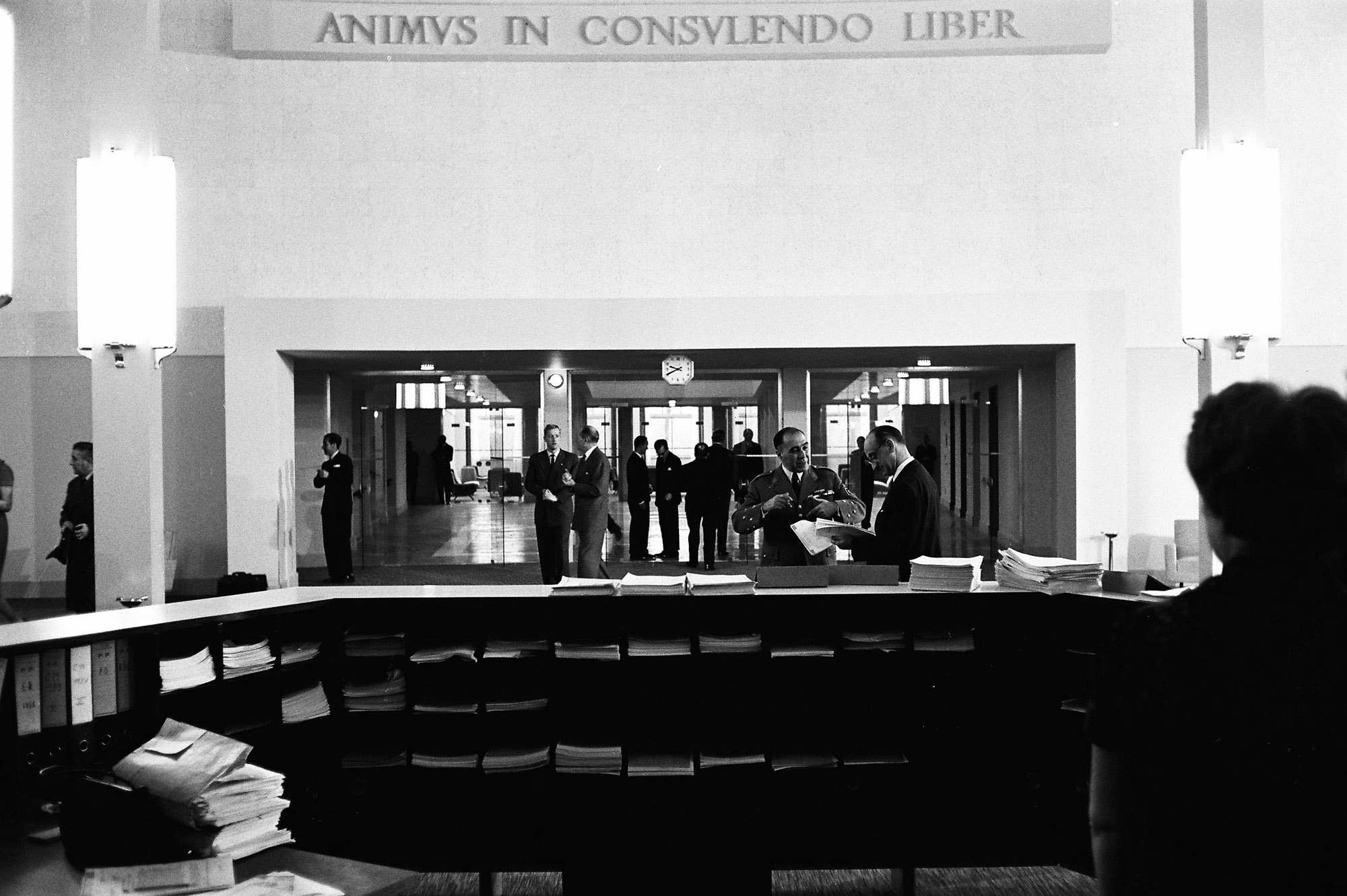
The NATO motto on display at the Alliance's Porte Dauphine Headquarters in Paris, 1959-1967
After NATO moved from Paris to Brussels in 1967, Secretary General Jospeh Luns decided to place the motto inside the Council’s main conference chamber (C-R(76)4.pdf). It was purposely placed in open sight, so that any NATO official or visiting Head of State and Government could read it upon entering the room, reminding them that free discussion and consultation are at the heart of the Alliance.
On 24 October 1974, Canadian Prime Minister Pierre Elliott Trudeau expressed his feelings about the inscription during his official visit to NATO Headquarters:
It was patently clear from this motto why NATO had remained an active and living entity: the process of consultations had forged a mode of action and thought which had an impact, not only in Brussels, but also in other negotiations.
Prime Minister of Canada 24 October 1974

Her Majesty Queen Elizabeth II and NATO Secretary General Joseph Luns in front of the motto at the old NATO Headquarters in Brussels
The motto remained on the wall of Conference Room 16 until 1987, when it was removed due to renovation work. The work was delayed and the motto's absence was felt until Juan Cassiers, the Belgian Permanent Representative to the NAC, reminded his colleagues of its existence and what the motto represented. Secretary General Lord Carrington promised to look into the matter and the motto was soon back on display.
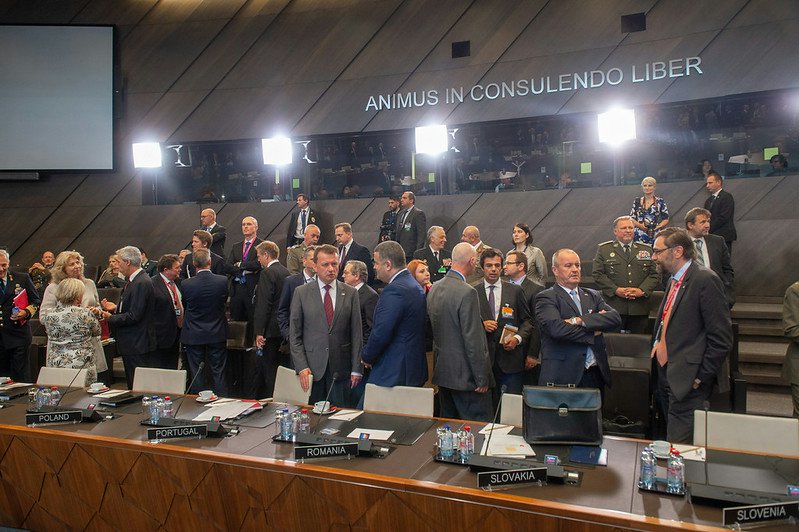
Following the move to the current NATO Headquarters in Brussels in 2017, the NATO motto was once again installed on the wall of the North Atlantic Council chamber.
After NATO moved to Brussels, its former headquarters in Paris were occupied by Paris IX Dauphine University (now Paris Dauphine University - PSL). Although the building's use had changed, the university maintained the motto in its original location, serving as a reminder to students about the importance of consultation in an academic environment. Indeed, Cato’s words resonated so strongly that the University also adopted them for its own motto.
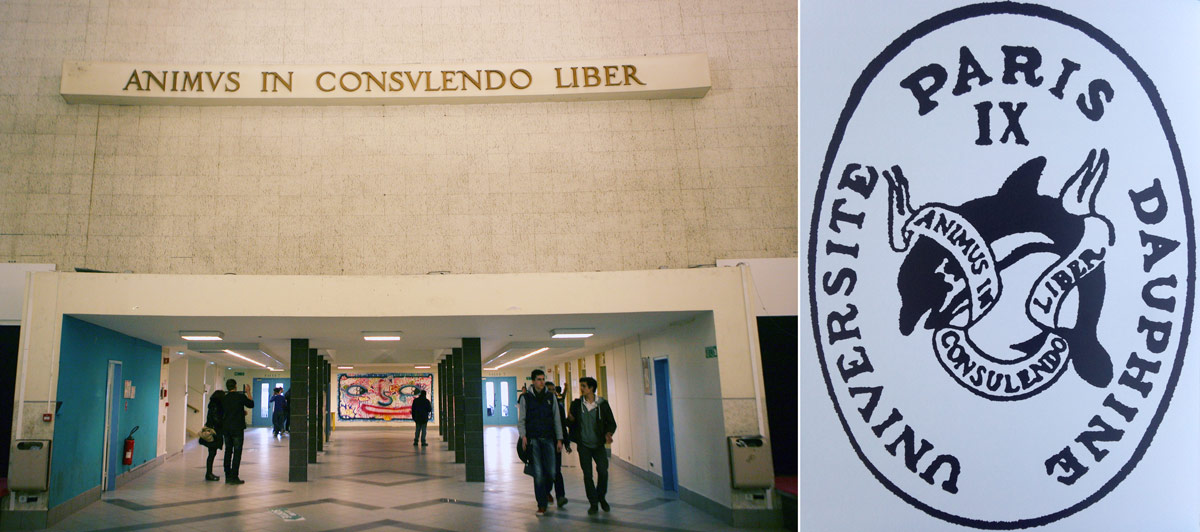
The motto at Paris IX Dauphine University. Special thanks to M. Bertrand Desprez for providing the photograph on the left.


