Close
Back

From now on you can download videos from our website
If you would also like to subscribe to the newsletter and receive our latest updates, click on the button below.
Enter the email address you registered with and we will send you a code to reset your password.
The password must be at least 12 characters long, no spaces, include upper/lowercase letters, numbers and symbols.
Click the button to return to the page you were on and log in with your new password.
Despite lying deep in the heart of Europe, Czechia is known worldwide for its vibrant capital city Prague, artists like Alfons Mucha and Franz Kafka, and athletes like Martina Navrátilová. During the Cold War, it was part of the Eastern Bloc of Soviet-aligned countries while also sharing a border with NATO. It suffered Soviet domination for more than four decades, including invasion and occupation by Soviet-led troops after 1968. It became a member of NATO only 10 years after the fall of the Berlin Wall as one of the first three countries from Central and Eastern Europe to join the very alliance that the Warsaw Pact had opposed.
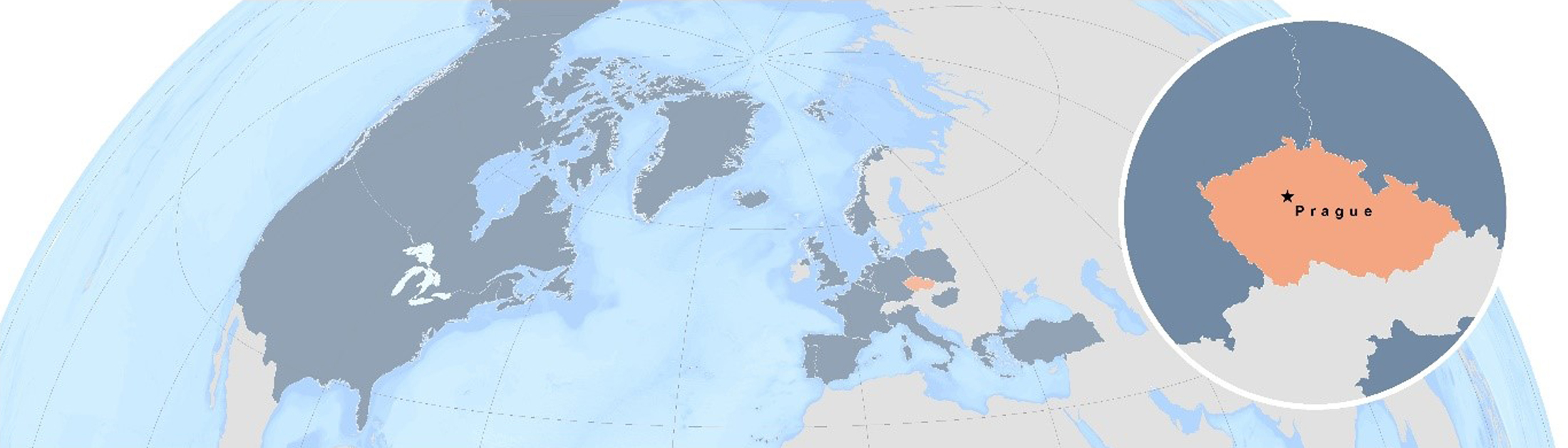
Czechia and its NATO Allies in 1999, the year it joined the Alliance.
"We have finally embarked on the path leading us to the Europe which is undivided and free. It is only symbolic that we are setting the most important milestone on this way almost exactly 10 years after the fall of the Berlin Wall. This year will be remembered as a turning point in our history."
Czech Prime Minister Speaking during the ceremony marking Czechia’s accession to NATO, 16 March 1999
In January 1968, reformist Alexander Dubček was elected as First Secretary of the Communist Party of Czechoslovakia. Under the slogan “Socialism with a human face”, he presided over the liberalisation of the country’s politics and civil society – a period that became known as the Prague Spring.
The Prague Spring and its aftermath inspired writers, poets and musicians. Milan Kundera wrote The Unbearable Lightness of Being and Karel Kryl recorded his album Brother, close the door.
Progress was halted on 20 August 1968 when, in the middle of the night, Soviet-led Warsaw Pact troops invaded Czechoslovakia. The Communist regimes in the other Warsaw Pact countries were worried that the liberalisation process could spread, endangering their position and power. After waking to the sight of Soviet tanks in their cities, citizens flooded the streets in protest against the occupation. Despite months of resistance, the momentum of the reformation was lost and the ensuing occupation resulted in harsh consequences for citizens.
In 1969, Alexander Dubček was replaced by Gustáv Husák who reversed many of the reforms and started the “normalisation” period, which saw Czechoslovakia become a rigid totalitarian regimes for nearly two decades.


A few days after the fall of the Berlin Wall in Germany on 9 November 1989 and following the demise of the communist regimes in Hungary and Poland, Czechoslovakia went through its own transition: the Velvet Revolution. Named for its non-violent, relatively smooth character, the revolution started as a peaceful student demonstration. When these demonstrations were suppressed by riot police, it triggered a chain of events that resulted in the fall of communism and the country’s eventual democratisation.
On 20 November 1989, over 500,000 protesters gathered in Prague, chanting, “Kdo, když ne my? Kdy, když ne teď?” (“Who else, if not us? When, if not now?”) and rattling keys to ring in a new era that would see the end of communism. By mid-December, the communist government gave up its rule.
The early 1990s were marked by fundamental global changes that allowed Czechoslovakia to freely decide its own future for the first time in decades. In 1991, the Warsaw Pact was disbanded and the Soviet Union dissolved, giving the young democracies of Central Europe even more freedom to determine their own geopolitical, military and economic futures.
Czechoslovakia declared its interest in joining the Euro-Atlantic community of nations and its structures, including both NATO and the European Union. However, the country’s new democratic leaders had to take into account the difficulties connected to market and democratic liberalisation, and the worries among the West about potential instability arising from the abrupt political changes.
To address these challenges, in 1991, Czechoslovakia founded the Visegrád Group together with Hungary and Poland. The initiative aimed to expunge the remnants of communism in the region, implement the required reforms and achieve faster integration in the Euro-Atlantic community. Joint and individual efforts spearheaded by each country significantly contributed to a quicker fulfilment of requirements and the achievement of NATO membership.
In December 1992, Czechoslovakia split into Czechia and Slovakia, in a peaceful process that is sometimes called the Velvet Divorce due to its conciliatory nature and the persistence of exceptionally close relations between the two countries. This opened a new chapter for Czechia as an independent country.
President Václav Havel played a key role in the accession of his country to NATO. A former dissident and a political prisoner of the Communist regime, he became a key player in the Velvet Revolution and Czechoslovakia’s movement for democratic reform as the first democratically elected president after the country regained its freedom from communism. Subsequently, he was one of the first heads of state from the other side of the Iron Curtain to pass the threshold of NATO Headquarters in Brussels. He shook hands with NATO Secretary General Manfred Wörner as early as March 1991 and established close relations with the Alliance as quickly as possible. Havel became a firm believer that the Alliance should be opened up to neighbouring countries that were pursuing the same goals of freedom and democracy. While he feared that Central and Eastern Europe could be prone to instability during this time of radical change, he also understood that NATO was at a crossroads and had the opportunity to redefine itself.
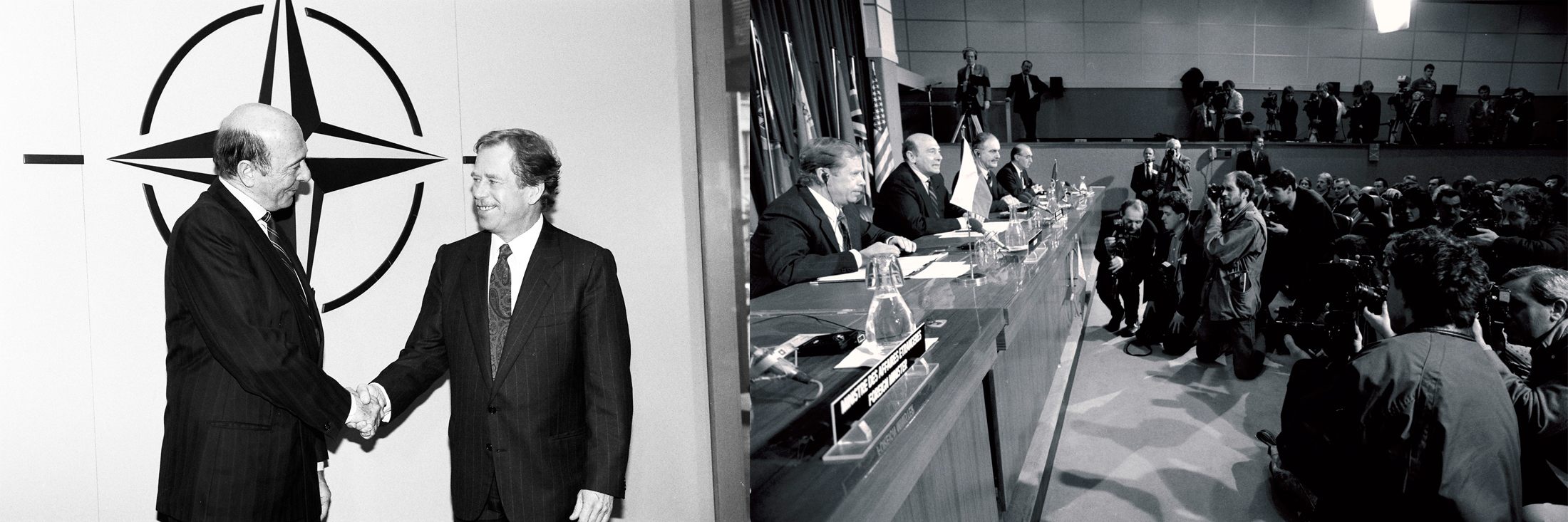 1. President Václav Havel (right) is greeted by Secretary General Manfred Wörner (left) at NATO Headquarters, 21 March 1991. 2. Press conference held during President Václav Havel’s visit to NATO Headquarters, 21 March 1991.
"…The windows having opened in the closed societies of Eastern Europe, the Allies do not intend to let them slam shut again."
Speaking during the North Atlantic Assembly in Rome, 9 October 1989
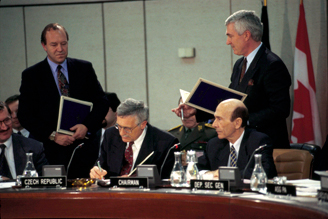 Václav Klaus, Prime Minister of Czechia, signs the Partnership for Peace Framework Document at NATO Headquarters on 10 March 1994.As Europe emerged from the divisions of the Cold War, NATO decided it would establish diplomatic relations with former Eastern Bloc countries that desired a closer relationship with the Alliance. Described as extending the "hand of friendship", this initiative soon took the form of the North Atlantic Cooperation Council (1991), where almost 40 countries – including NATO members and new partner countries like Czechoslovakia – could meet around the same table and consult each other on common security issues. Later, in 1994, the Alliance created the Partnership for Peace programme for individual partners that wanted to set up more practical and targeted cooperation with NATO. Czechia participated in both of these initiatives and many other activities that NATO was offering.
In the mid-1990s, it was becoming clear that the newly formed partnerships were only the beginning. As US President Bill Clinton said in 1994, the enlargement of NATO was "no longer a question of whether, but when and how". At the 1997 NATO Summit in Madrid, the then 16 NATO member countries started accession talks with Czechia, Hungary and Poland – an important step towards their NATO memberships.
Václav Havel – a politician and an artist
They say that all art is political. And in Václav Havel's case, this was especially true: the first president of the Czech Republic was also a prolific playwright and a published author.
Dozens of his plays focus on topics of power, bureaucracy and totalitarian regimes, which he experienced himself as a political dissident in communist Czechoslovakia. Using absurdist fiction, many of Havel's plays contain autobiographic elements, such as labouring at a brewery or recollections of his experience in politics. Since the first-ever performance of The Garden Party in West Berlin in 1964, Havel's plays have been performed numerous times all over the world, including in the United States, Canada and Australia, and have garnered international critical acclaim.
Besides being a writer, Havel was also a music buff. One evening in 1994, he stopped at the renowned Reduta Jazz Club in Prague with US President Bill Clinton. Knowing that Clinton was a saxophonist and an ardent jazz fan, Havel presented him with a Czech-made saxophone. President Clinton did not hesitate to play several songs with the band.
Even before NATO's Partnership for Peace initiative was launched in 1994, Czechia actively engaged with the Allies through military cooperation to improve interoperability and the professionalism of its forces. Czechia took part in Exercise Cooperative Bridge, which was hosted in Poland in the very first year that it joined the Partnership for Peace Programme. It was the first exercise of its kind where NATO Allies trained alongside former adversaries from the Eastern Bloc on the territory of a former Warsaw Pact country. A year later, Czechia organised Exercise Cooperative Challenge on its own soil, which included troops from 14 different countries.
"This story underlines one of the most heartening developments since the end of the Cold War: the return of the nations of Central Europe as our equal partners and friends."
5 February 1998
Sports diplomacy and the Nagano miracle
Across the country, everyone held their breath during the last minutes of the Olympic ice hockey final. And then, Czechs everywhere burst with joy. It was February 1998 and the Czech men's ice hockey team – whose team members had met only hours before their first match at the Winter Olympic Games in Nagano, Japan – won the gold medal. Considered underdogs from the start, the Czech team managed to beat former world champions and ensured that, as Václav Havel put it, “billions of people worldwide know what the Czech Republic is”.
The Nagano miracle was the most memorable, though not the first participation of Czech representatives in an international sports event. In 1994, Czechia competed in the Winter Olympics in Lillehammer, Norway, in its first international showcase since the dissolution of Czechoslovakia at the end of 1992. It has been actively participating in international sports events ever since.
Inside the Truman Library in Independence, Missouri in the United States, the accession ceremony on 12 March 1999 was a very personal moment for many. The ceremony was organised by the then US Secretary of State, Czechoslovak-born Madeleine Albright, whose family immigrated to the United States after the communist takeover in 1948. During the ceremony, Albright did not hide her joy and summarised the occasion in the simplest way: “Hallelujah!”
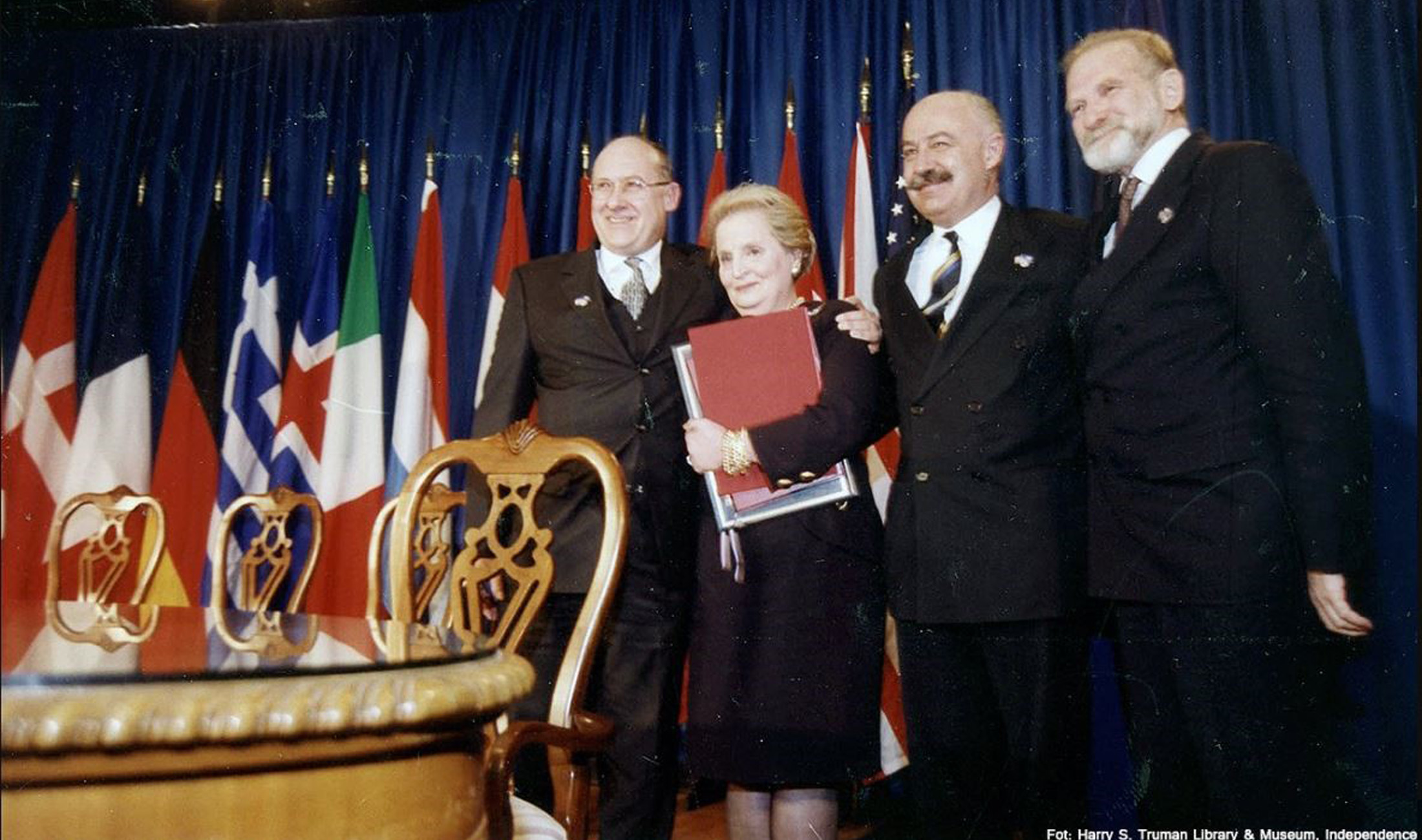
The accession ceremony of the Czech Republic, Hungary and Poland in the Truman Library. From left to right: Jan Kavan (Minister of Foreign Affairs, Czech Republic); Madeline Albright (US Secretary of State); Janos Martonyi (Minister of Foreign Affairs, Hungary); and Bronislaw Geremek, (Minister of Foreign Affairs, Poland). Photo courtesy Harry S. Truman Library & Museum, Independence, Missouri, United States.
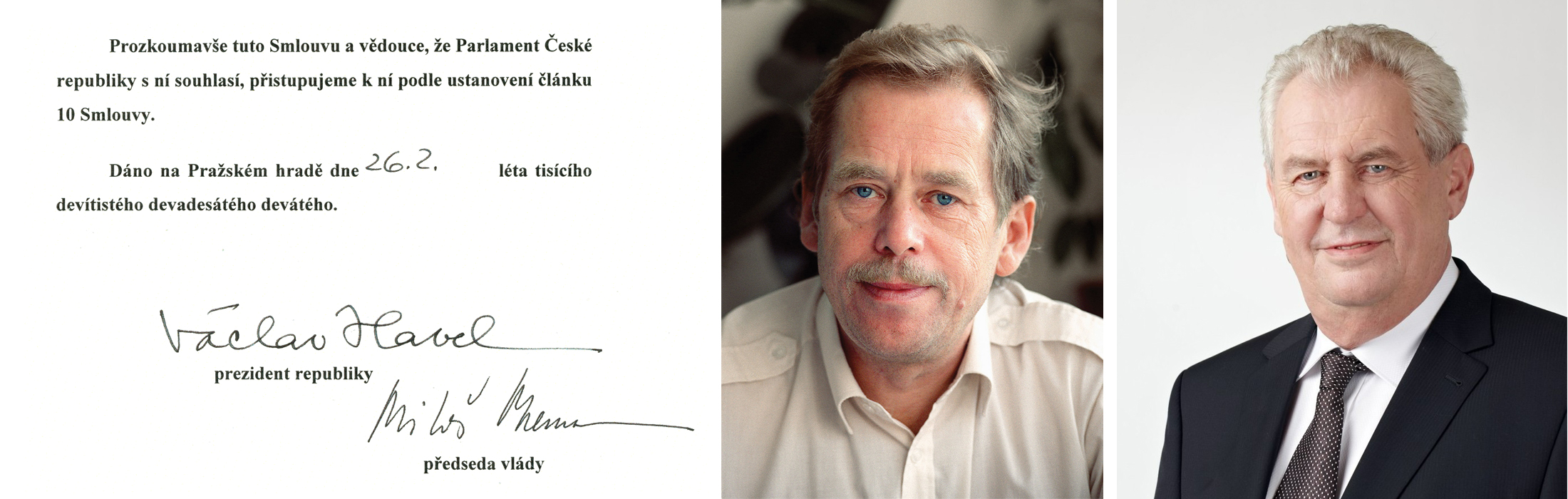
The Instrument of Accession was signed in Prague on 26 February 1999 by President Václav Havel (left) and Prime Minister Miloš Zeman (right).
Behind the documents and formalities of the accession, there were strong emotions. A flag-raising ceremony took place at NATO Headquarters in Brussels, Belgium on 16 March, just a few days after the accession ceremony in the United States. The Prime Ministers of Czechia, Hungary and Poland stood together next to NATO Secretary General Javier Solana. With the accession, NATO officially erased the old lines dividing Europe and entered a new phase of uniting East and West.
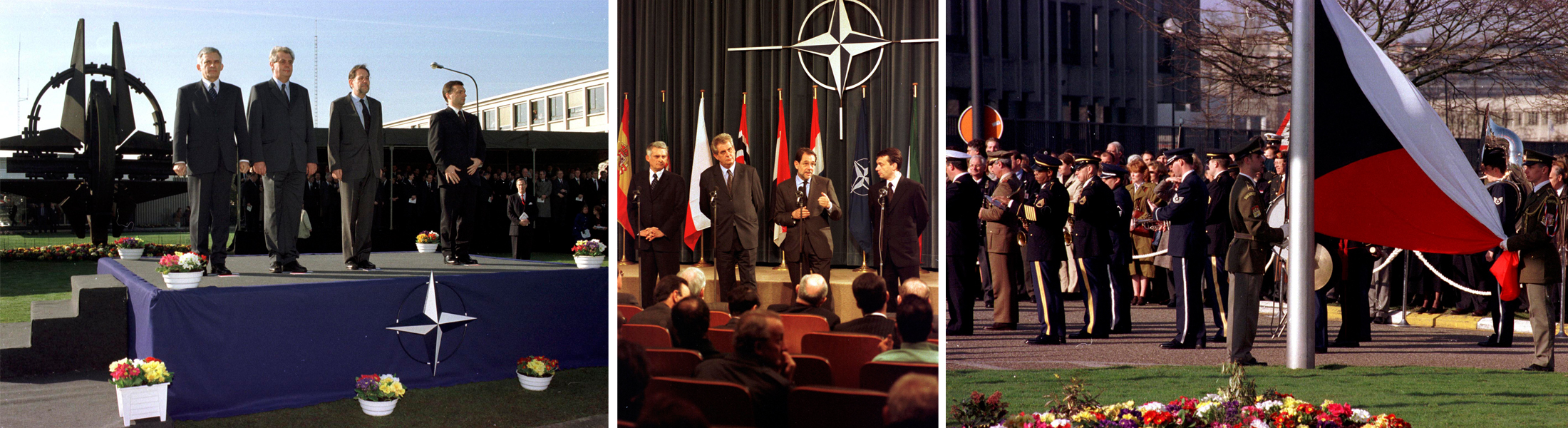
From left to right: Jerzy Buzek (Prime Minister of Poland), Miloš Zeman (Prime Minister of the Czech Republic), NATO Secretary General Dr Javier Solana, Viktor Orbán (Prime Minister of Hungary).
Only three years later, in 2002, Prague offered to host a NATO summit. It was the first summit to take place in a country from the former Eastern Bloc. In November, Heads of State and Government from the Alliance’s now 19 member countries convened in Prague Castle to witness yet another transformative moment for post-Cold War Europe: the start of accession talks for seven additional Central and Eastern European countries, namely Bulgaria, Estonia, Latvia, Lithuania, Romania, Slovakia and Slovenia. All seven countries would later join NATO in 2004.
"Prague is the transformation Summit. It is a truly defining moment for the North Atlantic Alliance. We will welcome new members, take on new missions, modernise our military capabilities, and strengthen relations with friends and partners throughout the Euro-Atlantic area. By doing so we will re-enforce that essential transatlantic bond on which our security and defence still depends."
21 November 2002
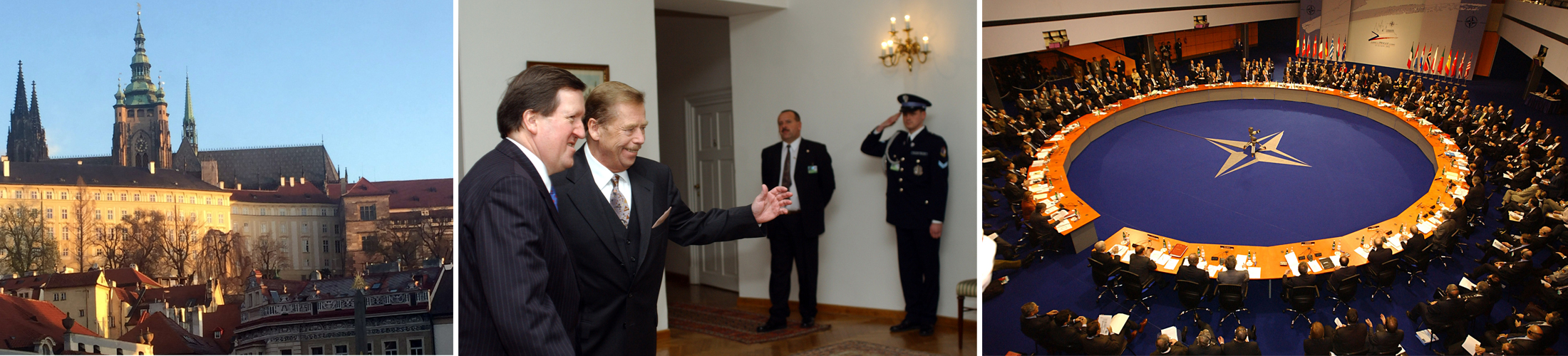
Czech President Václav Havel greets NATO Secretary General Lord Robertson at Prague Castle at the 2002 NATO Summit in Prague.
To discover how Czechia contributes to the Alliance today, visit NATO on the Map.


