Close
Back

From now on you can download videos from our website
If you would also like to subscribe to the newsletter and receive our latest updates, click on the button below.
Enter the email address you registered with and we will send you a code to reset your password.
The password must be at least 12 characters long, no spaces, include upper/lowercase letters, numbers and symbols.
Click the button to return to the page you were on and log in with your new password.
Canada, a founding member of NATO, was one of the first countries to propose the idea of a transatlantic defensive alliance after the Second World War. Working closely with their American and European colleages, Canadian negotiators helped write the 14 articles of the North Atlantic Treaty. From the beginning, Canada emphasised that NATO needed to be more than just a military pact – it needed to promote political, economic, and cultural bonds between its members.
Since signing the North Atlantic Treaty, Canada has participated fully in NATO activities, including stationing troops in Europe for the duration of the Cold War. Ultimately, Canada has worked to expand the definition of security at NATO, pushing for greater emphasis on civilian aspects of security while also contributing to the Alliance's military capabilities.
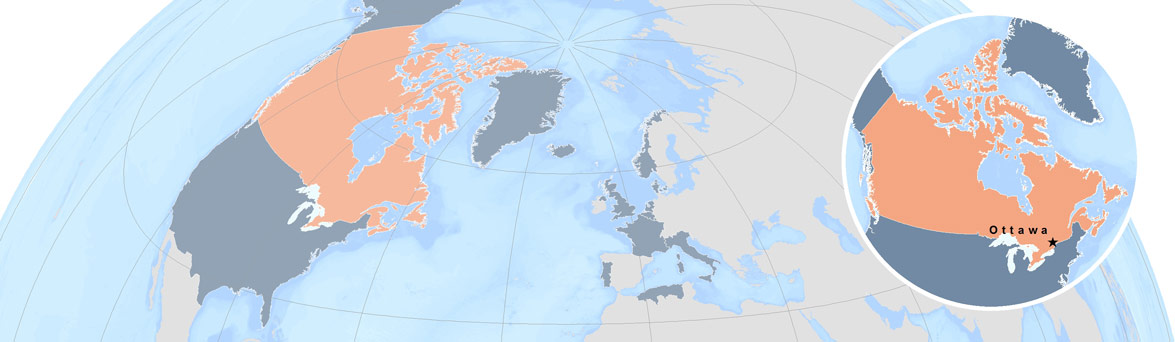
Canada and its NATO Allies in 1949, the year it helped found NATO.
"This treaty is not a pact for war, but a pledge for peace and progress."
Minister of Foreign Affairs speaking at the signing of the North Atlantic Treaty Washington, D.C. 4 April 1949
Any discussion of Canada's involvement in NATO must begin with Lester B. Pearson. Secretary of State for External Affairs (Foreign Minister) at the time, Pearson played a key role in drafting the North Atlantic Treaty and helping NATO find its feet as an international organisation. He believed that NATO could – and should – be more than just a military alliance.
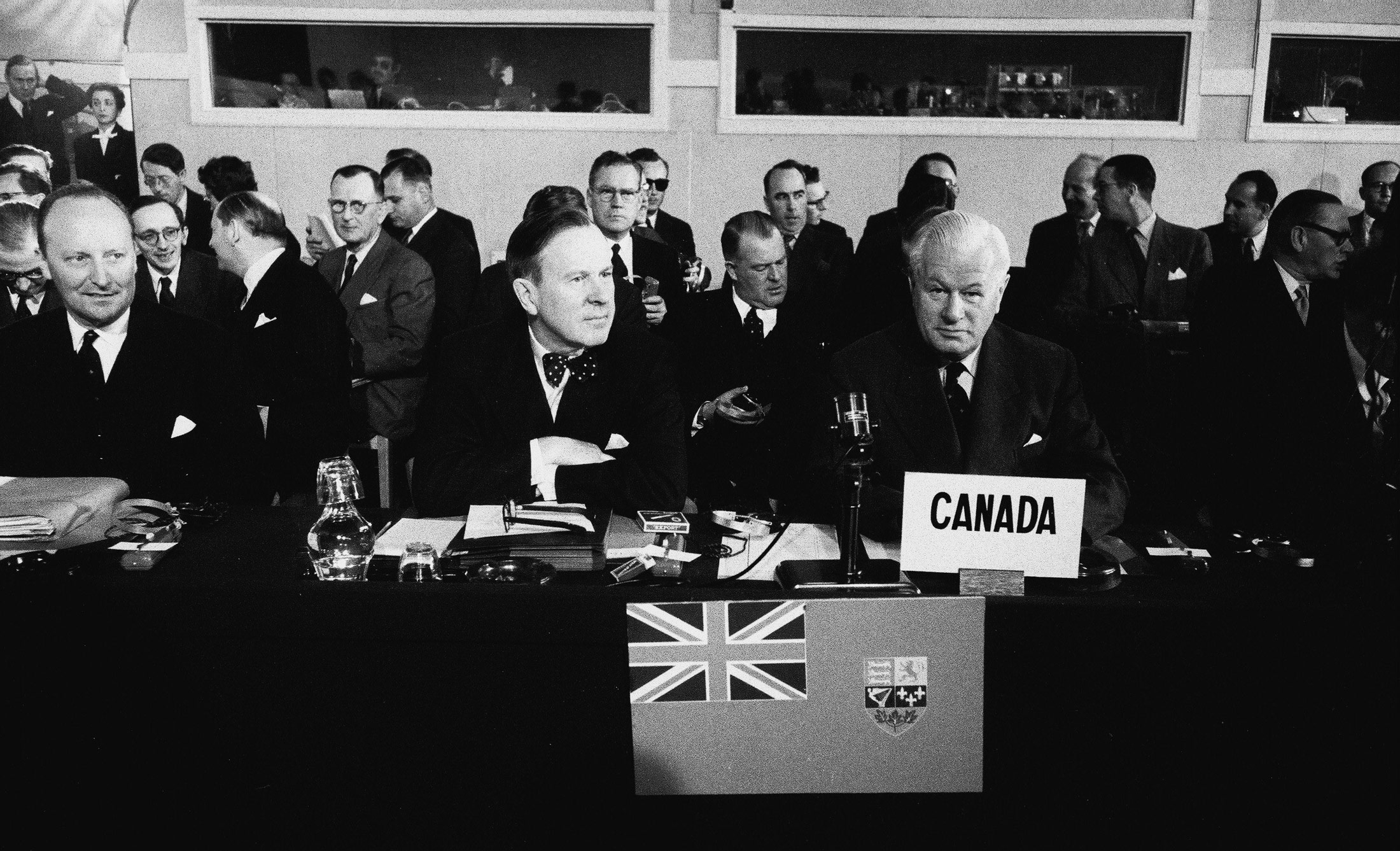
Pearson (centre left) at Germany’s accession to NATO, 1955.
When it came time to negotiate the North Atlantic Treaty, Pearson and the Canadian delegation pushed for the inclusion of a clause that encouraged members to forge stronger political and economic ties, in addition to coordinating their militaries. This clause – not immediately popular with the Allies, but vociferously defended by Canada – came to be known as "the Canadian Article."
Article 2 of the North Atlantic Treaty
“The Parties will contribute toward the further development of peaceful and friendly international relations by strengthening their free institutions, by bringing about a better understanding of the principles upon which these institutions are founded, and by promoting conditions of stability and well-being. They will seek to eliminate conflict in their international economic policies and will encourage economic collaboration between any or all of them.”
Implementing Article 2 proved to be an even bigger challenge than getting it into the Treaty had been. By the mid-1950s, NATO remained almost exclusively a military organisation. Recognising this as a shortcoming, the North Atlantic Council (NATO’s principal political decision-making body) asked the Foreign Ministers of Canada, Italy and Norway to “advise the Council on ways and means to improve and extend NATO cooperation in non-military fields and to develop greater unity within the Atlantic Community.”
Pearson and his two colleagues – known today as the Three Wise Men – recommended increased political consultation and dialogue among members in a report entitled The Report of the Committee of Three on Non-Military Cooperation in NATO. Many of the report’s more ambitious recommendations forenhanced economic partnerships and cultural connections were not fully implemented, but two major initiatives were adopted: a more robust information programme to explain NATO and its mission to Allied audiences, and the creation of a NATO Science Programme, which has encouraged scientific and technological innovation across the Alliance and provided support to many Nobel laureates. Ultimately, Pearson and his colleagues laid the foundation for the development of NATO in the non-military field and, more broadly, in the development of political consultation between members.
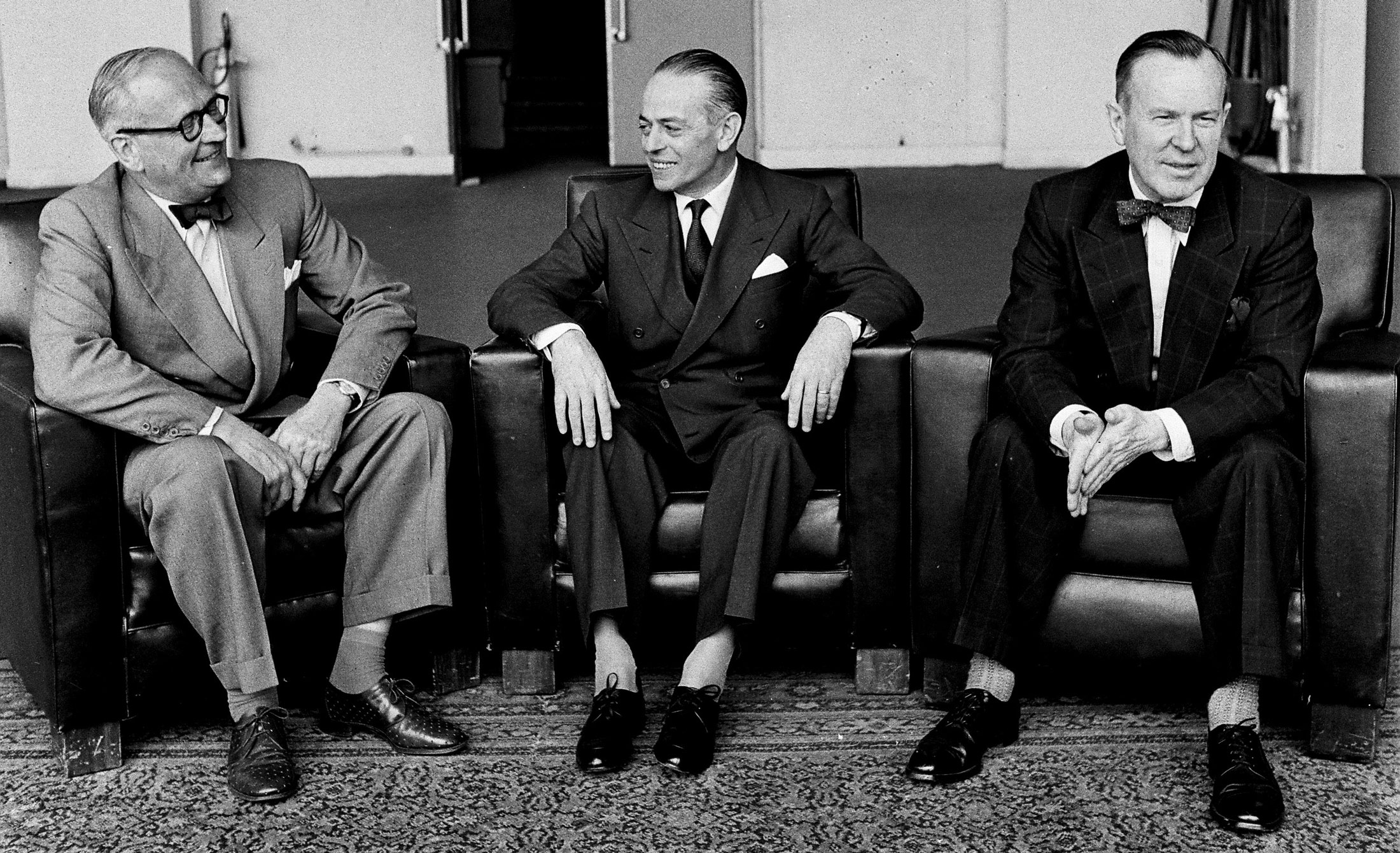
The Three Wise Men. From left to right: Halvard Lange of Norway, Gaetano Martino of Italy, and Lester B. Pearson of Canada.
For all his accomplishments, Pearson was a humble man. He would have been the first to acknowledge that he did not bring Canada into NATO single-handedly. He worked closely with associates like his chief aide, Escott Reid (who was the first Canadian to propose the idea of a North Atlantic collective security alliance) and Canada's ambassador to the United States, Humphrey Hume Wrong (who played the most active role in negotiating the text of the Treaty in 1948).
Louis St. Laurent (one of Pearson’s predecessors as Prime Minister, pictured below alongside Canada's Instrument of Ratification of the Treaty) also contributed to NATO’s foundation. He delivered a landmark speech to the United Nations General Assembly in September 1947 where he told delegates that the UN had become "frozen in futility and divided by dissension" and that a new collective security body was needed.
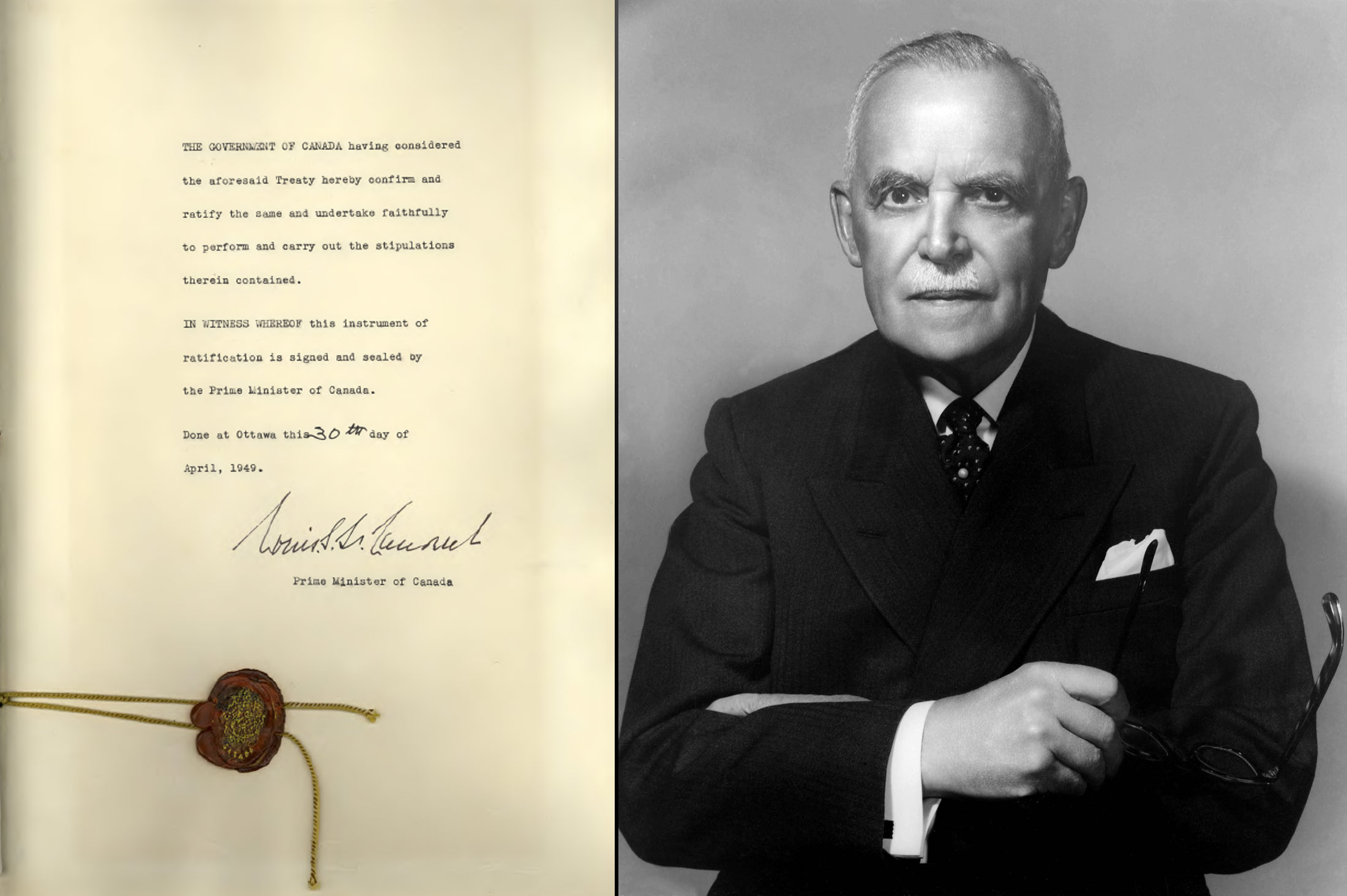
Canada’s Instrument of Ratification of the North Atlantic Treaty was signed in Ottawa by Prime Minister Louis St. Laurent on 30 April 1949, formally confirming Canada’s entry into NATO.
Together with his colleague George Ignatieff (who would later become Canada’s ambassador to NATO), Pearson was the first NATO Foreign Minister to visit the Soviet Union. In 1955, Pearson and Ignatieff participated in a drinking contest with Soviet leader Nikita Khrushchev where the Canadians reportedly downed 18 shots of vodka (nearly two pints each). Pearson's own Foreign Affairs Minister, Paul Martin Sr., also played an important role in Canada's NATO relationships, including by negotiating the deployment of US-controlled nuclear weapons on Canadian territory in 1963.
For a diplomat who rubbed shoulders with the global elite, Pearson cut an unusually modest figure, always showing up with a smile and sporting one of his signature bow ties. Known to some as “the unhappy warrior” because of his distaste for the cut-and-thrust of domestic politics, Pearson was 50 years old when he got into politics and was never comfortable with the “hoopla and circus” that came with being Prime Minister. Nominated for UN Secretary-General in 1946, 1950 and 1953 (and blocked by a Soviet veto all three times), Pearson later confessed that this was “the job I really wanted”. Nevertheless, first as Foreign Minister and then as Prime Minister, Pearson helped establish Canada’s position as a key NATO Ally.
Listen to an interview with Michael Pearson, Lester Pearson’s grandson.
This video, part of the "Atlantic Community" series produced by NATO in the 1950s, helped introduce Canada to other NATO members.
Pierre Trudeau was a NATO sceptic when he first took office as Prime Minister after Pearson in 1968. During a press conference following his first election win, he argued that Europe had recovered from the war and that it no longer needed “Canadian military ‘might’ to defend itself”. The following year, Trudeau cut Canada’s military presence in Europe from approximately 9,800 troops to 5,000. Speaking to his Cabinet, Trudeau argued that Canada’s interests lay in North America, not Europe.
"We should be protecting our internal security, defending our three seas, and then considering other possible international commitments. It was not logical or rational to protect that which was not ours."
Prime Minister of Canada during a Cabinet discussion on Canadian defence policy March 1969
Trudeau was not alone in his doubts about NATO’s future. There was a broad feeling among Canadians that Canada was being completely overlooked amid rising tensions between the United States and the European Allies. Both the United States and the United Kingdom had announced plans to redeploy and possibly reduce their military presence on the continent. France had just withdrawn from NATO’s integrated military structure, insisting that NATO bases and forces must be removed from its territory. All in all, NATO’s value and continued existence were very much in doubt at the end of the 1960s, and Canada was just as sceptical as some other Allies.
Throughout the first half of the 1970s, Canada’s armed forces reached their lowest capacity during the Cold War, with only 78,000 personnel and aging equipment that was nearing obsolescence. In 1974, however, Trudeau changed his mind about NATO, choosing to maintain Canada’s contingent of heavy armoured tanks along the Iron Curtain rather than replacing them with light armoured vehicles as he had previously promised. This change of heart was inspired by Helmut Schmidt – first as Minister of Defence and later as Chancellor of West Germany – who had a “soft spot in his heart for Canada”.
Over the course of several years, Schmidt and Trudeau developed a personal friendship. In every meeting, Schmidt reinforced the symbolic importance of having Canadian troops along Germany’s East-West border. As Defence Minister, he also sent German troops to conduct joint military exercises in Manitoba and instructed the German armed forces to procure more equipment from Canadian manufacturers. Through this relationship, Trudeau came to recognise the political and strategic importance of maintaining Canada’s military presence in NATO. He continued Canada’s involvement in the Alliance for the remainder of his time as Prime Minister, and sought to build greater economic and cultural ties with Canada’s European Allies.
After becoming Prime Minister in 1984, Brian Mulroney initiated a review of Canada’s military capabilities and NATO commitments. This review found that, although the later Trudeau years saw a sustained support for Canada's armed forces in NATO, much of Canada’s military equipment was becoming obsolete and at risk of “rust out”. As a result, the Mulroney government’s 1987 Defence White Paper promised to increase defence spending, purchase nuclear-powered submarines, modernise Canada’s air defences, and consolidate all of Canada’s European-based forces into a single command in West Germany.
 The end of the Cold War in 1989-1991 (including the dissolution of the Soviet Union) changed the security dynamics of Europe and altered Canada’s defence priorities. An economic recession and ballooning government deficits in the same period led the Mulroney government to rethink its planned military expansion. Although Canada continued plans to develop its maritime capabilities, Mulroney chose to cancel an increase in forces envisaged for West Germany and decided to withdraw the last Canadian land forces from Europe. On 10 July 1993, the last permanently stationed Canadian Armed Forces personnel left Europe.
Who was NATO’s first-ever female Defence Minister?
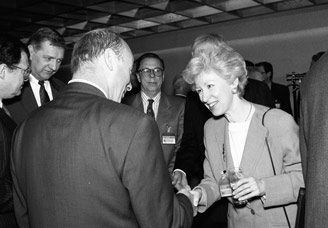
Canadian Defence Minister Kim Campbell was the first female defence minister in the Alliance.
She is pictured here attending the NATO Defence Ministers’ meeting in 1993.
Shortly after this appointment, she became Canada’s first female Prime Minister.
As a founding member of NATO, Canada has hosted meetings, conferences and joint military exercises from the early 1950s onwards. Most of these events took place in Ottawa, but various meetings of the North Atlantic Council and NATO working groups made significant policy decisions and announcements in cities across Canada from coast to coast.
In 1951, Canada hosted a North Atlantic Council meeting in Ottawa. At this meeting, Allies agreed on NATO’s first expansion, extending membership to the Kingdom of Greece and the Republic of Türkiye. They also agreed to establish “a Ministerial Committee composed of representatives from Belgium, Canada, Italy, the Netherlands and Norway, to consider the best means of strengthening the Atlantic Community and of implementing Article 2 of the Treaty”, which ultimately led to the Report of the Three Wise Men (see above). Finally, the Allies signed the Civilian Staff Agreement, which lays out the foundational terms for NATO’s permanent International Staff personnel.
In 1963, Prime Minister Pearson hosted the second NATO ministerial meeting in Ottawa. The delegates discussed the ongoing lessons learned from the Cuban Missile Crisis the previous autumn, and approved the organisation of nuclear forces (both American Polaris submarines and British V-bombers) assigned to NATO’s Supreme Allied Commander Europe.
In 1974, Ottawa hosted the North Atlantic Council again. Prime Minister Pierre Trudeau delivered a speech on the continued importance of NATO in its 25th anniversary year. Allies issued the Ottawa Declaration on Atlantic Relations, reaffirming their ongoing support for NATO and its vital role in collective security.
"We are gathered today in a building which symbolises to all Canadians our democratic processes... There are buildings similar to this in each of our countries. Each of them serves to recall the proud heritage of democratic thought to which we all lay claim. Those buildings are more important to NATO in the long run than any array of weapons."
Prime Minister of Canada speaking in the Senate of Canada Ottawa 18 June 1974
In 1983, NATO’s Nuclear Planning Group met in Montebello, Quebec (midway between Ottawa and Montreal) and released the Montebello Decision, which declared that “the policy of the Alliance is to preserve the peace through the maintenance of forces at the lowest level capable of deterring the Warsaw Pact threat”. As such, the Montebello Decision on the Reduction of Nuclear Forces announced NATO’s commitment to removing 1,400 nuclear warheads from Europe.
NATO has also organised and participated in meetings in Halifax, Kananaskis, Toronto and Vancouver. Several of NATO’s Secretaries General have delivered speeches at events across Canada, including in Montreal and Quebec City. In short, many regions of Canada have played host to NATO events and meetings, some of which have resulted in significant policy statements by NATO leaders.
In addition to hosting Council and Ministerial meetings, joint military exercises were also organised in Canada with NATO Allies. Pilots from NATO Allies including France, Germany, the United Kingdom and the United States learned how to fly at the Canadian Forces Flying Training School in Moose Jaw, Saskatchewan. In the 1980s, Canada hosted the Rendezvous NATO exercises in Wainwright, Alberta. By virtue of its vast territory and varied terrain, Canada provides the perfect venue for joint military exercises and training.
Canada also hosted the NATO Open Skies conference in Ottawa in February 1990. On the margins of this meeting between NATO and Warsaw Pact countries, representatives of East and West Germany and the four wartime occupying powers (the United States, the United Kingdom, France and the Soviet Union) agreed on the Two Plus Four framework that eventually reunified Germany in October 1990.
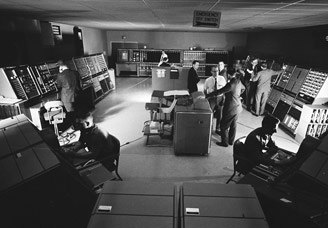
Monitoring the Arctic skies
The North American Aerospace Defense Command (NORAD) is a binational command run by Canada and the United States, which monitors North American airspace for incoming threats. It is not part of NATO, but is a joint contribution to Allied security. Throughout the Cold War, and continuing today, Canada’s North has hosted NORAD radar stations.
Just as Canada has welcomed troops from NATO Allies to North America, it has also sent thousands of Canadians to Europe and to operational theatres around the world. Since 1949, Canada has maintained a permanent representation at NATO Headquarters, following as the Alliance's headquarters moved from the United Kingdom to France, and from France to Belgium.
During the Cold War, Canada also stationed troops at military bases across Europe, primarily in France and West Germany. The main Canadian Army base was in Lahr, West Germany and surrounding German communities. The Royal Canadian Air Force (RCAF) had its European headquarters in the town of Metz, France, close to the German border. The RCAF maintained air stations on either side of the French-German border: in Grostenquin and Marville in France, and in Zweibrücken and Baden-Söllingen in West Germany.
What did daily life look like for Canadian troops and their families based in Europe during the Cold War? These photos tell the story:
These Europe-based Canadian forces were involved in activities as diverse as participating in NATO exercises, holding elections far from home and competing in tank competitions.
To discover how Canada contributes to the Alliance today, visit NATO on the Map.


