Close
Back

From now on you can download videos from our website
If you would also like to subscribe to the newsletter and receive our latest updates, click on the button below.
Enter the email address you registered with and we will send you a code to reset your password.
The password must be at least 12 characters long, no spaces, include upper/lowercase letters, numbers and symbols.
Click the button to return to the page you were on and log in with your new password.
Iceland’s strategic position as the guardian of vital waterways makes it a valuable and valued Ally, even though it has no military. In 1949, public opinion was openly divided on NATO membership and, later on, the country went into conflict with a fellow Ally… over cod. So how did Iceland contribute to NATO throughout the Cold War?
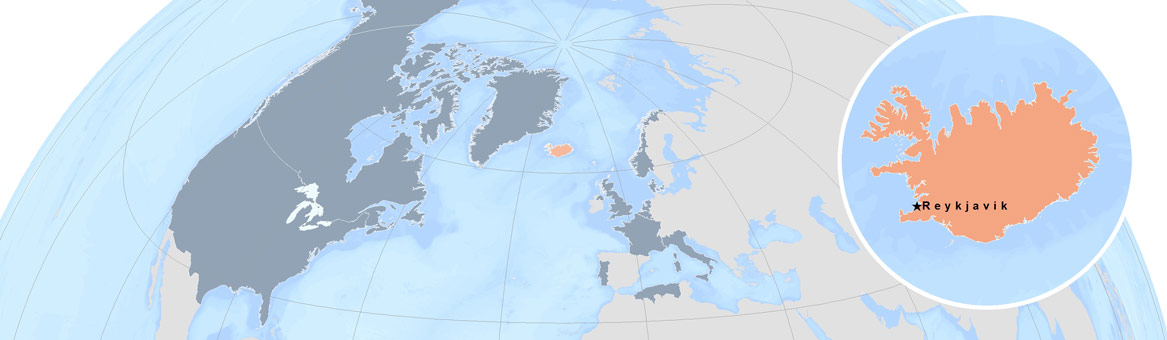
Iceland and its NATO Allies in 1949
"My people are unarmed and have been unarmed since the days of our viking forefathers. We neither have or can have an army... but our country is, under certain circumstances, of vital importance for the safety of the North Atlantic area."
Speaking at the signing of the North Atlantic Treaty Washington, D.C., 4 April 1949
Iceland, unique among NATO Allies, does not have a military. Icelanders have long been proud of their country’s pacifist tradition, which goes back further than its independence from Denmark in 1944. So the decision to join the Alliance as a founding member in 1949 was controversial. Throughout the Cold War, Iceland had several national debates about whether or not to withdraw from NATO. But despite this internal ambivalence, Iceland has continuously contributed as a valuable member of NATO, based on shared values and unity, democracy and freedom. During the Cold War, Iceland allowed NATO Allies to station troops on its strategically critical island and volunteered the Icelandic Coast Guard toassist the Organization, activities that were pursued after the fall of the Berlin Wall.
During the Cold War, it often seemed as if the people of Iceland were split right down the middle into two opposing camps: one in support of NATO and the other against. Indeed, Iceland was the only Ally to have a riot in its capital city on the day that its parliament voted to join NATO asa founding member. On 30 March 1949, opponents of Iceland’s NATO membership organised a rally and marched to the main square in front of the Althingi building (Iceland’s Parliament) only to be met by NATO supporters. The government had been warned about the protest and had called on the citizens of Reykjavík to defend the Althingi. Several hundred citizens had heeded the government’s call and now surrounded the building to protect the parliamentarians from any interference. As the Althingi voted by a large majority to join NATO, chaos erupted outside. Anti-NATO protestors pelted the Althingi building with eggs and rocks, shattering every window on the building’s front side. Some stones even landed in the parliament chamber during the debate. The riot lasted for several hours, continuing even after the vote had concluded. The pandemonium was eventually reined in by the Reykjavík police, who had to use tear gas to disperse the crowd.
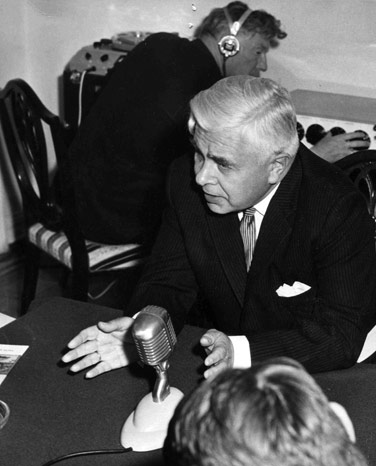 Without Bjarni Benediktsson, Iceland may have never joined NATO. Iceland’s Foreign Minister (1947-1953) during the country’s accession to the Alliance and later Prime Minister (1963-1970) was a strong and constant proponent of NATO membership. He was a realist when it came to Iceland’s security in the international system. During the Second World War, when Iceland was occupied by British and American military forces, most Icelanders assumed that after the war the country would return to its traditional neutrality. Benediktsson however, predicted that Iceland would no longer be able to avoid being involved in the competition between great powers, and voiced the opinion that Iceland’s defence agreement with the United States would have to become permanent. Iceland gained independence from Denmark on 17 June 1944. During the debate in the Parliament over NATO membership, he pointed to Soviet aggression against Czechoslovakia and West Germany and told NATO opponents that they were dreaming if they thought Iceland would have its neutrality respected during another world war.
Described by The New York Times as “a short stocky man with white hair and a bulldog‐like appearance”, Benediktsson was known for his intelligence and determination. Fellow Icelanders liked to say that he had “one of the best heads in the country, but he could butt with it, too”. Despite this reputation for intractability, Benediktsson was generally a silent and unobtrusive man, but he did have his moments of dry wit and wry humour. When anall-male Icelandic choir was touring through Morocco and Algeria, for example, he commented on the history of Arab pirates raiding the Icelandic coasts and kidnapping hundreds of Icelanders as slaves. After the choir’s performance , he is said to have remarked, “I think we have now thoroughly revenged ourselves”.
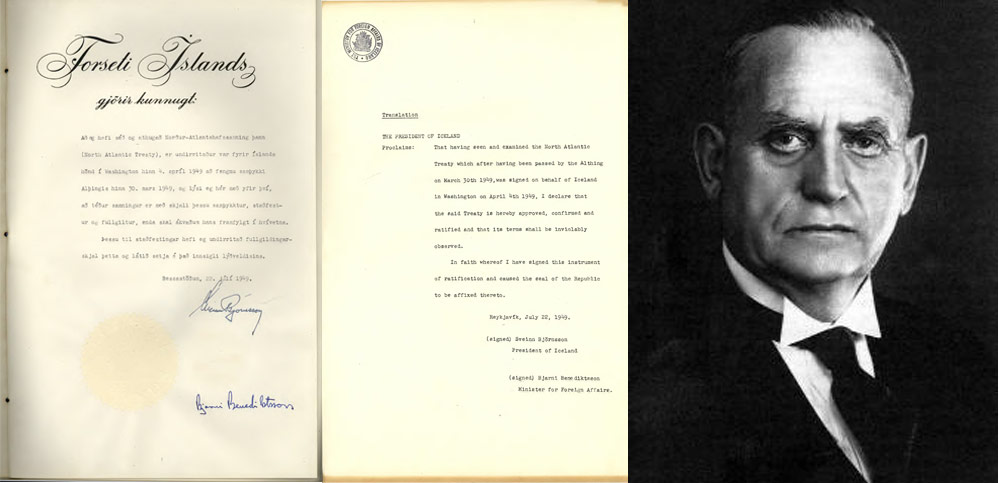
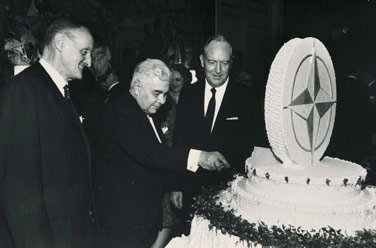 Given the structure of Iceland’s government, which always involves a coalition of parties, Benediktsson never had the same kind of singular power that many presidents and prime ministers in other NATO countries enjoyed. Fortunately, throughout his time as foreign minister and prime minister, Benediktsson had many allies both in his own Independence Party and in the parties of his coalition partners. Prime Minister Stefan Jóhann Stefansson (1947-1949) of the Social Democratic Party bluntly stated that Iceland had abandoned its neutrality in 1941 when it invited the United States to station troops on its land and there was no going back now. Finance Minister Eysteinn Jónsson of the Progressive Party argued that “because of Iceland’s geographical position, cultural relationship, and similarity of government, Iceland should cooperate with the democratic nations. There are people who will not admit this. Those are the people whose chief interest is that our lot will be the same as the lot of the Czechs and the Poles”. As NATO celebrated its 20th anniversary in 1969, Bjarni Benediktsson explained how important it was for Iceland to be a part of the community of free nations, institutionalised by the founding of NATO. He said that members of the Alliance might be different from each other in many ways but they were also firmly united around certain common interests and ideals. Allies faced the same threats and needed to confront them as one. This is how Bjarni Benediktsson made his case for NATO’s key role in Iceland’s national security. An argument that was valid half a century ago and still is.
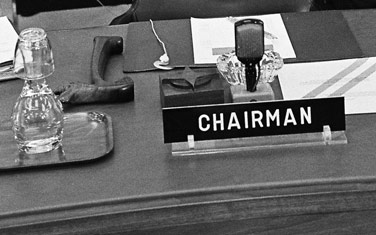
A hand-carved gavel for NATO
In 1963, Iceland donated a hand-carved gavel to NATO, to be used by the Secretary General during meetings of the North Atlantic Council. The gavel was carved from palisander wood by renowned Icelandic sculptor Ásmundur Sveinsson. The twin of this gavel was presented by Iceland to the United Nations General Assembly, the only difference being the NATO compass symbol carved into the NATO gavel’s handle. Unfortunately, Secretary General Joseph Luns reported in 1975 that the NATO gavel had been damaged, so Iceland presented NATO with a replica of the original gift.
The critics were generally divided into two groups: Icelandic nationalists, who feared that the presence of foreign troops would dilute Icelandic language, culture and ethnic purity, and Icelandic Socialists who wanted Iceland to develop a closer relationship with the Soviet Union rather than with the Western Allies. The biggest concern for Icelandic nationalists was that their newly independent country would be pulled along by bigger players on the world stage and overrun by foreign soldiers at home. As a result, the United States agreed to strictly limit the interactions of American troops with Icelanders, including by setting curfews for service members. The Socialists were responsible for instigating most of the demonstrations against NATO membership. They demanded a national referendum on membership, but this proposal was voted down in the Parliament. Whatever their motives, many Icelanders have protested the country’s ongoing membership in NATO over the years using a common phrase:
Ísland Úr NATO og herinn burt!"
Translated into English, this means “Iceland out of NATO and the Army out!”.
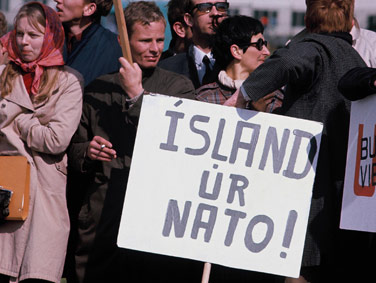 It became a rallying cry for NATO critics over the course of the Cold War, many of which organised intoa broader anti-war group called Samtök hernaðarandstæðinga (Campaign Against Militarism). This group has continued to stage protests during significant events and haseven inspired a dozen anti-NATO protest songs. Although opposition to NATO persisted in Iceland over the decades, there have also been strong demonstrations in support of the Alliance. Most notably, in 1974, the government announced that it would be closing the US military base and asking the American troops to leave. Pro-NATO Icelanders circulated apetition in support of keeping the base open, and it received over 55,000 signatures —more than one quarter of Iceland’s population at the time.
Quoted famously by Winston Churchill, German general and political scientist Karl Haushofer said that “whoever controlled Iceland held a revolver constantly pointed at Great Britain, Canada, and the United States”. The control of the seas surrounding Iceland has long protected both Europe and North America from a North Atlantic threat, and is one of the reasons why Iceland continues to be such a vital member of the Alliance.
Iceland is the only Ally that does not have its own military forces. As a founding member, and engaged in a bilateral defence agreement with the United States, Iceland provided facilities and land for NATO installations as its main military contribution to the Alliance until the 1990s. The main NATO installations in Iceland have been Keflavík airport, where a permanent US defence force was hosted until 2006 (Iceland continues to operate the NATO radar installations and integrated system operated from Keflavík and provides host nation support to NATO Allies).
Keflavík Air Base was the site of NATO’s main presence in Iceland for the duration of the Cold War. The military facility, a 40 minute drive from Reykjavík, housed armed forces from several NATO Allies — primarily the United States and its Iceland Defense Force, but also Canada, Denmark, the Netherlands, Norway and other countries. As the most visible symbol of Iceland’s participation in NATO, Keflavík has been the flashpoint for debates and protests over the years. However, since 2006 there has not been a permanent foreign military presence in the Keflavík area.
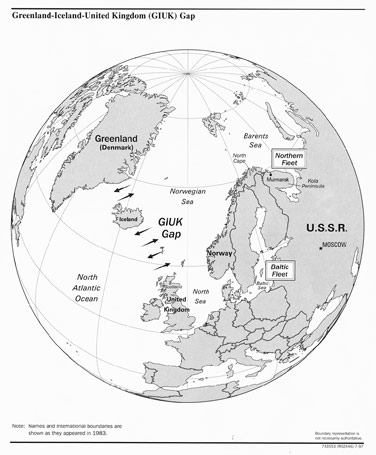
As important as Keflavík Air Base was to American and NATO forces, even more important were the waters surrounding Iceland. The GIUK Gap is the name for the maritime channels between Greenland, Iceland and the United Kingdom which connect the Arctic Ocean and the Norwegian Sea with the North Atlantic.
During the Cold War, these maritime passages were the only routes for Soviet submarines to leave naval bases in northern Russia and have access to the Atlantic Ocean — and onwards to the east coast of North America. One of the main tasks of the US forces stationed at Keflavík was therefore to monitor for submarines in the GIUK Gap and patrol Icelandic waters. Submarine surveillance is still conducted by US aircraft.
As Iceland’s capital city, Reykjavík has been the primary site of important NATO meetings and activities in the country. The North Atlantic Council met in the capital in 1968, when the Allies issued the “Reykjavik Signal” on disarmament and arms control with the Soviet Union, and in 1987, when Allies discussed further nuclear and conventional arms reduction. In 1986, Reykjavík also hosted a summit between US President Ronald Reagan and Soviet leader Mikhail Gorbachev, which laid the ground work for the 1987 Intermediate-Range Nuclear Forces Treaty (INF) between the United States and the Soviet Union.
Match of the Century
In Reykjavik, on 1 September 1972, Bobby Fischer became the first American to win the World Chess Championship. He played against the Russian grandmaster Boris Spassky during what has been called the "Match of the Century". Chess was considered to be another battlefield during the Cold War, one which the Soviets excelled at.
The biggest conflict that took place in Iceland’s seas was actually with another NATO Ally. At the height of the Cold War, Iceland and the United Kingdom engaged in three different “Cod Wars”. These maritime skirmishes arose following Iceland’s claim to control commercial fishing in territorial waters, in line with developments in international law on the sea and to defend vital national interests. The British Royal Navy steppedin to escort the British fishing vessels as the Icelandic Coast Guard enforced this new policy and the conflict escalated into a diplomatic crisis for the Alliance.
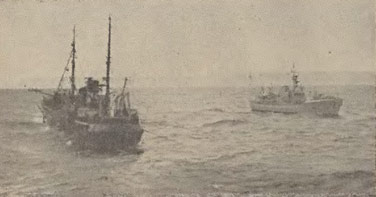
British trawler Coventry City (left) passes Icelandic Coast Guard patrol vessel Albert (right) in 1958. Author: Issac
Iceland’s economy was - and still is - massively reliant on fishing and, in particular, cod fishing. After the Second World War, with the rise in commercial fishing around the world, Icelanders realised that their fish stocks were being so drastically reduced that they had totake radical steps to protect their country’s livelihood. The Icelandic government closely followed the evolution of legislation and international rulings on the continental shelf and territorial waters off the coast. Based on that and national legislation from 1948, Iceland extended its exclusive economic zone from three to four nautical miles off its shores in 1952. This meant that British trawlers would no longer be able to access these fishing grounds. The British fishing industry retaliated by revoking docking permits for Icelandic ships, effectively banning imports of Icelandic cod into the United Kingdom. But this protectionist strategy backfired as Iceland merely started trading more with the Soviet Union and exporting more fish to the United States.
The first real Cod War broke out in 1958 when Iceland extended its maritime borders from four to 12 nautical miles offshore. The United Kingdom refused to recognise these new boundaries and sent Royal Navy ships to escort UK fishing vessels in Icelandic waters. The dispute severely affected diplomatic relations between both countries, but eventually they came to a settlement in early 1961.
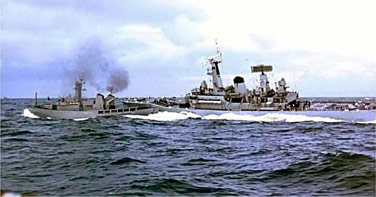
HMS Scylla and Icelandic Coast Guard ship Odinn collide, 23 February 1976. Author: Issac.
Iceland extended its fishing limits again in 1972 — this time to 50 nautical miles. In the Second Cod War, the Icelandic Coast Guard used special hooks to cut the wires that connected the nets to British fishing trawlers. The United Kingdom again sent the Royal Navy to escort their fishing fleet and this time the conflict escalated even further, with vessels on both sides colliding, causing severe damage. Iceland cut diplomatic ties with the United Kingdom, threatened to pull out of NATO, and the United Kingdom again capitulated to Iceland’s demands after NATO Secretary General Joseph Luns prevailed on the British to back down.
The third and final Cod War played out exactly the same as the second, only this time Iceland extended its exclusive fishery limits from 50 to 200 nautical miles. The Icelandic Coast Guard and the Royal Navy again came to blows. Iceland again threatened to leave NATO and the United Kingdom again gave in. Shortly thereafter, the United Nations Convention on the Law of the Sea established that a country’s exclusive economic zone would extend 200 nautical miles offshore.
To discover how Iceland contributes to the Alliance today, visit NATO on the Map.


