Close
Back

From now on you can download videos from our website
If you would also like to subscribe to the newsletter and receive our latest updates, click on the button below.
Enter the email address you registered with and we will send you a code to reset your password.
The password must be at least 12 characters long, no spaces, include upper/lowercase letters, numbers and symbols.
Click the button to return to the page you were on and log in with your new password.
The NATO phonetic alphabet is one of the most widely recognised symbols of the Alliance. Created in 1956, it helps NATO forces communicate with each other clearly and quickly, which can make all the difference in emergency situations.
Take the quiz to see if you know all 26 letters of the phonetic alphabet, then read on below to learn about its history!
Take the quiz below!
Learn more about the answers below.
A
Able
Alfa
Amsterdam
Adam
B
Baltimore
Baker
Brazil
Bravo
C
Casablanca
Charlie
Coca
Canada
D
Denmark
Delta
Dog
David
E
Edison
Easy
Echo
Elsa
F
Foxtrot
Fox
Florida
Fiesta
G
Golf
George
Gallipoli
Gold
H
Havana
Hotel
How
Harry
I
India
Italia
Ida
Item
J
Jerusalem
Jig
Juliett
Jupiter
K
Kilo
Kilogram
King
Khartoum
L
Liverpool
Lima
Love
Liter
M
Mike
Madagascar
Metro
Maestro
N
New York
Nan
November
Nectar
O
Oslo
Oscar
Oboe
Opera
P
Paris
Peter
Papa
Peru
Q
Queen
Quebec
Quiz
Quetzal
R
Roma
Roger
Rosa
Romeo
S
Sierra
Santiago
Sugar
Santa
T
Tripoli
Tango
Tare
Thomas
U
Uppsala
Uniform
Uncle
Union
V
Victoria
Valencia
Vaniya
Victor
W
William
Whisky
Whiskey
Washington
X
X-ray
Xanthippe
eXtra
Xaintrie
Y
Yoke
Yokohama
Young
Yankee
Z
Zebra
Zulu
Zanzibar
Zurich

Soldiers from the Durham Light Infantry operate a radio and keep watch for the enemy, near Bayeux, Normandy, France on 11 June 1944. © IWM (B 5378)
The NATO phonetic alphabet was established in 1956 and just a few years later became the established universal phonetic alphabet. However, it took several adaptations before the version used today came into effect.
In 1927, the International Telecommunication Union (ITU) produced the first phonetic alphabet to be recognised internationally. Most of its letters were based on the names of cities and countries:
Amsterdam, Baltimore, Canada, Denmark, Eddystone, Francisco, Gibraltar, Hanover, Italy, Jerusalem, Kimberley, Liverpool, Madagascar, Neufchatel, Ontario, Portugal, Quebec, Rivoli, Santiago, Tokio, Uruguay, Victoria, Washington, Xantippe, Yokohama, Zululand
In 1932, the ITU updated this alphabet with several changes:
Amsterdam, Baltimore, Casablanca, Danemark, Edison, Florida, Gallipoli, Havana, Italia, Jerusalem, Kilogramme, Liverpool, Madagascar, New York, Oslo, Paris, Quebec, Roma, Santiago, Tripoli, Upsala, Valencia, Washington, Xanthippe, Yokohama, Zürich
On the military side, the United States adopted a Joint Army/Navy Phonetic Alphabet, called the "Able Baker" alphabet after the first two code words, across all of its military branches in 1941. Two years later, the British Royal Air Force decided to use the Able Baker alphabet as well.
Able, Baker, Charlie, Dog, Easy, Fox, George, How, Item, Jig, King, Love, Mike, Nan, Oboe, Peter, Queen, Roger, Sugar, Tare, Uncle, Victor, William, X-ray, Yoke, Zebra
A common criticism of these alphabets was that they skewed English in composition. A new version incorporating sounds common to English, French, and Spanish was proposed by the International Air Transport Association (IATA) and came into effect on 1 November 1951 for civil aviation only.
Alfa, Bravo, Coca, Delta, Echo, Foxtrot, Gold, Hotel, India, Juliett, Kilo, Lima, Metro, Nectar, Oscar, Papa, Quebec, Romeo, Sierra, Tango, Union, Victor, Whiskey, eXtra, Yankee, Zulu
Although the IATA phonetic alphabet had been adopted for civilian aviation, militaries and NATO continued to follow the Able Baker phonetic alphabet for several years. Eventually, however, civilian and military authorities agreed that there should be a single, universal phonetic alphabet. NATO therefore launched a review of the IATA alphabet in the mid-1950s, spearheaded by the United Kingdom and the United States.
The initial proposal from NATO called for the adoption of the IATA alphabet, with changes to five letters: Coca, Metro, Nectar, Union and eXtra. This proposal was submitted to the International Civil Aviation Organization (IACO), although debate continued over the code word for the letter N (Nectar versus November) (see declassified document from the NATO Archives: SGWM-762-54).
On 8 April 1955, the North Atlantic Military Committee Standing Group advised that whether or not the proposal was approved by the IACO, the alphabet would "be adopted and made effective for NATO use on 1 January 1956" (see declassified document from the NATO Archives: SGM-0217-55).
Allied militaries hesitated to adopt the alphabet for national use until the ICAO ruled on the proposal, thus creating a rather odd situation in which NATO Military Commands would be the sole users of the proposed phonetic alphabet. Luckily this situation did not last for long, as the ICAO approved the alphabet, with November as the code word for the letter N.
On 21 February 1956, NATO Allies were advised “that the new Phonetic Alphabet is to be made effective in NATO 1 March 1956” (see declassified document from the NATO Archives: SGM-0156-56).
The ITU formally adopted this phonetic alphabet a few years later, making it the established universal phonetic alphabet governing all military, civilian and amateur radio communications. Since NATO Allies had spearheaded the final revision, it became known from that point on as "the NATO phonetic alphabet".
Alfa, Bravo, Charlie, Delta, Echo, Foxtrot, Golf, Hotel, India, Juliett, Kilo, Lima, Mike, November, Oscar, Papa, Quebec, Romeo, Sierra, Tango, Uniform, Victor, Whiskey, X-ray, Yankee, Zulu
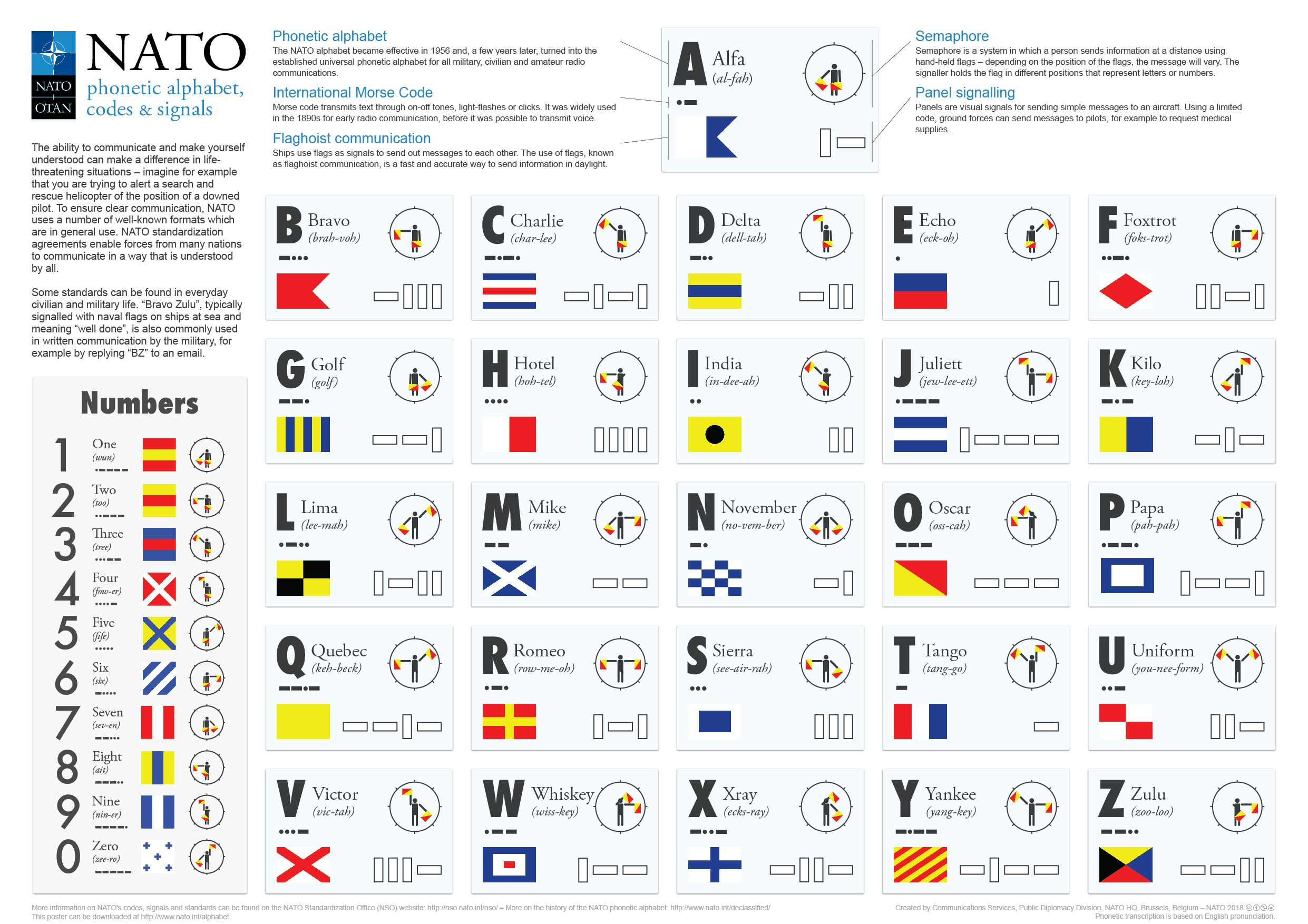
The NATO phonetic alphabet and its related Morse code, flaghoist and semaphore signals


