Close
Back

From now on you can download videos from our website
If you would also like to subscribe to the newsletter and receive our latest updates, click on the button below.
Enter the email address you registered with and we will send you a code to reset your password.
The password must be at least 12 characters long, no spaces, include upper/lowercase letters, numbers and symbols.
Click the button to return to the page you were on and log in with your new password.
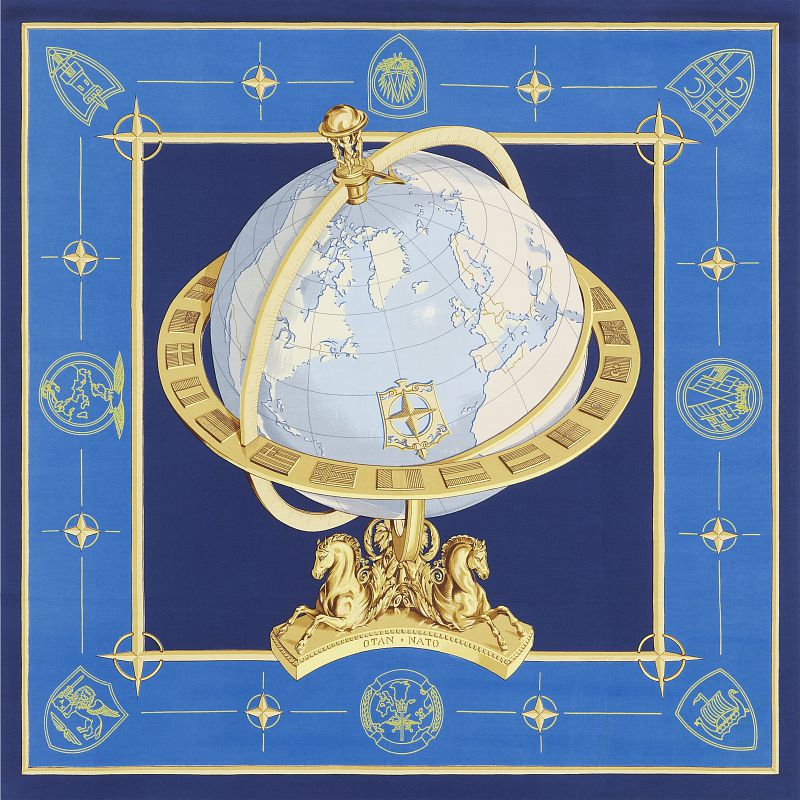
In 1956, the French luxury brand Hermès created a custom silk scarf featuring a special NATO design.
The limited-edition scarf was commissioned for the meeting of the North Atlantic Council on 13-14 December 1956 at the Alliance's Palais de Chaillot Headquarters near the Eiffel Tower in Paris.
Approximately 300 scarves were produced, which were either donated or sold to NATO personnel and to the national delegations of NATO's member countries.

Introduced in 1937 to celebrate the 100th anniversary of Hermès, the carré de soie (silk square) is one of the luxury house's most iconic products. Nowadays, one of these timeless pieces sells every 30 minutes around the world.
The NATO Hermès scarf was designed by Hugo Grygkar. It depicts a globe focused on the North Atlantic, showing the borders of the then 15 NATO Allies: Belgium, Canada, Denmark, France, West Germany, Greece, Iceland, Italy, Luxembourg, the Netherlands, Norway, Portugal, Türkiye, the United Kingdom and the United States. Particular features include: