Close
Back

From now on you can download videos from our website
If you would also like to subscribe to the newsletter and receive our latest updates, click on the button below.
Enter the email address you registered with and we will send you a code to reset your password.
The password must be at least 12 characters long, no spaces, include upper/lowercase letters, numbers and symbols.
Click the button to return to the page you were on and log in with your new password.
Well, good evening, and I also believe it was very good that we met today in this UDCG. Because Ukraine, as we know, is facing a harsh winter. Another harsh winter. It’s the fifth winter of Russia’s full-scale invasion. And we know that Russian bombs continue to rain down on Ukrainian cities, seeking to make life unbearable for the civilian population. So, Ukraine needs our support. And NATO Allies are delivering.
Today, we heard announcements of more air defence, of more missiles, ammunition, more drones, and hundreds of millions for PURL. Over the course of the programme, Allies have now pledged more than 10 billion US dollars to PURL and US Foreign Military Sales for Ukraine. We all agree that it is important that we keep up this level of support. We are doing our part to ensure peace talks will be successful, and that we can finally bring this war to a just and lasting peace. But for any peace to hold, Ukraine will need to be able to defend itself now and in the future. And to do that, Ukraine will continue to need our support, and not only this winter, but also beyond.
So, we’re continuing to build NATO 3.0 – a stronger Europe and Canada in a stronger NATO. This also applies to Ukraine, Europe and Canada are leading in our support, and I welcome that Allies continue to step up.
But NATO 3.0 also means a fairer NATO, and here European Allies will need to share the burden even more equally. A few countries are still doing the lion’s share. We all want Ukraine to succeed. We all need to do our part. And we will continue this conversation in the Coalition of the Willing in Berlin in two days’ time on Thursday.
Sabine Siebold, Reuters: First of all, I also meant to ask a question about the deep strikes to the German Defence Minister and to Sec Gen: Whether you share Secretary Colby's position that these deep strikes should no longer be carried out? The second question to everybody: Could you please tell us whether you learned more about the U.S. posture review? Whether you got any details concerning the scope, the potential scope, whether there might be any defence gaps left in Europe after the US might carry out such a troop drawdown?
NATO Secretary General Mark Rutte: Maybe on your first question: I think, without going into all the details, I think we all agree in NATO that it is important, of course, for Ukraine to do everything to defend themselves against Russia’s attacks. We know they are largely targeting Ukraine's civilian population and infrastructure. And secondly, to push back Russia’s invasion, and that means along the front line. And here we can say that Ukraine is having some real successes. And then, of course, the third element is what do you need to do to disable Russia’s war machine? And I think it’s important that that war machine, of course, is disabled. And I think we all agree that this is important, that this is necessary, and also important that we continue to support Ukraine.
(…)
Thomas Gutschker, FAZ: Thanks so much. Thomas Gutschker, with Frankfurter Allgemeine Zeitung. Question to the Secretary General: A year ago on this podium, you said that NATO should prepare to have at least one billion dollars a month for the PURL programme in the upcoming year. That would have brought it to 12 billion. If I take your 10 billion figure and deduct the 4.3 from last year, we are at half of that amount. So why is the PURL programme not so attractive as you wanted it to be, and what still needs to be remedied to make it more attractive to Allies?
NATO Secretary General Mark Rutte: Well, I would argue with you on this, because I think it is very successful. And it is delivering essential U.S. gear at a high pace into Ukraine, which only the U.S. is able to provide, and Europeans paying for it. And I think, well, we could dispute a bit whether you need half or a full billion a month or whatever. But I think when you look at the total number now, about 10 billion, it is a success. And it is very important that the Europeans keep on supplying the money, which is also happening. And then, of course, in addition to what the EU and European and Canadian Allies are doing to support Ukraine bilaterally.
(…)
Alex Cadier, TVP World
Thank you so much. Thank you for the question. First question to the Defence Secretary and Mr Pistorius, if I could. Both of you have pledged more for Ukraine. Both of your countries have given air defence. Germany, of course, announcing more money for Patriots. But there is the pledge not in the room, the pledge not made, which is Allies with air defence, with PAC-3s that the Minister on the end of the stage could use tomorrow, not using them, not sending them to Ukraine. Is that a source of frustration for the two of you?
(…)
NATO Secretary General Mark Rutte
Do I maybe say something about Patriots? Because let’s face the facts: the Patriots are in huge demand. And we also know that when you look at the stockpiles, be it in the U.S. or in Europe, there is a limit to it. And what I’m seeing, be it the United States, be it the Patriot nations in Europe, they are doing everything to, well basically work very hard to find ways to do what is necessary and what is possible. But let me also add that it is not just the PAC-2s and the PAC-3s which protect Ukraine. It is also the 20mm ammunition for F-16s to take out the jet-powered drones. It is, as was mentioned before, the ASTERs, the IRIS-T, and all the other air defence systems. So, there’s a little bit of a risk, yeah, that we over-emphasise on Patriots. It is very important, and I would love it to be more, but there is a limit to what is available in the stockpiles in the U.S. and in Europe. And that means that we will constantly work very hard - and I know the U.S. is doing this, they’re looking hard at this, the Europeans are doing it, all the other Allies, to help Ukraine get what it needs.
(…)
Victor Jack, POLITICO
Hi, Victor Jack from Politico. Thanks so much for the briefing. Two quick questions. First, I have a follow-up on what my colleague was saying to the Secretary General. Last year, you set a target of setting 12 to 15 billion dollars for PURL for this year, and Allies separately agreed in Ankara a 70 billion target of aid for Ukraine. There's several billion missing from both targets. How confident are you that you can meet those targets for this year?
(…)
NATO Secretary General Mark Rutte
Well, the 70 billion is a hard target, and we are a couple of billion close to getting to the 70 billion, but still a couple of billion we need to get to, and we discussed that today. And I’m cautiously optimistic we will get there. When it comes to the PURL programme, it was an estimation, and we see in practice that we don’t need the amount of money we thought we’d need. But when you look at what is actually flowing into Ukraine, it is at a high pace, all the essential US gear. So there, it was not so much a target, but what we assumed it would be is a little bit less, but still a considerable amount of money used to pay for this, paid for by Europeans and Canada, bought from the U.S.


German Minister of Defence, Boris Pistorius, and Ukraine Minister of Defence, Evgeny Khmara
Ukraine Minister of Defence, Evgeny Khmara
German Minister of Defence, Boris Pistorius, and Ukraine Minister of Defence, Evgeny Khmara
NATO Secretary General Mark Rutte
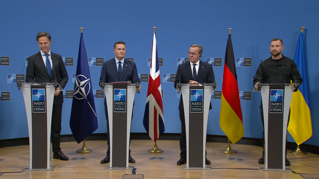
Joint press conference by the UK Secretary of State for Defence, Wes Streeting, NATO Secretary General Mark Rutte, German Minister of Defence, Boris Pistorius, and Ukraine Minister of Defence, Evgeny Khmara
Joint press conference by the UK Secretary of State for Defence, Wes Streeting, NATO Secretary General Mark Rutte, German Minister of Defence, Boris Pistorius, and Ukraine Minister of Defence, Evgeny Khmara
NATO Secretary General Mark Rutte
NATO Secretary General Mark Rutte
Joint press conference by the UK Secretary of State for Defence, Wes Streeting, NATO Secretary General Mark Rutte, German Minister of Defence, Boris Pistorius, and Ukraine Minister of Defence, Evgeny Khmara
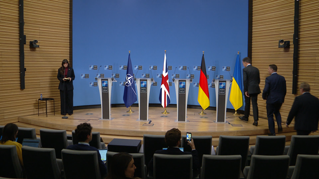
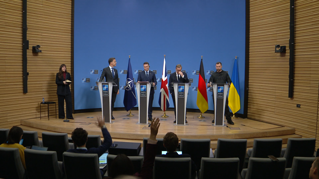
Joint press conference following the Ukraine Defence Contact Group meeting