Close
Back

From now on you can download videos from our website
If you would also like to subscribe to the newsletter and receive our latest updates, click on the button below.
Enter the email address you registered with and we will send you a code to reset your password.
The password must be at least 12 characters long, no spaces, include upper/lowercase letters, numbers and symbols.
Click the button to return to the page you were on and log in with your new password.
Prime Minister Janša, dear Janez,
It’s a pleasure to welcome you to Brussels. We’re old friends. Good to see you also now in this building, and to see you again after a successful meeting and a Summit we had in Ankara, in July.
For over two decades now, Slovenia has been a valued Ally, contributing to Euro-Atlantic security. Under your leadership, Slovenia is committed to our collective deterrence and defence, and playing its part in ramping up its defence spending, and continuing, continuing to support Ukraine.
Slovenia contributes to our Forward Land Forces in Latvia and Slovakia. Slovenia also continues to play a very important role in supporting stability across the Western Balkans. A region of strategic importance to the Alliance. You contribute personnel to our peacekeeping KFOR mission in Kosovo, helping to maintain a safe and secure environment for all communities. And you contribute to our efforts in Bosnia and Herzegovina, including by leading an initiative to strengthen the national military police, as part of our Defence Capacity Building package.
Just as Slovenia stands with NATO, Allies also stand with Slovenia. Hungarian and Italian jets safeguard your skies. And NATO Allies sent urgent aid to help save lives after the 2023 floods. Let me also thank you, for Slovenia’s steadfast support to Ukraine – and I know this is personal. With over 60 million euros in security assistance provided in 2025. You contribute to NATO’s PURL initiative and to the Czech Ammunition Initiative. And you contribute personnel to NATO’s Security Assistance and Training Command in support of Ukraine.
Russia continues to wage its brutal war of aggression against Ukraine. At a staggering cost to Russia. With over 40,000 casualties per month. Russia is struggling in Ukraine and continues to lash out, with reckless and dangerous attacks, including on civilian infrastructure, close to NATO territory. The strike on a passenger train in Ukraine yesterday shows how desperate Putin has become. He thinks that he can stop us from supporting Ukraine. And that he can undermine our unity. He is wrong. Our answer is to increase support to Ukraine, so it has what it needs to defend itself. And our commitment to NATO’s collective defence is ironclad. We will always do what is necessary to protect every inch of Allied territory.
Dear Janez, thank you again for Slovenia’s contributions to the Alliance. For your leadership. For your personal commitment to NATO. And for our friendship. Thank you so much.
NATO Spokesperson Allison Hart
And now we’ll take your questions. Let’s start here with AFP, third row.
Olivier Baube, AFP
Thank you, Oliver Baube from AFP.
NATO Secretary General Mark Rutte
Good to see you again. Good afternoon.
Olivier Baube, AFP
Good afternoon, Secretary General. The question is for you. After what happened recently this weekend near the Polish border, I was wondering if NATO Allies would consider something a bit stronger than delivering Patriots, which obviously they can't really do. So, are you considering, or are you discussing, a sky shield, for instance, for Ukraine? Is that something possible?
NATO Secretary General Mark Rutte
Well, what we have seen over the last couple of weeks now and months, is indeed, the incident yesterday, but also what happened in the hybrid sphere in Leipzig and other places in the last couple of months again. And let me say, first of all, on yesterday, it shows I think, again, that Russia is growing increasingly reckless as it continues its terrible war against Ukraine, including evidence yesterday again targeting the infrastructure upon which Ukraine depends. Of course, I will never go into intelligence matters, but the strikes yesterday on trains in Ukraine, close to NATO’s territory, again I believe show Putin's desperation and also his desire to sow fear and terror.
Our reaction will always be more support for Ukraine, so whatever Putin thinks to achieve by these acts, he will not achieve. The support is there, it is only growing stronger, we have seen this in Ankara, in the Foreign Ministers' meeting, in the Defence Ministers' meeting, leading up to Ankara, but also in the UDCG last week. And when it comes to hybrid, also here Putin knows very well that he will not be able to divide us. And we have all the response options we need when it comes to hybrid. It will not always be visible and public what we do – some is, some is not public, for reasons we cannot always disclose.
But I can assure you, we have all the response options. And also here, the most important one, of course, is making sure that Ukraine has what it needs to stay in the fight. But also, as you have seen with the undercutting of the undersea sea cable between Finland and Estonia; Baltic Sentry, increasingly putting strategic dilemmas to the Russians when it comes to the shadow fleet. All of this is evidence that we stand ready and we have everything at our disposal.
NATO Spokesperson Allison Hart
Right, Slovenia's press agency here in the second row.
Blaž Mohorčič, Slovenian Press Agency
Thank you, Blaž Mohorčič with the Slovenian Press Agency. For Mr Secretary General, did Prime Minister convince you now that now Slovenia would really invest this 2% into core defence, and would you say that Slovenia is now a reliable Ally?
NATO Secretary General Mark Rutte
Well, it was already a reliable Ally, but we had a bit of an issue when it came to defence spending, and here there is an absolute commitment not only to the 2%, but also the credible path to the 3.5% to be reached latest in 2035. So, the answer is yes.
NATO Spokesperson Allison Hart
Reuters over here in the third row.
Andrew Gray, Reuters
Thank you. Andrew Gray from Reuters. Hi. Secretary General, you mentioned in your remarks the Western Balkans and, in particular, Kosovo and KFOR. As you know, this week the verdict is expected in the trial of former President Hashim Thaçi. Are you concerned about possible violent unrest in Kosovo, in the region, as the result of that verdict, whichever way it goes? And KFOR has been caught by surprise in the past by upsurges of violence there. Do you have credible plans in place, and can you say anything to reassure the people of the region that you'll be able to deal with whatever might happen?
NATO Secretary General Mark Rutte
Basically, your question goes back to the reason KFOR is there, and KFOR is there to make sure that NATO contributes to stability and peace. This has been done through the years, as you know, enabling important economic and also social development, and this is now for over two decades a safe and secure environment for all people in Kosovo. This is true today. This is true whenever; whatever news might come out this week and in the coming time. But also, when it comes to our long-term commitment to peace and security in Kosovo, it's there to stay, in terms of constantly assessing what is the best setup of KFOR, how is it best fitted for the situation at hand, and this is Kosovo, but this of course has also an impact on the whole region.
NATO Spokesperson Allison Hart
Delo here in the centre.
Peter Žerjavič, Delo
Hi, Slovenian Daily Newspaper Delo. For many years now, Slovenia has not been able to meet the NATO capability target. It means one or two medium combat battalion groups. In the new security environment, and taking into account new experiences of war in Ukraine, is it still reasonable for the Alliance to continue insisting on that requirement, and consequently, Slovenia has to provide, let's say, 50 to 100 armoured vehicles?
NATO Secretary General Mark Rutte
I’m very happy with the question, the part in English, because it hits what we are doing here. The 3.5% is not just plucked from the air. It is deeply rooted in, exactly as you mentioned, the capability target process.
So the Defence Ministers agreed, in a run-up to the Summit in The Hague, what each of the 32 Allies should be able to deliver, to make sure that if an Article 5 situation arises, that we can defend ourselves. And that is then distributed amongst the nations, and for Slovenia, or for my country the Netherlands, or for the United Kingdom, everybody knows exactly what to do. And that has been costed, and then we came to the conclusion that to pay for all this, you need to spend somewhere between 3.5,3.6 percent – ballpark 3.5, that was the target in The Hague when it comes to the core defence spending, plus of course the defence-related (spending), leading to the overall 5 percent.
What we have been doing in that whole process is constantly figuring in the latest insights, for example from Ukraine from the battlefield, other information we have on modern warfare. And basically, what that has led to is the realisation that you need both. You need the more traditional, that is the people, the big-ticket items, including the fighter jets and the tanks, etc., but also the latest technology when it comes to artificial intelligence, when it comes to drone, counter-drone technology, etc.
And it is that combination which is making sure that we can defend ourselves, not only today but also in the future, and again leading up to a total amount of spending, which is approximately 3.5% by 2035. And therefore, it is so important that the countries like Slovenia commit themselves to a credible path to get there, but also to start from a base of a bit above 2%, so that we know that over those next eight, nine years, we can get there.
NATO Spokesperson Allison Hart
Alright, one more question – POLITICO.
Victor Jack, POLITICO
Hi. Thanks for the press conference. Victor Jack from Politico. I have two questions following up from my colleague from AFP. Is NATO working on a specific new response to Russia's escalating hybrid campaign in Europe? And is there a risk that, if there is a sabotage incident in the near future which leads to casualties, and NATO doesn't offer a concrete new response, it will be perceived as weak by Russia and by voters?
NATO Secretary General Mark Rutte
Well, I don't think it will be perceived as weak. But again, as I said, also in reaction to AFP, we have all the response options. We cannot simply always tell you what they are. So, some of them will be public, some are not, and of course the response does not always have to be tit-for-tat.
So when, for example, we were confronted with the cutting of an undersea sea cable over a year ago, there was a symmetric reaction in terms of creating Baltic Sentry to protect the Baltic Sea. But at the same time, what you are seeing, of course, is that Allies are also originating from that mission more and more. Look at France, look at the United Kingdom, Belgium, Sweden, others.
We are doing more and more to confront the shadow fleet, which is imposing costs on Russia. Ukraine, at the moment... of course, NATO is not fighting in Ukraine, but NATO countries are helping Ukraine to stay in the fight, and that is leading at the moment to over 40,000 casualties on the Russian side – which is terrible, by the way, for the families, for the next of kin, for everybody. But this is what Putin is willing to sacrifice: over 40,000 of his own people for this somewhat crazy fight he is mounting against Ukraine without any reason, without any provocation from the Ukrainians. But he is willing to impose those costs on his own people.
That's why I said before: if you are a young man in Russia and you join the fight, the chances are big that you will not return home, because your president simply doesn't care about your life. He just wants to somehow continue this fight against Ukraine – and Ukraine is able to maintain in that fight, also thanks to support Ukraine is getting from NATO Allies. Not fighting, but in terms of practical support.
So that's also, of course, happening, and therefore I'm saying to Putin and everyone who wants to listen: if you continue doing this, we will not only have our response options – again, some visible, some not – we will also continue supporting Ukraine, and it will be more and not less. And that's exactly what's happening. Look at the UDCG last week: again, the Brits committing 100 million pounds to PURL, and so many other commitments. So, this continues. 70 billion from Europe, the loan, Ukraine Support Loan, which is now morphed into concrete support for Ukraine. So, this is exactly what needs to happen.
NATO Spokesperson Allison Hart
Thank you so much. I'm sorry that we don't have more time, but thanks for joining us and have a good afternoon.
NATO Secretary General Mark Rutte
Thank you.


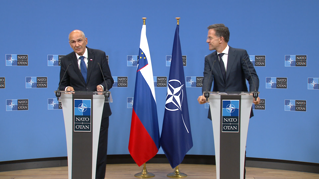
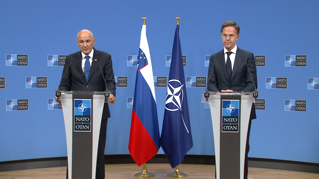
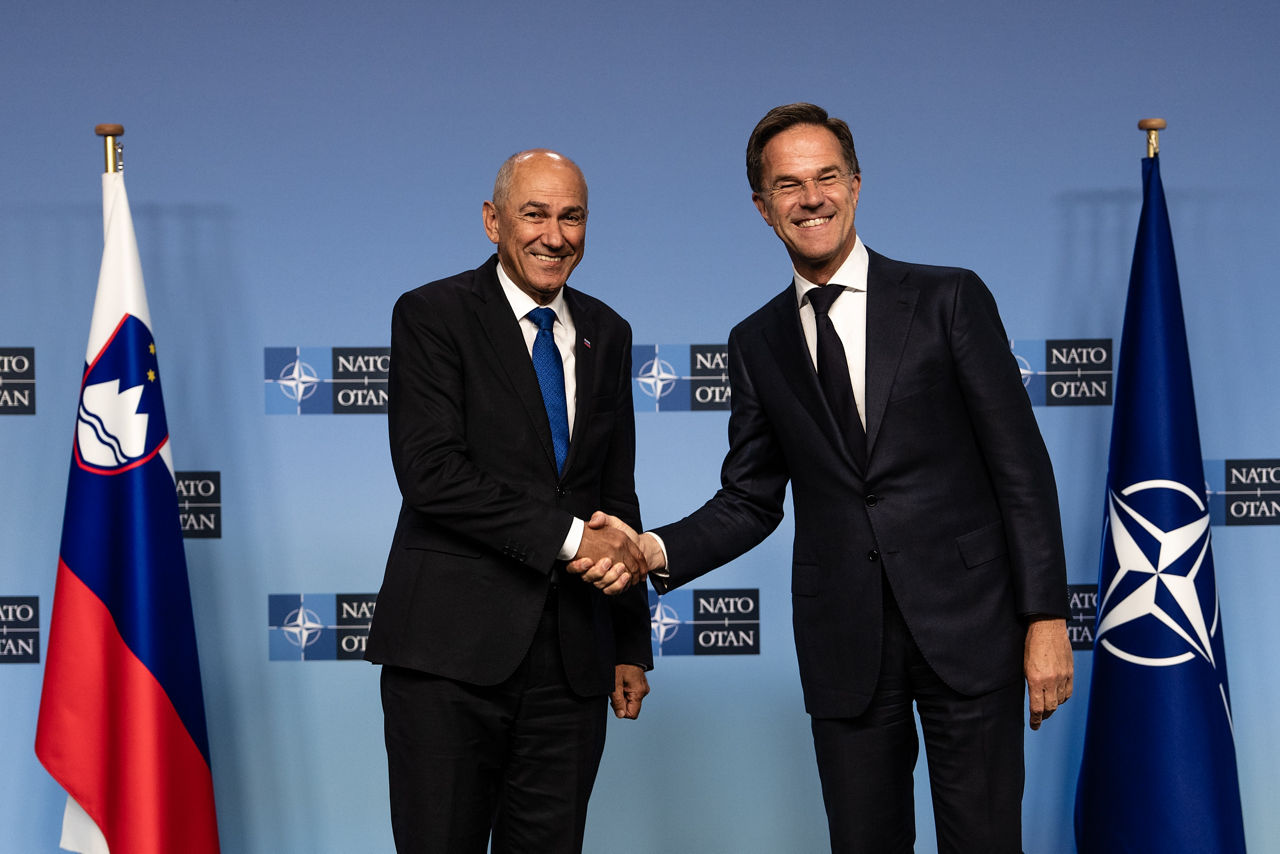
NATO Secretary General Mark Rutte with the Prime Minister of Slovenia Janez Janša
NATO Secretary General Mark Rutte with the Prime Minister of Slovenia Janez Janša
NATO Secretary General Mark Rutte with the Prime Minister of Slovenia Janez Janša
NATO Secretary General Mark Rutte with the Prime Minister of Slovenia Janez Janša
NATO Secretary General Mark Rutte with the Prime Minister of Slovenia Janez Janša
NATO Secretary General Mark Rutte with the Prime Minister of Slovenia Janez Janša
NATO Secretary General Mark Rutte with the Prime Minister of Slovenia Janez Janša
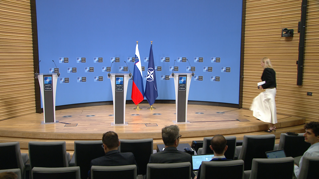
Joint press conference with NATO Secretary General Mark Rutte and the Prime Minister of Slovenia Janez Janša
Joint press conference with NATO Secretary General Mark Rutte and the Prime Minister of Slovenia Janez Janša
Joint press conference with NATO Secretary General Mark Rutte and the Prime Minister of Slovenia Janez Janša
Joint press conference with NATO Secretary General Mark Rutte and the Prime Minister of Slovenia Janez Janša
Joint press conference with NATO Secretary General Mark Rutte and the Prime Minister of Slovenia Janez Janša
Joint press conference with NATO Secretary General Mark Rutte and the Prime Minister of Slovenia Janez Janša
Joint press conference with NATO Secretary General Mark Rutte and the Prime Minister of Slovenia Janez Janša
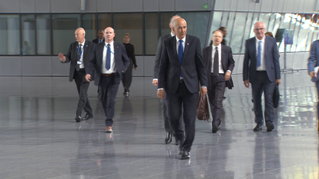
NATO Secretary General meets the Prime Minister of Slovenia