Fermer
Retour
Accédez aux ressources médiatiques officielles de l'OTAN. Un contenu de qualité professionnelle, diffusé sur les dernières actualités. La référence pour les professionnels des médias.
Accédez aux ressources médiatiques officielles de l'OTAN. Un contenu de qualité professionnelle, diffusé sur les dernières actualités. La référence pour les professionnels des médias.
Désormais, vous pouvez télécharger des versions complètes ou partielles de nos vidéos depuis notre site Web.
Si vous souhaitez également vous abonner à la newsletter et recevoir nos dernières mises à jour, cliquez sur le bouton ci-dessous.
Entrez l'adresse e-mail avec laquelle vous vous êtes inscrit et nous vous enverrons un code pour réinitialiser votre mot de passe.
Le mot de passe doit comporter au moins 12 caractères, sans espaces, inclure des lettres majuscules/minuscules, des chiffres et des symboles.
Cliquez sur le bouton pour revenir à la page sur laquelle vous étiez et connectez-vous avec votre nouveau mot de passe.
Good morning, everyone.
It’s great to see you.
Tomorrow, NATO Defence Ministers will gather, as this will be for the last time, before our Summit in Ankara in July.
We will start the day with a meeting of NATO’s Nuclear Planning Group with those Allies involved, followed by a meeting of the North Atlantic Council, at 32, where we will discuss final preparations for the Summit.
In the afternoon, there will be a meeting of the Ukraine Defence Contact Group, the UDCG, co-chaired by Germany and the UK.
We have a lot to talk about.
We continue to face a dynamic security environment, and Allies are consistently working to ensure we are prepared to deter aggression and defend ourselves against any threat. And here I really want to welcome the deal made by President Trump with Iran.
The US action to prevent the threat of a nuclear-armed Iran and degrade its ballistic missile capability improves security for us all. And, the deal President Trump struck has created an opportunity to ensure Iran never obtains a nuclear weapon.
The restoration of free passage through the Strait of Hormuz will be a massive step forward. And I know that many Allies – through the initiative led by France and the United Kingdom – are ready to support.
Looking to our agenda for Defence Ministers tomorrow, Allies will demonstrate progress on building a stronger Europe in a stronger NATO.
We need more forces, more resources and a much stronger industrial base.
That means making steady increases to defence investment.
And more fairly sharing responsibility for our collective security.
Ahead of the Summit in Ankara, Allies will highlight how they’re delivering on commitments made in The Hague last year.
Investing 5% of GDP in defence by 2035.
That’s what we agreed.
So, I expect nations to present clear, concrete and credible plans to reach that goal. Ideally, well ahead of the agreed timeline. And many are already showing that they are doing exactly that.
The numbers are clear. We saw a massive increase in defence investment in 2025 – with European Allies and Canada increasing their core defence investment by over 90 billion dollars. That is an astounding figure – amounting to a nearly 20% increase in a single year. With further increases already on the books for 2026.
These significant investments are producing real capabilities – and we’re already seeing that European Allies and Canada are more capable and take more responsibility for our security. This includes taking on more key leadership roles in NATO’s military structures as well as shouldering more in the context of what NATO might need to deter in peacetime and defend in crisis or conflict.
And here I want to highlight what is truly a sign of success in how NATO is evolving. You will likely have seen news of the US adjusting its contributions to the NATO Force Model. In some cases, this has been cast as a problem – as the US pulling away from its Allies.
But that is not the reality.
The US has made clear that it is committed to NATO.
That commitment comes with an expectation that Allies will more fairly share the responsibility for our security here in Europe.
They have made clear that the US nuclear deterrent is solid.
And that it is crucial that Europe and Canada do more on the conventional front, understanding that the US has obligations around the globe that it needs to account for.
We have looked at the division of labour in the context of conventional forces, and we see that European Allies and Canada are ready, willing, and able to do more.
Based on this, the United States has adjusted its pledges to the NATO Force Model.
This is not primarily about where forces and assets are currently, but about who would do what if our defence plans were activated.
Historically this was overly reliant on the US. Now the US has adjusted its pledged contributions – and other Allies have stepped up to contribute more.
And this is fair. This makes us stronger. And this is what NATO 3.0 is all about. A stronger Europe in a stronger NATO.
So, we are seeing more investment. We are seeing better burden sharing.
And we also know that, as we increase investment, it’s not the money alone that matters. We need to ensure our men and women have what they need to keep us safe.
Ramping up defence investment means ramping up defence production. And we need this across the whole of the Alliance – on both sides of the Atlantic.
And we also know that the security environment is evolving, and NATO is evolving with it. We must harness the power of innovation.
We are working hand in hand with industry to ensure that supply meets demand, so that this Alliance maintains its cutting edge. NATO can do it because it’s not just home to some of the biggest defence companies in the world, but also some of the most novel and innovative.
This makes us stronger and more secure while also creating jobs and economic growth. It is a real win-win.
Finally, with Russia’s war in its fifth year, providing support to Ukraine remains a priority. Ukraine is demonstrating that the Russian war machine is not unstoppable, and is shifting the dynamics on the battlefield.
Together, Allies have given billions in artillery, and ammunition and aid, but it is crucial to continue this support to help Ukraine maintain its advantage.
This will be my message at the UDCG.
So, as you can see, we have plenty on the agenda. And I will be back tomorrow to tell you how it went.
But in the meantime, of course, I am ready to take your questions.
NATO Spokesperson Allison Hart
Okay, let's start here in the second row. AFP.
Max Delany, AFP
Thank you very much, Secretary General. Max Delany from AFP.
NATO Secretary General Mark Rutte
How are you? Yes, hello, good to see you.
Max Delany, AFP
Coming back to the Force Model – which you gave a long explanation to – you didn't mention the timeline, though, for the US plans to reduce their commitments to the Force Model. Is this from tomorrow – these US assets would not be available if NATO's defence plans were activated, or is it over longer time, to give the Europeans the ability to replace them? And, if there is a war, you just said that the defence plan, the US will have a lesser role in it. Do you not expect the US to come all in, in Europe. if there's a war with Russia?
NATO Secretary General Mark Rutte
Again, let me start by saying, this is not about where forces and assets are currently located, it's about who would do what, if our defence plans were activated, so let's say in case of an Article Five situation. And what the Supreme Allied Commander, SACEUR, has said is that, when it comes to the capabilities the United States will no longer pledge, there are largely capabilities available that other Allies already have, or will have in the near future. And we have already seen that, as the United States has adjusted its pledged contributions, other Allies have stepped up to contribute more – in some cases completely, in some cases nearly – but there are also areas that require more work but the overall picture is looking good.
NATO Spokesperson Allison Hart
Okay, next question. Let's go here. Third row, second one in.
Melike Pala, Anadolu Agency
Hello, Secretary General, Melike Pala, Anadolu, Turkish news agency. I have a question about the Strait of Hormuz, actually, because two days ago, during his meeting with Trump, French President Macron offered to help reopen the Strait of Hormuz if they were requested by the regional actors, including the United States, and also say that European forces could be rapidly deployed to the area. I wonder, what is the NATO's vision as well as position in this regard? Thank you.
NATO Secretary General Mark Rutte
Well, of course, this is legally and literally speaking outside NATO territory, but it is absolutely clear that we have the United Kingdom and France coordinating all of this. We are really seeing massive pre-deployment of assets over the last two months by European Allies and others close to theatre, particularly when it comes, for example, to demining, radar, and other technologies necessary. And, as I understand it, what I'm hearing from the G7 is that this was discussed. So, what could this UK-French led initiative, with so many countries involved, what could they do post this whole deal, which has been struck between the United States and Iran, to make sure that they help to deliver on this commitment, of making sure that the freedom of navigation is fully restored. But this is all in the making but the good news is that these discussions are ongoing. Whether NATO will play a role there, yes or no? If helpful, of course we will play a role, but if they can do it without us, also okay. So, we are always ready to help if so wanted.
NATO Spokesperson Allison Hart
Okay, coming here, third row in the towards the centre, Politico.
Victor Jack, Politico
Hi, Victor Jack from Politico. Thanks for the press conference. I have a question on defence spending. So, some Allies' defence spending is set to flatline this year, while others – Czechia, Slovenia, Hungary, for example – is actually likely to fall below 2% of GDP this year. What's your message to these Allies, given the commitments that they made last year? Thanks.
NATO Secretary General Mark Rutte
Well, again, when you look at the increases, they're really staggering. So in total this is over 90 billion in one year, 2025 – 90 billion more spent on defence than the year before. When you look at all 2%, almost all Allies are on 2%. Last year, Albania, Czechia, Slovenia were not but they have clearly committed to reach more than 2% this year. And then these three countries, when you look at the overall picture, it is a really small number. There’s 800 million they are not spending when it comes to the full 2%, compared to a total defence spend of 571 [billion] US dollars. So, 800 million, less than 1 billion US dollars, compared to 571 [billion] US dollars, including this over 90 billion increase, almost 20%. So, this is really great news. And what we are getting in is reports from all Allies that they are really ramping up, and we have seen so many already on the 5%, the 3.5%, the Germans reaching it in 2029 having doubled their defence spending compared to 2021, over 150 billion. So, this picture really looks good, and this is necessary because we have to defend ourselves.
NATO Spokesperson Allison Hart
Okay. Second row, Reuters.
Sabine Siebold, Reuters
Thank you, Secretary General. You actually dodged Max's question on whether the reductions in US commitments to NATO's defence plans is effective immediately. Could you tell us whether these reductions are in fact as we speak now?
NATO Secretary General Mark Rutte
On that specific question, it is very difficult to answer yes or no because this is not about, let's say, this is about the what and the when, if Article Five will be triggered. So that means that, the US saying we have adjusted our contributions to the NATO Force Model, that means that other Allies have to step up, and there we see the picture positive, generally, which is some already filled, some nearly, some still more work to do. But it's not that you can answer that question with a yes or no. It's clear that US has adjusted its commitment to the NATO Force Model, but in technical terms, it is not a yes or no.
Sabine Siebold, Reuters
And on those Allies that you mentioned are stepping up right now, are you confident that all these capabilities that have been reduced by the US now will be back filled by the Ankara Summit?
NATO Secretary General Mark Rutte
Again, it's a very technically complicated issue but what we are working on also makes sure that what the US has been providing so far will be filled, that we fill that gap. And again, that looks very good. A lot of it done, some of it nearly, and some of it requiring more debates and discussion.
NATO Spokesperson Allison Hart
Okay, coming over here, second row on the aisle.
Isabelle Schaefers, ZDF
Hi, Isabelle Schaefers, German TV ZDF. Just one short question on clarification, because you said that the USA no longer provides capabilities that the European Allies can provide. Have they consulted before? So, have they asked them what capabilities do you have? So, which one can we take out, or was it the list that was just presented and now they have to go with it? And then my main question, on the Strait of Hormuz: do you have any indications what the US actually requests from the Allies in NATO, if this French-UK initiative will be enough and quick enough?
NATO Secretary General Mark Rutte
Yes. On the first question, at a technical level, these discussions are going on for really some time now. It's one of the reasons, of course, why, as an Alliance, we have committed to reach the 3.5% core defence spending, as part of the overall 5% defence spending, because it is fair that, where the United States has to take care of multiple theatres – not only Europe, but, for example, also the Indo-Pacific – and knowing that in case of a situation where they need their assets in both theatres, the assets will be spread too thinly. It’s only fair, of course, that the Europeans take on a bigger share of the burden when it comes to the defence of Europe. As I said before, we have 600 million people living here to defend ourselves against 140 million Russian population - not the population, they are not a problem - but a country with 140 million people led by somebody who is an adversary of NATO and of Europe and the whole of NATO territory. And it's a bit strange that we still need so much help from another country, eight hours flying from here on the plane, with 350 million people to defend ourselves against 140 million. So that over time the US stays involved conventionally, and of course when it comes to nuclear umbrella, but over time when it comes to these contributions to the NATO Force Model that the Europeans take over a bigger share of the burden is totally right. This is part of the bigger discussion of the 5%, which we decided on in The Hague, which equalises the defence spending in Europe with the defence spending in the United States, which is taking out this big pebble in a shoe of irritants on the US side since Eisenhower. It has been solved by President Trump and by the other 31 Allies.
When it comes to your second question, the French and the Brits are leading this coalition. The discussions are ongoing as far as I understand, but obviously this is not NATO leading it. It's very much a French British-led initiative, with, I think, over 40 countries now participating to help to make sure that the freedom of navigation is restored, and that discussion is ongoing. It has been discussed in the G7, as you have seen, and my understanding is that to big parties is about demining, because this is one of the big issues, the mines there, and Europeans are sitting on a lot of demining capacities which the US is lacking to that extent. So, this is one of the areas where Europe has more than the United States. So, I guess, going forward, we will see that discussion further evolving. But obviously, I know what's happening. We are listening in, but we are not leading it. This is really led by the French and the British with the Americans.
NATO Spokesperson Allison Hart
Okay, staying in the second row, third one in.
Ruslana Brianska, Hromadske Radio Kyiv
Good morning, Secretary General. My name is Ruslana Brianska, Hromadske Radio Kyiv. What can Ukraine expert from the NATO Summit in Ankara? And maybe is Ukraine likely to receive the proposed €70 billion in support?
NATO Secretary General Mark Rutte
Well, you already saw some very positive, I think, statements coming out of the G7 yesterday. I think also what the G7 agreed on Ukraine was extremely important, and let's welcome that. I, at least, would very much welcome what the leaders agreed on. And when it comes to Ankara, but also the Defence Ministers tomorrow, we all focus, particularly of course on what Ukraine needs to maintain the fight, and that is all the crucial flow of equipment into Ukraine, that's coming from Europeans, but also this flow of essential stuff which only the US is able to provide. For example the interceptors for the Patriot systems, which are so crucial to defend your cities and your crucial infrastructure. And there is a big commitment on the US side, on the American, on the European side, to keep that flow going to make sure the money is there. This is this famous PURL programme. We will have now the Ukraine Support Loan on the EU side kicking into gear, so that will help. I'm not going to give you numbers at this moment, but I'm pretty confident that collectively we'll make sure you have what you need as far as Europeans and Americans can help to defend yourself.
NATO Spokesperson Allison Hart
All right. Fourth row in the very centre.
Irina Somer, Interfax Ukraine
Thank you, very good morning. News Agency Interfax Ukraine, Irina Somer. Actually, follow up to my colleague question regarding Ankara Summit. Can we expect NATO-Ukraine Council? We know that Zelenskyy is invited already, but how about Council, and if yes, on which level? And by the way, why don't we have Council during this Ministerial? Thank you.
NATO Secretary General Mark Rutte
Yes, well, during this Ministerial, we already have a Ukraine Defence Contact Group meeting. We also have an NPG, so a Nuclear Planning Group meeting. So, the programme is already packed, and we had a NUC – a NATO-Ukraine Council – in Kyiv only two weeks ago at the level of the Ambassadors, which was an impressive visit with the Ukrainian President being there and addressing all the questions and issues Ambassadors raised. It was a moving experience to have that meeting in the Presidential Palace in Kyiv. We assume for the Ukrainian President during the NATO Summit to have a programme similar to what we had last year in The Hague, so many meetings but no sit down with all the 32 leaders, because we will have one session with the 32 which is at a level of the 32.
NATO Spokesperson Allison Hart
Coming here third row, Lithuanian Public Broadcaster.
Milda Vilikanskyte, Lithuanian Public Broadcaster
Thank you. Good morning, Milda Vilikanskyte from Lithuanian Public Broadcaster. I have a short follow-up what my colleague from Politico asked about spendings. We heard Czechia’s Prime Minister Babiš saying that his country will miss 2% this year, but he doesn’t see here any problem because he's in a good relationship with Donald Trump. So, I want to ask you, do you think it is enough to have good relationship with Donald Trump not to reach what agreed? And I have a question on nuclear deterrence. We know that already nine countries joined France initiative of nuclear umbrella. Would you say that this initiative is an ambition to one day be able to replace United States with nuclear weapon, or it could be as addition to what we have already? Thank you.
NATO Secretary General Mark Rutte
Well, that's not the ambition of the French initiative. So, I very much welcome the French initiative. It creates an additional strategic dilemma to the Russians, but it's not to replace the nuclear umbrella from the United States, which is the ultimate guarantor of our freedom in Europe. So that will stay in place. But the French nuclear capability, of course, being important, not being formally part of the NPG process because the French have decided to stay out of that – but of course we regularly update, we know what is happening – and this latest initiative by the French President is welcomed by all the countries involved, including the United States. And also, the French made clear that this has nothing to do with replacing the US nuclear umbrella. When it comes to your first question, without commenting on individual leaders, I have a very good relationship with Andriy Babiš. We know each other for many years, and I know that the Czech Republic is as committed as everyone to what we decided in The Hague. Czechia did not reach the 2% last year but I know that the Czech government is working very hard to make sure that, when it comes to a credible trajectory, it will be there.
NATO Spokesperson Allison Hart
Okay, we're going to go to the back now.
Thomas Gutschker, FAZ
Thanks a lot, Thomas Gutschker with FAZ, I’m up here.
NATO Secretary General Mark Rutte
Yes. Hi.
Thomas Gutschker, FAZ
Yes. Hi. A question on deep precision strikes. It appears that with the US de-commitments to the NATO Force Model, this issue becomes front and centre now of discussions among member states. Yet two years ago in Washington, an initiative was already started by four countries, meanwhile six. So far we have seen nothing concrete from that – ELSA, it was called. So, I'm wondering, does it need more steering from NATO? And what is your thinking about the precision strike capabilities? How important is this, and what kind of capabilities does NATO need to develop – or European Allies need to develop – to replace some of the US effects?
NATO Secretary General Mark Rutte
Thank you for that question. When it comes to the NATO Force Model, I've seen some reporting on numbers and all that. As you know, we never comment on that, because we will never make our enemies wiser on what we are doing. So all that reporting, of course, that's the media, you can do that, but we will never comment on it because we want to make sure that we keep a maximum of secrecy, and keep it secret to what we are doing, etc. when it comes to concrete numbers. When it comes to DPS, of course, that is an important part of your overall portfolio of systems and weapons we have at our disposal as NATO. And there's always, when it comes to all these systems, there is a division of labour, who is doing what. I know the ELSA initiative, I know what the previous US administration agreed with Germany, so of course we are looking very much into that, trying to wherever we can be helpful to participate in those discussions. But also there, I have to tell you that I have to do that with a little bit holding back on telling you everything we are doing, because also here this news press conference, of course, might also be listened in by the people to whom this might be directed, if necessary, when we have to defend ourselves.
NATO Spokesperson Allison Hart
All right, let's come over here. Third row, NTV.
Güldener Sonumut, NTV
Yes, Secretary General. Gu from NTV Türkiye. I have two short questions. So, Max raised the timeline issue. There is a timeline issue with regards to industrial production at the time when US is scaling down its presence in Europe. European defence industry is a bit like Chanel, or Yves Saint Laurent, so the quality is tremendous but the production is limited, so this is creating a gap, particularly for the appetite of Russia, a growing appetite for Europe. So, do you think that in due course, two, three years, we are able to ramp up this production? And second question is, with regard for the last six months, there was some ups and downs in relations between the two sides of the Atlantic, Since now there is an agreement on Hormuz, do you think that the Ankara summit will be kind of, you know, kiss and hugs amongst the Allies or not?
NATO Secretary General Mark Rutte
Well, on the first question, we have that problem across the Alliance. I don't mean the Chanel problem but I mean the lack of defence industrial output, so I leave the Chanel comment with you, but when it comes to the overall defence industrial output, this is a problem for the whole of the Alliance, the United States, Europe, Canada, we all are facing this issue because we are not producing enough. I have every confidence that with all the extra money coming in, look at the 90, over 90 billion extra, Canada and Europe spending on defence in 2025. Which is really staggering, which is historical. And again, when I look at the numbers coming in for 2026, and we know that a big part of that will be spent on defence industrial output. This means that companies like in Türkiye, where you have I think over 3000 defence industrial companies, they know the market is there. The same for the Germans, the French, the Dutch, and all the other defence industrial bases in Europe and Canada and the United States. What I am concentrating on, is two things: one is to make sure that we ramp up the production, and yes, I'm confident that we will be able to do that in time to make sure we are strong, we are strong at the moment, but also in the mid and the longer term, we can defend every inch of NATO territory. The second thing I'm working on is to make sure that it's transatlantic because Europe cannot do it alone, the US cannot do it alone, we need each other, when it comes to the investments, when it comes to innovation, when it comes to making sure that you figure in the latest technologies, for example, learning from Ukraine on drone technology, we have to do this together. And also, with Europe, it's important that countries like Türkiye and Norway and the United Kingdom are participating as much as possible in what Europe as a whole is doing, again, in a transatlantic spirit.
On your second question, this is a democratic Alliance, that means you will always have debates, and that's what makes us so strong. But you also know that now, for 77 years, we always come together, and we find common ground, because this is about our defence, which is task number one of every government, and we are there to defend the United States, Canada, Europe, to make sure that nobody could ever mount a successful attack against us.
NATO Spokesperson Allison Hart
Okay, let's come over here. Fourth row, Teri.
Teri Schulz, DW
Thank you very much. Teri Schultz with DW. Hi. Are you concerned by reports, most recently voiced by Kaja Kallas, that China is training Russia, that the involvement of China is greater than was previously was previously known. I mean, they're not. Is this lethal assistance or not?
NATO Secretary General Mark Rutte
We are constantly trying to follow exactly what China is doing, Of course, we know already that Russia is not alone, that they get vital support from North Korea, from China, from Iran, that these four countries are closely working together, and that there are mutual agreements. Maybe not always legally on paper, but who is doing what for the other, and what do you get in return? For example, when it comes to North Korea they are getting vital ballistic missile technology from the Russians, in return for their support for the war effort of Russia, this crazy war of aggression against Ukraine. When it comes to China, what we know of course is the sanction circumvention, the dual-use goods, etc. We are not naive. We follow everything exactly. I cannot tell you more at this moment, or at least in this open press conference, but you can be assured that we follow every. Yeah, so we have to do this in a private meeting but then still you want to report it, so I might still have to hold back a bit,
NATO Spokesperson Allison Hart
Okay. And just next to her in the green.
Alice Tidey, EURACTIV
Good morning, Alice Tidey for EURACTIV. I want to go back briefly to the Ukraine fund. Has the US indicated that it plans to participate in this fund, because I understand they stopped all donations to Ukraine a couple of years ago, so will they put money on the table? And then, second question, apart from this fund, which could be one of the main deliverables of the Summit, with three weeks away, what does a successful Summit outcome look to you?
NATO Secretary General Mark Rutte
For me, the most important thing is that, and again, I think you can already see it today from the G7 statement, is that the western world, all NATO Allies are completely committed to make sure that Ukraine maintains its position in the fight against Russia, is able to defend itself, is able to, whenever it comes to peace negotiations, to have these negotiations from a position of strength, that's what we are aiming for. When it comes to the money part, the US has been very clear. That they continue to provide all the essential help for Ukraine, as they have been doing in the past, including when it comes to weapon systems only the US can provide, for example, when it comes to the air defence systems, from Patriot and other systems, and this is this PURL programme, which is paid for by European and Canadian Allies. So I think the US rightly said, we are not going to put in the money there. Sometimes you have Congress deciding on amounts of money for Ukraine, but when it comes to the big money needed in bucks, big sums of money needed for Ukraine, its coughed up by Europeans and Canada, but crucial that the US keeps on supplying that even today with all the pressure when it comes, also on the United States to make sure that they can maintain all theatres they are active in, this vital support of interceptors continues flowing into Ukraine, but paid for by Europeans and Canada.
Alice Tidey, EURACTIV
On the second question, on a successful outcome?
NATO Secretary General Mark Rutte
Now I try to answer that to saying, for me, the successful outcome is that there is an absolute ironclad commitment by the whole of the Alliance, as we did in The Hague, and what you've seen since The Hague, with the PURL programme, with all the support still going into Ukraine. Ukraine also sharing more and more of their battlefield insights with the Europeans, Canada, and United States, for example, through our joint centre in Poland, JATEC, but also other ways to basically share all these insights when it comes to drone technology and modern war fighting, where NATO also can learn, of course, and Ukraine can still learn from NATO. So, this is exchanging all these insights. It is still investing in Ukraine's defence industrial base, making sure the Czech Ammunition Initiative is up and running, PURL is up and running, making sure all the bilateral support is there, and particularly focused on the concrete needs of Ukraine, so not just on what countries might be able to provide but really reacting to and acting on the concrete demands from Ukraine when it comes to what they need to stay strong.
NATO Spokesperson Allison Hart
Coming over here. Second row, Deutsche Welle.
Xenia Polska, Deutsche Welle
Xenia Polska. Morning, it's still morning. Xenia Polska, Deutsche Welle, Russian-Ukrainian Service. Secretary General, considering the need for the European Allies to take over more responsibility from the United States and invest more in their own defence, how do you make sure this does not compete with continuous military support to Ukraine?
NATO Secretary General Mark Rutte
It doesn't, to be honest. I think we can do it, has to be and - and. And everybody realizes that on the one hand we have to make sure that the support for Ukraine is there, in terms of the money needed to get the weapons systems, to make sure we produce them on time, if we do not have them in our stockpiles, but at the same time making sure that we build up as rapidly as possible our own, I think, are you from Poland yourself?
Xenia Polska, Deutsche Welle
No, I am from Ukraine.
NATO Secretary General Mark Rutte
You are from Ukraine, but I think, Ukraine, of course, is a case in point, that you are under immense pressure of a full war effort, where so many Ukrainians are paying the ultimate price, that you are able to maintain the country in that fight against an adversary, which is much bigger., Now maintaining, longer this fight than the First World War, four and a half years now, is testament of your immense resilience. But when you look at Poland, for example, it's also clear Poland is rapidly ramping up its defence production, it's rapidly ramping up its defence expenditure, making sure that they can defend themselves at the same time they continue their support for Ukraine. So, just one example. Sorry, I thought you were from Poland, but Poland, as an example of how this support is maintained.
NATO Spokesperson Allison Hart
Okay, we're nearly out of time, but we'll take just a few more questions. We'll come to the centre here in the third row.
Alexandra Filippenko, The Breakfast Show
Good morning. Alexandra Filippenko, The Breakfast Show, Russian independent media in exile in Lithuania. So, Ukraine is now successfully striking deep inside Russia, thanks to its own technologies, but in Washington, especially after the Sunday talks with President Zelenskyy and with Putin, Washington expressed that those strikes might hinder peace talks. What does NATO want? To Ukraine to continue the pressure or to hold back for those talks?
NATO Secretary General Mark Rutte
Let's start with answering the question, why Ukraine is doing this. This is because Ukraine, on the 24th of February 2022, was confronted with a Russia which started a full- scale invasion. Of course, after already in 2014 starting the war with capturing Crimea. And this was unprovoked, totally reckless, and of course Ukraine has to defend itself. This is what we all think and fight and do, and try to Ukraine to help with. And I think the G7 statement yesterday, signed by all the Heads of State and Government present in this beautiful French town, is very clear on this. So maybe I can just refer to the statement, and I think it gives you the clarity that we agree on this, that we have to make sure that Ukraine has what it needs to stay strong.
NATO Spokesperson Allison Hart
Fourth row over.
Lana Gedosevic, BLIC Television Serbia
Good day, Lana Gedosevic for BLIC Television from Serbia. Last week, NATO stated that security situation in Kosovo is stable, allowing the adjustment of optimization of the KFOR mission. What did that exactly mean? Does it mean in the ground? And what the situation is going to look like, especially if we speak about Serbian minority in North Kosovo?
NATO Secretary General Mark Rutte
Yeah, so, good question. When you look at the security situation in Kosovo, what we've seen over the last years is that it has continued to improve, so that's good news. And that is why NATO ceased in January the deployment of reserve forces to the Kosovo force, and this is after two years of continuous rotation, and at the same time we are constantly looking at what is the best posture for KFOR going forward. At this moment, you see that KFOR has an overall size of about 4700 troops. What we will do is go back to the pre-2023 levels, of course, and depending on the circumstances, you will see a KFOR going forward with between 3000 and 3500 troops, and that is I think reflecting the improved security situation, where the KFOR mission, of course, stays absolutely focused on its core mission.
NATO Spokesperson Allison Hart
Coming to the first row here.
Iida Hallikainen, Ilta Sanomat
Good morning, Secretary General. Iida Hallikainen for Ilta Sanomat, Finland. President of Finland, Alexander Stubb, has spoken about reopening channels of communication with Russia. Last week he said that contact should be established within the coming months. What is your view on this, and what might a future dialogue with Russia look like?
NATO Secretary General Mark Rutte
Clearly, this is something debated among Allies, absolutely. You also see this discussion in the European Union, and of course, the President of Finland is also participating in those discussions, the Prime Minister and the President. And at the moment this is not a discussion we are having in NATO at the political level, it's really a discussion playing out in the EU at the moment, and of course we are following that and we'll be supportive wherever we can.
NATO Spokesperson Allison Hart
Okay. Final question. Second row here. Gentleman in the blue jacket,
Daniel Tkiie, First Western Ukrainian TV,
Daniel Tkiie, Ukrainian TV. Does Ukraine have a stronger hand right now, both at the negotiating table and on the battlefield? And after this G7 summit this weekend, this week, is President Trump moving closer to Ukraine's position? What is your feeling? Are you more positive about US position in that?
NATO Secretary General Mark Rutte
Well, to be honest, I've always been positive about the US position because I always felt, and still think and have the conviction, that it is only the United States who was able to break the deadlock, originally, when President Trump came back into office last year, in February. He consistently has been working with his team, with Steve Witkoff and Jared Kushner, Marco Rubio, with Pete Hegseth, to do everything possible to bring this terrible war, this terrible war, to an end. When you look at the battlefield situation, obviously it has changed somewhat in terms that Russia is not making advances at the moment on the battlefield, it seems. And you are doing well, and it is not that you were getting big pieces of land back, but at least the front line is more stable, and the advances by the Russians have been halted much more than, let's say, two or three months ago. So, of course that's important, and we are seeing that you are able, as Ukraine, to kill or seriously wound between 30 and 35.000 Russians a month. Which are really impressive numbers, of course terrible for the families, etc. of all the men in the Russian armed forces, but hey, Ukraine didn't ask for them, you have to defend yourself. So, this is what happens in wartime and you are extremely successful in doing this, and that means that Russia has more and more problems to refill all those gaps in their armed forces necessary to maintain the fight in Ukraine. And the numbers, when you compare them, I said that before, it's really staggering, because 30 to 35.000, that's basically in three weeks what the Russians lost in Afghanistan in the 1980s in 10 years, they now lose in three weeks. It is in five weeks what America had in casualties in Vietnam in 15 years. In five weeks now Russia is losing those numbers in Ukraine, in fighting Ukraine. So, on all these fronts I think Ukraine is really doing better but still I think we all want this war done, and to get it, bring it to a peace deal, but to get there you need two to tango. Your president is willing to tango, is willing to get to a negotiating table, but clearly the Russian President, Vladimir Putin, so far is not. And here the American president is, I think, playing a very positive role now, for a year and a half in trying to get this work done. He wants to get it done, and I completely support him.
NATO Spokesperson Allison Hart
All right, that's all we have time for now. But we will be back this afternoon with the Prime Minister of Latvia.


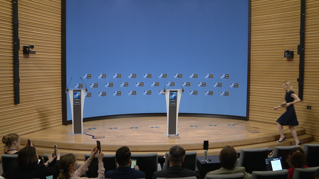
Pre-ministerial press conference by NATO Secretary General Mark Rutte ahead of the meetings of NATO Ministers of Defence in Brussels
Pre-ministerial press conference by NATO Secretary General Mark Rutte ahead of the meetings of NATO Ministers of Defence in Brussels
Pre-ministerial press conference by NATO Secretary General Mark Rutte ahead of the meetings of NATO Ministers of Defence in Brussels
Pre-ministerial press conference by NATO Secretary General Mark Rutte ahead of the meetings of NATO Ministers of Defence in Brussels
Pre-ministerial press conference by NATO Secretary General Mark Rutte ahead of the meetings of NATO Ministers of Defence in Brussels
Pre-ministerial press conference by NATO Secretary General Mark Rutte ahead of the meetings of NATO Ministers of Defence in Brussels
Pre-ministerial press conference by NATO Secretary General Mark Rutte ahead of the meetings of NATO Ministers of Defence in Brussels
Pre-ministerial press conference by NATO Secretary General Mark Rutte ahead of the meetings of NATO Ministers of Defence in Brussels
Pre-ministerial press conference of the NATO Secretary General