Fermer
Retour
Accédez aux ressources médiatiques officielles de l'OTAN. Un contenu de qualité professionnelle, diffusé sur les dernières actualités. La référence pour les professionnels des médias.
Accédez aux ressources médiatiques officielles de l'OTAN. Un contenu de qualité professionnelle, diffusé sur les dernières actualités. La référence pour les professionnels des médias.
Désormais, vous pouvez télécharger des versions complètes ou partielles de nos vidéos depuis notre site Web.
Si vous souhaitez également vous abonner à la newsletter et recevoir nos dernières mises à jour, cliquez sur le bouton ci-dessous.
Entrez l'adresse e-mail avec laquelle vous vous êtes inscrit et nous vous enverrons un code pour réinitialiser votre mot de passe.
Le mot de passe doit comporter au moins 12 caractères, sans espaces, inclure des lettres majuscules/minuscules, des chiffres et des symboles.
Cliquez sur le bouton pour revenir à la page sur laquelle vous étiez et connectez-vous avec votre nouveau mot de passe.
Mr. President,
Mr. Speaker of the Parliament,
Madam Prime Minister,
Dear Marcos,
Dear Commissioner,
Thank you very much for giving me the pleasure and the opportunity to come back to Vilnius.
I do believe that location is a message, and having this NPA plenary here today in Lithuania demonstrates the importance of the Baltic region, the importance of Lithuania for our transatlantic security.
Lithuania is vital for our shared security and essential for NATO’s deterrence and defence, but it also shows how no Ally ever stands alone in the Alliance.
Our Forward Land Forces are deployed from the Baltic to the Black Sea. Our NATO jets protect the skies here, but also across the totality of the eastern flank. NATO is ready, willing, and able to defend every inch of Allied territory.
We stand in solidarity with Romania after the drone incident last week.
And as we heard also today, our host here in Vilnius and other eastern flank Allies know too well what Russia is capable and willing to do, and how reckless their actions have become. This reckless behaviour is a danger to us all. It continues to target civilians and civilian infrastructure across Ukraine, and the consequences of Russia’s illegal war of aggression impact very directly our own security.
This is why the paramount role of NATO, our role, is to never let our guard down, especially as we know that the threat that Russia poses to our Alliance will not vanish, even with the end of the war in Ukraine.
Russia is investing 40% of its budget in defence. You don't do this if you're interested in peace. You don't do this if you are a status quo power. And Moscow is churning out military equipment around the clock.
On the other side, we also have to look at the big picture. We have to be clear about the fact that China continues to modernise its forces and expands its nuclear capabilities without any transparency, investing massively in military technology and innovation, but also enabling Russia’s war in Ukraine.
Iran has long posed a threat with its both nuclear and ballistic missile programme, and it is now trying to hold the global economy hostage by closing the Strait of Hormuz.
Therefore, the conclusion is clear. In a more dangerous and volatile world, we must invest in our security, and we have to ramp up our defences, all of us. And we have to do it together.
In just six weeks' time, Allied Heads of State and Government will meet in Ankara. The Secretary General of NATO has a clear message for the NATO Summit: we have to turn commitments into action now.
Last year in The Hague, Allies agreed to spend 5% of GDP in defence by 2035, and this was the commitments part. Ankara will be about turning cash into combat ready capabilities, significantly scaling up our defence industries, strongly supporting Ukraine. It will be all about delivering.
It's a bit like the Olympic motto: it has to be faster, it has to be higher, it has to be stronger, and we have to do it together.
In this plenary, you do represent in your democracies the 1 billion people in Europe and North America that NATO protects, and you also have the power to shape the political direction and the decisions back in your capitals.
I know from my old days in national politics, both in parliament and in government, that whenever a decision involves money and financing and budgets, discussions are always long, difficult, sometimes even painful. I do know that sometimes negotiating with our finance ministers looks like talking to a wall.
But even finance ministers now have seen that without security, all becomes nothing. No growth of GDP, no foreign or domestic investments, balance sheets become meaningless.
So this is why deciding to make defence spending a priority is really an absolute necessity.
I count on all of you to help and sustain, sustain and support the accelerating defence investment, and I count on you to support your governments to come to Ankara and to live up to our joint commitments, in order to keep all of us safe.
Let me be very clear: we are already making progress on this front. In 2025, the combined defence spending of European Allies and Canada increased by 20% compared to the previous year. This is more than 100 billion US dollars that were spent in 2025 more compared to the year before, and this is huge. So we have to appreciate the progress that we already see happening.
So NATO's deterrence and defence is strong, but it has to remain strong, it has to enhance, it has to strengthen.
We also have no doubts that our transatlantic relationship remains rock solid. For decades, there have been debates within NATO about how to rebalance our security for the better. How the burden of defence should be shared more fairly, so that we are less reliant on just one Ally. Although this is the biggest Ally, still, we believe that in order for our Alliance to grow stronger, it has to be a more balanced relationship.
America has made clear that it expects its Allies to be able to step up and carry greater responsibility for Europe's conventional defence, backed by US power. This is exactly what we see happening now, and this is exactly the goal that we have for the future, and for Ankara.
We have heard these messages from the United States during our NATO Foreign Ministerial Meeting in Sweden just two weeks ago, and we have just confirmed there, while having all the 32 Ministers of Foreign Affairs, that the trajectory that we are on is towards a stronger Europe within a stronger NATO.
So, we are seeing real increase in the capacity of America's Allies. For example, the five top investors, the five top spenders in terms of defence spending in NATO, are all European Allies.
European Allies and Canada are leading the efforts of NATO’s Forward Land Forces along NATO’s eastern flank. Seven out of eight are led by European Allies. This is what we mean when we say stronger Europe.
But we must also ensure that our transatlantic industrial base becomes stronger, because as we said, it’s not only about investing more, it is also about having the right warfighting capabilities, a lot more than we have now, and this will be the front and centre at the Ankara Summit.
The drone incident in Romania, the experiences in this region, across this region, with air violations, show the importance of strong air defences. So, we need a stronger air defence. We need jets, we need missiles, we need interceptors, we need counter drones and drone technologies to keep us safe.
And this is why we need to produce faster. We need to produce at scale.
Factories must ramp up production, diversify also supply chains and integrate the latest technologies.
We need a new and robust transatlantic defence industrial base. We must leverage the capabilities, technologies, and the know-how that our companies have, both here in Europe but also in North America.
As parliamentarians, you look at national regulations, and you can really help us get rid of any obstacles when it comes to increased defence production, but also when it comes to defence industrial cooperation.
I’m glad that today we are also joined by Commissioner Kubilius. Yesterday, we have discussed how can our two organisations work better, because we believe that this is a natural thing. We believe that we share the same challenges.
We have 23 sovereign nations in common, and 96% of the EU population lives in countries that are also NATO Allies.
We have also addressed not the challenge, but the need to involve also non-EU NATO Allies who make significant contributions to the security in Europe. Their fullest involvement in EU defence efforts remains essential in the strategic partnership between EU and NATO.
We already work on several initiatives, including our support to Ukraine, defence production, but also societal resilience.
When you combine economic might with top-notch defence and tech industries, you see why together EU and NATO have everything we need to succeed.
My last point is on Ukraine, another priority for the NATO Summit in Ankara.
Ukraine’s security is directly linked with ours. This is a sentence that we all repeat, because it is true.
And even with the many pressing security challenges we face, Ukraine remains fully on our radar, and our support must endure.
This is how we see our NATO PURL – [Prioritised] Ukraine Requirements List – initiative as essential, because it continues to deliver urgent support to Ukraine. It has already supplied around 70% of all missiles for Ukraine's Patriot batteries and 90% of all ammunition used in other air defence systems.
But we believe that more is needed, and we need this quickly. They need air defences, they need drones, they need ammunition, and they really need it right now.
So, once again, I look at you and count on you to help ensure that our support to Ukraine is sustainable, and that all Allies pull their weight.
We talk a lot about burden-sharing when it comes to defence investment, but this is also an area – and Mr. President, thank you for raising this issue, and all of you – we need more of a burden-sharing also when it comes to supporting Ukraine, because we don’t see it as a burden, we see it as our responsibility and an investment in our security.
Ukraine is not only a security recipient; it is becoming more and more a security provider.
If you look at what has happened in the last years ever since the Russian attack on Ukraine started, you will remember that when it started, they called it the special military operation. They envisaged a short one. It didn't go to plan.
And what we see these days is that Russia is suffering heavy losses because of the courage, the skill, and the expertise of the Ukrainian armed forces.
So, make no mistakes, Russia is struggling in Ukraine, and this is why they are becoming more reckless, and this is why we have to support Ukraine even more.
We are learning a lot from Ukrainian experience. They are becoming an innovation powerhouse.
And this is why today and tomorrow in Vilnius we will hold our NATO-Ukraine Defence Innovators Forum to actually talk about the opportunities, how to harness that knowledge, that expertise, that strength in the Ukrainian armed forces.
Ukraine is now the most advanced real-world laboratory for defence technology, uncrewed systems, electronic warfare, AI-assisted targeting, and much more.
So, I hope many of you will be able to join us at the Forum. Use the opportunity, explore ideas for cooperation, and go back to your capitals with concrete proposals. This will be good for Ukraine, but this will be also good for NATO.
As you can see, we have a lot of work ahead of us.
They say that the best way to predict the future is to create it. So, our role in creating this safe, secure future is by investing in our resources, investing in stronger Europe in stronger Alliance.
Thank you for supporting that goal.


NATO Deputy Secretary General Radmila Shekerinska with Juozas Olekas, Speaker of the Parliament of Lithuania
NATO Deputy Secretary General Radmila Shekerinska with Marcos Perestrello, President of the NATO Parliamentary Assembly
NATO Deputy Secretary General Radmila Shekerinska meets with Andrius Kubilius, Commissioner for Defence and Space, European Commission
NATO Deputy Secretary General Radmila Shekerinska meets with Andrius Kubilius, Commissioner for Defence and Space, European Commission
NATO Deputy Secretary General Radmila Shekerinska meets with Andrius Kubilius, Commissioner for Defence and Space, European Commission
NATO Deputy Secretary General Radmila Shekerinska with Marcos Perestrello, President of the NATO Parliamentary Assembly and Benedetta Berti, Secretary General of the NATO Parliamentary Assembly
NATO Deputy Secretary General Radmila Shekerinska with Marcos Perestrello, President of the NATO Parliamentary Assembly and Juozas Olekas, Speaker of the Parliament of Lithuania
NATO Deputy Secretary General Radmila Shekerinska with Mircia Chelaru, Member of the Senate of Romania, Marcos Perestrello, President of the NATO Parliamentary Assembly, Inga Ruginienė, Prime Minister of Lithuania and Juozas Olekas, Speaker of the Parliament of Lithuania
NATO Deputy Secretary General Radmila Shekerinska with Andrius Kubilius, Commissioner for Defence and Space, European Commission, at the Spring Session of the NATO Parliamentary Assembly
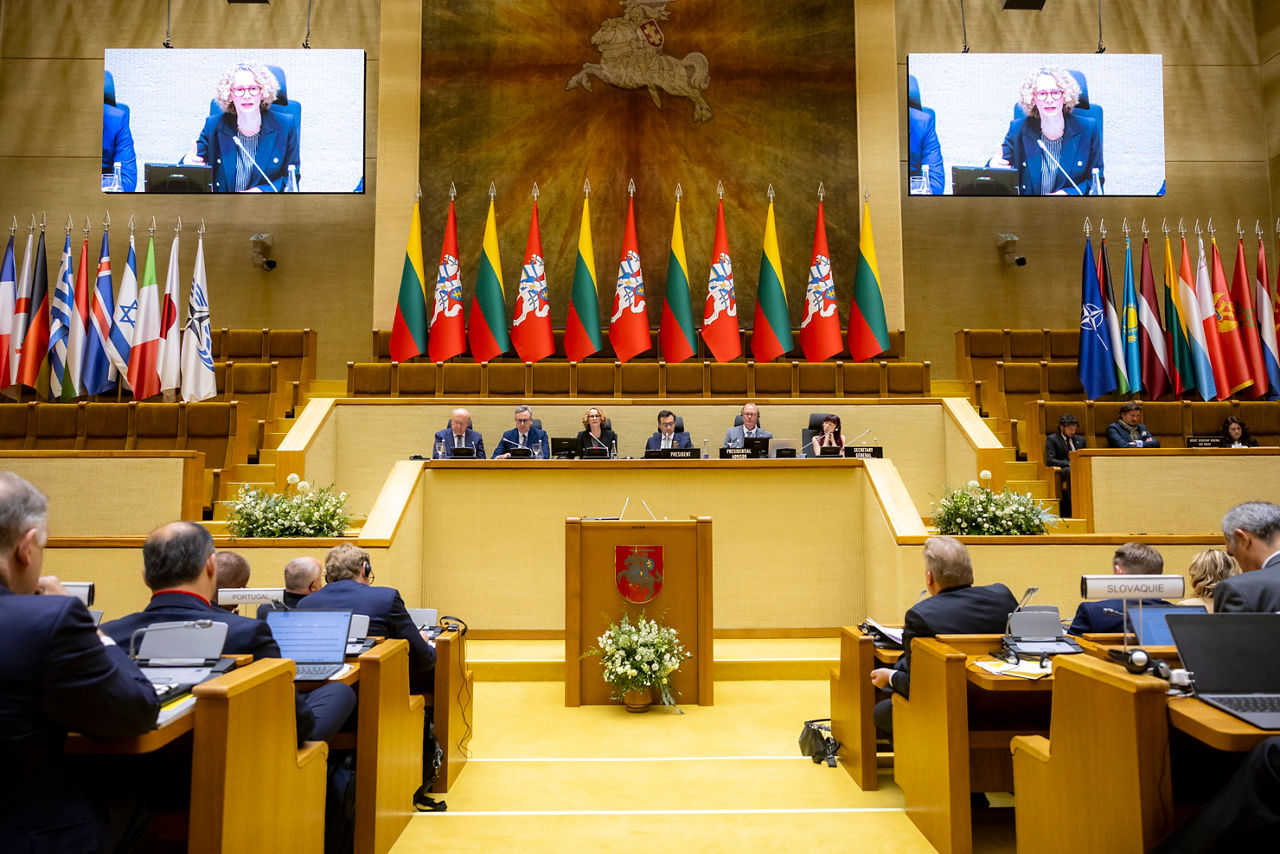
Keynote address by NATO Deputy Secretary General Radmila Shekerinska at the Spring Session of the NATO Parliamentary Assembly
Keynote address by NATO Deputy Secretary General Radmila Shekerinska at the Spring Session of the NATO Parliamentary Assembly
Keynote address by NATO Deputy Secretary General Radmila Shekerinska at the Spring Session of the NATO Parliamentary Assembly
Keynote address by NATO Deputy Secretary General Radmila Shekerinska at the Spring Session of the NATO Parliamentary Assembly
Keynote address by NATO Deputy Secretary General Radmila Shekerinska at the Spring Session of the NATO Parliamentary Assembly
Moderated discussion and Q&A session with NATO Deputy Secretary General Radmila Shekerinska at the Spring Session of the NATO Parliamentary Assembly
Moderated discussion and Q&A session with NATO Deputy Secretary General Radmila Shekerinska at the Spring Session of the NATO Parliamentary Assembly
Moderated discussion and Q&A session with NATO Deputy Secretary General Radmila Shekerinska at the Spring Session of the NATO Parliamentary Assembly
NATO Deputy Secretary General Radmila Shekerinska meets with the US NPA Delegation: Neal P Dunn, Beth Van Duyne, Rick Larsen, Michael R Turner, Brendan Francis Boyle, Donald Norcross
NATO Deputy Secretary General Radmila Shekerinska meets with the US NPA Delegation: Neal P Dunn, Beth Van Duyne, Rick Larsen, Michael R Turner, Brendan Francis Boyle, Donald Norcross
NATO Deputy Secretary General Radmila Shekerinska meets with the US NPA Delegation: Neal P Dunn, Beth Van Duyne, Rick Larsen, Michael R Turner, Brendan Francis Boyle, Donald Norcross
NATO Deputy Secretary General Radmila Shekerinska meets with Juozas Olekas, Speaker of the Parliament of Lithuania
NATO Deputy Secretary General Radmila Shekerinska meets with Juozas Olekas, Speaker of the Parliament of Lithuania
NATO Deputy Secretary General Radmila Shekerinska meets with Juozas Olekas, Speaker of the Parliament of Lithuania
NATO Deputy Secretary General Radmila Shekerinska meets with Juozas Olekas, Speaker of the Parliament of Lithuania
NATO Deputy Secretary General Radmila Shekerinska and Serhii Boiev, Deputy Minister of Defence of Ukraine at the NATO-Ukraine Defence Innovators Forum 2026.
NATO Deputy Secretary General Radmila Shekerinska and Robertas Kaunas, Minister of Defence of Lithuania, at the NATO-Ukraine Defence Innovators Forum 2026. Meeting with Serhii Boiev, Deputy Minister of Defence of Ukraine
NATO Deputy Secretary General Radmila Shekerinska and Robertas Kaunas, Minister of Defence of Lithuania, at the NATO-Ukraine Defence Innovators Forum 2026. Meeting with Serhii Boiev, Deputy Minister of Defence of Ukraine
Remarks NATO Deputy Secretary General Radmila Shekerinska at the NATO-Ukraine Defence Innovators Forum 2026
Remarks NATO Deputy Secretary General Radmila Shekerinska at the NATO-Ukraine Defence Innovators Forum 2026
Remarks NATO Deputy Secretary General Radmila Shekerinska at the NATO-Ukraine Defence Innovators Forum 2026
Remarks NATO Deputy Secretary General Radmila Shekerinska at the NATO-Ukraine Defence Innovators Forum 2026
NATO Deputy Secretary General Radmila Shekerinska and Robertas Kaunas, Minister of Defence of Lithuania
NATO Deputy Secretary General Radmila Shekerinska meets with Robertas Kaunas, Minister of Defence of Lithuania