Fermer
Retour
Accédez aux ressources médiatiques officielles de l'OTAN. Un contenu de qualité professionnelle, diffusé sur les dernières actualités. La référence pour les professionnels des médias.
Accédez aux ressources médiatiques officielles de l'OTAN. Un contenu de qualité professionnelle, diffusé sur les dernières actualités. La référence pour les professionnels des médias.
Désormais, vous pouvez télécharger des versions complètes ou partielles de nos vidéos depuis notre site Web.
Si vous souhaitez également vous abonner à la newsletter et recevoir nos dernières mises à jour, cliquez sur le bouton ci-dessous.
Entrez l'adresse e-mail avec laquelle vous vous êtes inscrit et nous vous enverrons un code pour réinitialiser votre mot de passe.
Le mot de passe doit comporter au moins 12 caractères, sans espaces, inclure des lettres majuscules/minuscules, des chiffres et des symboles.
Cliquez sur le bouton pour revenir à la page sur laquelle vous étiez et connectez-vous avec votre nouveau mot de passe.
Good morning, and it is good to see you all here in this building.
As you know this week, NATO Foreign Ministers will meet in Helsingborg, in Sweden, where we will prepare for the NATO Summit in Ankara in early July.
This will be the first meeting of NATO Foreign Ministers hosted by Sweden, and we are grateful to them for their hospitality.
As you know, Sweden is NATO’s newest Ally, having joined in 2024 after many years of military non-alignment. This says a great deal about how fundamentally our security environment has changed, especially when it comes to Europe.
It is more dangerous, more contested. And that makes it all the more important that NATO Allies work together to safeguard our freedom and security.
Russia remains the most direct threat to Euro-Atlantic security. It continues to wage a brutal war of aggression against Ukraine. At the same time, Allies face persistent and growing attempts to undermine our security and stability including cyber-attacks, sabotage, and threats to our critical infrastructure.
And this is why Allies took a historic decision on defence investment in The Hague. And it is why Ankara will be about delivering on our commitments.
The question is no longer whether we need to do more.
The question is how quickly Allies can turn commitments into capabilities.
In Helsingborg, Foreign Ministers will help prepare the Summit in Ankara.
They will discuss how we are delivering on the defence investment plan agreed in The Hague; strengthening our warfighting capabilities; and ramping up defence industrial production on both sides of the Atlantic.
We need a credible path to deliver the commitments agreed in The Hague. A credible path means steady, sustained increases in defence investment. Allies are already investing more. Much more. And we see many working to accelerate the pace of investment. To chart an ambitious but achievable trajectory to the investment we know we need.
And delivering means not only getting the budget right. But ensuring the investments yield capabilities. So that our militaries have what they need to deter and defend – more air and missile defence, more long-range strike capabilities, more drones, more ammunition, and larger stockpiles.
This means we need to produce faster and at a greater scale – on both sides of the Atlantic.
NATO is – and will always be – a transatlantic Alliance.
Part of keeping this Alliance strong involves shifting responsibilities. Moving away from unhealthy over-reliance on one Ally to a fairer sharing of the responsibility for our collective security.
Europe and Canada are stepping up. They are investing more, and taking on more responsibility for conventional defence. And, as anticipated, the United States is also adapting.
We see this not only as the US adjusts its force posture in Europe. But in the new distribution of leadership roles for example in NATO’s Command Structure – where Europe will lead all three Joint Force Commands, while the US will lead the three component commands.
We will continue to see this transformation to a stronger Europe in a stronger NATO: NATO 3.0.
A stronger NATO, with a healthier, more sustainable division of responsibilities to deliver the security we all need.
In Helsingborg, we will discuss our continued strong support for Ukraine – another priority for the Ankara Summit. Ukrainian Foreign Minister Andrii Sybiha will join us tomorrow evening in Sweden.
Ukraine’s security is directly linked to our own security. Ministers will discuss how to ensure support for Ukraine remains substantial, sustainable, and predictable – and based on Ukraine’s requirements.
PURL remains an important mechanism for delivering urgent support to Ukraine. Allies continue to contribute -with the most recent announcements of more than half a billion dollars from Norway and Canada.
Since the launch of this initiative last summer, PURL has supplied around 70% of all missiles for Ukraine’s Patriot batteries, including PAC-3, and 90% of the ammunition used in other air defence systems. This support continues to flow.
But we must to build on this further, and ensure that Allied support remains sustainable for the long term.
We continue to see the impacts of the war Russia is raging against Ukraine.
Just yesterday, as part of NATO's Baltic Air Policing, Romanian F-16’s downed a drone over Estonia. This was a Ukrainian drone, but it wouldn't have been there but for Russia's aggression.
The key is that NATO's air defences were effective yet again and we will continue to improve our capacity to address any threat to our territory or to our people.
Ministers will exchange views on key developments affecting Allied security, including in the Middle East.
As I reflect on current developments, I see two distinct situations – both of which carry significant implications for our security. On one hand, there is the US effort to ensure Iran doesn’t obtain nuclear weapons – and a nuclear Iran is an outcome the NATO Alliance and the broader international community has long deemed unacceptable.
On the other, Iran is trying to hold the global economy hostage by closing a vital waterway on which much of the world depends – especially many NATO Allies and partners. This is a direct assault on freedom of navigation and global commerce. Importantly, we are now seeing many countries coming together around plans to ensure freedom of navigation. Some are moving assets to the region including France, Belgium, the Netherlands, Italy, Germany, the United Kingdom, and others. And this preparation is key to ensure that the Strait can be open for transit.
And as we discuss the current situation, we will also discuss how to further strengthen cooperation with NATO’s partners in the Gulf region.
So, our meeting in Helsingborg will have a broad agenda – but the central theme is clear.
The central theme is delivery.
Delivery of our deterrence and defence, of a stronger, fairer NATO, delivery of support for Ukraine, and ultimately of the security of one billion people across the Alliance.
And with that, I am ready to take your questions.
Andrea Palasciano, Bloomsberg News
Secretary General, hello Andrea Palasciano from Bloomberg News. I want to ask you about the situation in the Middle East. You mentioned that a lot of Allies have join interests in the Strait of Hormuz. At which point, and under which conditions, would NATO be ready to consider further involvement under a NATO flag, and what could that look like, and what's the timeline? Thank you.
NATO Secretary General Mark Rutte
Well, let me first acknowledge the fact that European and Canadian Allies have heard the US call for action. We have basically seen, not basically, we have seen from day one, from day one, thousand of flights taking off from European bases, in basically in support of US operations, and this was all aligned and in line with bilateral commitments. And this is all over Europe, it's massive: it's restocking, it is refuelling, etc. And then to your question, when it comes to the Strait, you now see Allies increasingly reacting to the call for action, hearing the call for action when it comes to pre-positioning crucial assets close to theatre. And of course, this Alliance always has debates and discussions going on, how we can, yes or no, have a potential contribution, as NATO, to whatever is happening. Also, in my mind, these are informal discussions. But hey, the situation is dynamic, the situation is continuing to develop, and we are continuing to monitor.
Matteo Bagnoli, Ansa
Yes. Hi, Matteo Bagnoli, Ansa. Thank you for taking my question. Secretary General, next week the European Foreign Affairs Ministers are convening in Cyprus, and one of the key issues there is to find out which red lines are for Europe for possible direct negotiations with Russia. Do you support a direct negotiation process between Europe and Russia? And secondly, one of the names that is being floated as a possible European negotiator is Mario Draghi, who seems to be the solution for every problem in Europe. Would you...
NATO Secretary General Mark Rutte
He’s amazing.
Matteo Bagnoli, Ansa
Would you support him as a possible European negotiator?
NATO Secretary General Mark Rutte
Mario Draghi is a close personal friend, but I'm not going to comment on whoever should take that role. I think first the EU has to decide on what role it will play, it wants to play, and then if the answer is yes, there has to be a debate on who can play that role. But I really leave that with the European Union. I think it's really for them to decide, not for me to comment.
Andrew Gray, Reuters
Good morning. You have said that you have a no-surprises agreement with President Trump in terms of the transition to a greater European role in NATO. But what we've seen over the last couple of weeks is repeated surprises over this announcement about a drawdown of US troops. First, it was meant to be coming from Germany, now it's meant to be coming from Poland. Nobody's very clear about the numbers, even the Polish government doesn't seem to know what's happening, and NATO itself said it was seeking to clarify with the US when it made the initial announcement. So, doesn't this mean that it's not no-surprises, it's turned into surprise central, and that undermines your deterrence?
NATO Secretary General Mark Rutte
I will answer your question, but let me first zoom out for a few — not for a few minutes, I won't be that long — but let me first zoom out, and then I'll get to your question. What is happening at the moment, and this is taking place now since February last year, is that the Europeans and the Canadians are massively stepping up in terms of defence spending. As I mentioned before, Germany will spend by 2029 over 150 billion euros, that's over 175 billion dollars, twice as much as in 2021. We see this all over Europe, my country, the whole of the European Allies, and Canada — the whole of the Alliance on 2% and including the bigger economies. So, this is massively taking part at this moment happening.
You heard the US Vice President yesterday. I totally agree with him. Europe has to take a bigger role. Europe will take a bigger role together with Canada, a stronger Europe in a stronger NATO, taking more of the responsibility for the conventional defence. And yes, the US will stay involved in Europe, also over time, of course, when it comes to nuclear, but also when it comes to the conventional. Against that background, we know that adjustments will take place. The US has to pivot more towards, for example, Asia. This will take place over time, in a structured way. What you have clearly heard yesterday from the Supreme Allied Commander, from General Grynkewich, when it comes to this announcement, the 4,000-5,000, it is rotational forces not having an impact on NATO's defence plans.
Max Delany, Agence France Presse
Thanks so much, Secretary General, Max Delany, AFP. Just following up on this subject, you said “structured”, but this seems anything but structured. So, how do you respond to this notion that this is punitive, impulsive, from President Trump against Germany for speaking out against him? And then, secondly, on a related note, this new Force Model is expected to be agreed on by defence policy people on Friday. The US is widely expected in Europe to massively reduce the number of its forces. Do you expect them to reduce the number of forces available to SACEUR, and what message will they send over the US commitment to Europe?
NATO Secretary General Mark Rutte
Hey, the NATO Force Model and the US contribution to the NATO Force Model, this is a debate which started again a year ago. This is why Europe is spending so much more to basically end the over-reliance on one Ally when it comes to defence of the totality of NATO territory. This is why European and Canadian Allies are increasing their spending, increasing their capabilities, massively investing in the defence industrial base on both sides of the Atlantic. When it comes to the NATO Force Model, we have the processes in place. This is normal business. So, this was to be expected. I think it is only right that it happens. What exactly will be the announcement — you have to wait until later. I'm not allowed to disclose that, but I think this is exactly as we expected, and absolutely within the realm of the no-surprises approach.
Milda Vilikanskytė, Lithuanian Public Broadcaster
Thank you. Hello, Secretary General. Milda Vilikanskytė from Lithuanian Public Broadcaster. You mentioned yesterday's incident in Estonia. Today, we had an incident in Lithuania. Also, drone citizens got code red alerts to their phones. They went to shelter. I know that it is mostly national responsibility to intercept, to find those drones, but unfortunately it looks like countries on their own are not capable to do that successfully. So, could we say that fighter jets are still the only, the main option to shut down drones? Or do NATO have algorithms how to do that? And second question on that, do you have information that Russia overtake those Ukrainian drones and navigate them to Baltic States on purpose? Thank you.
NATO Secretary General Mark Rutte
Well, let's look at what happened over the last couple of days. This is exactly what we planned and prepared for: a calm, decisive and proportionate response to these drone incursions. And if drones come from Ukraine, they are not there because Ukraine wanted to send a drone to Latvia, Lithuania, or Estonia. They are there because of the reckless, illegal, full-scale attack of Russia starting in 2022 after, of course, what they did in Crimea in 2014 against Ukraine. This is why this is happening. And as you have seen yesterday, on the 19th of May, was that yesterday or the day before, it was a Romanian F-16 fighter jet from NATO's Baltic Air Policing mission in Lithuania shooting down this drone over Estonian airspace. So, this is exactly what we planned and prepared for.
When it comes to your broader question about how can you best counter drones, this depends, of course, on the situation. I will not comment on in what situation you need fighter jets or other systems. But, more generally speaking, as you know, part of Eastern Sentry is not only to bring together all our capabilities on the Eastern flank, but also to be able learning all the lessons from Ukraine and the drone war Ukraine is fighting against Russia successfully, to incorporate those lessons in NATO systems, models, and approach. Because in the end, we have to be conscious of the fact that warfighting has changed and Ukraine is showing this every day.
Milda Vilikanskytė, Lithuanian Public Broadcaster
Do you have information that Russia overtook the drones?
NATO Secretary General Mark Rutte
I have no information on that, no, no, I don't have information on that.
Zoriana Stepanenko, Radio Free Europe's Ukrainian service
Thank you so much for giving me the floor. Zoriana Stepanenko, Radio Free Europe's Ukrainian service. Secretary General, following up to the question of my colleagues, Russia insists that Latvia is giving its territory to Ukraine in order to launch the attacks on Russian territory with the drones, and claims that NATO membership will not protect Latvia from the possible retaliation by Russia. In this context, Russia's representative at the UN Security Council even referred to the decision-making centres in Latvia. So, my question is, what is your reaction to the spread of such claims about NATO Ally, and what is your reaction to the threats coming out from Russia? So, should they be taken seriously? Or this is just yet another example of that...
NATO Secretary General Mark Rutte
That Russian claim is totally ridiculous, totally ridiculous, and Russia knows it.
Serife Cetin, Anadolu Agency
Thank you very much, Secretary General. I'm Serife Cetin from Anadolu Agency. You've mentioned it yourself during your statement, I think it wouldn't be an over exaggeration to state that the Alliance is facing threats not only externally but internally as well, and views are evolving that the Summit in Türkiye will actually be one of the most important, consequential Summits in the history of the Alliance. You recently revisited Türkiye yourself, so I'd like to know what your expectations are for the Ankara Summit, and do you think NATO can emerge stronger from this Summit? Thank you.
NATO Secretary General Mark Rutte
Yes, I already think NATO is stronger than a year ago. Look at what the European and Canadian Allies are doing in ramping up their defence spending, taking more control of the conventional defence of this part of NATO territory, and therefore making it possible for the US indeed to pivot also to other interests, which we completely share. When it comes, for example, to the Indo-Pacific, it is crucial, of course, that US is able also to open up resources to do more in the Indo-Pacific if they so wish. But it has to be done in a controlled way over time, exactly as the senior American politicians, including the Vice President and the Secretary of Defence, have stated. And this is taking place. It is ending the over-reliance on one Ally. It is also equalizing the defence spending in Europe and Canada with the defence spending in the United States. We talked about this for 30, 40, 50 years, basically since Eisenhower, and it took us all the way to Trump 47 to solve this, last year in The Hague: the 5% defence spending commitments and Allies are delivering, the defence spending last year was increasing by 20% in Europe and Canada, there's a lot of money. So, I think we are in a better shape, and you will always have internal debates. This is an Alliance of democracies. There will always be discussions. That's unavoidable. I even think it is the strength of this Alliance.
When it comes to Türkiye and the Summit, I want that Summit to really focus on the biggest issue we are facing today. The biggest issue we are facing today, when it comes to Alliance policy, is how can we not only ramp up spending, but then morph that into, transfer that into more defence industrial output. I'm meeting today with financial capital firms when it comes to defence spending. I was meeting yesterday with industry. I will meet again with industry in a couple of weeks. You have seen the American President, President Trump, meeting with the primes, the big primes in the United States, being very clear that he wants to quadruple, then to quadruple, the defence industry output. I completely support that policy. I have my own conversations with American companies, European companies, Canadian companies. And when I talk Europe, including Türkiye and the UK and Norway and European Union, we have to do more because we know there is a massive need for increase in defence industrial production. What I expect in Ankara is really again a splash like we had in The Hague. The Hague splash was about defence spending. The Ankara Summit has to be about really, now, moving the needle substantially when it comes to defence industrial production.
Dan Michaels, Wall Street Journal
Thank you very much. Dan Michaels, hi. Good morning. Can I follow up on your comment just now? So, we're now years into the war in Ukraine, and a lot of these conversations are very similar to the ones that were happening in 2022. So, from all your discussions, can you explain to us why it is taking so long for industry to ramp up? Thank you.
NATO Secretary General Mark Rutte
Yeah, I think there are many reasons. I think part of it is that the defence industry sometimes is requiring 5- to10-year long-term contracts, which is very difficult. In the US system, you basically are working from on a yearly cycle. In the European system, you work from elections to elections, so basically 4- or 5-year cycles. So, it is difficult to give those long-term demand signals. But what I am telling the industry is this: seeing that we are now collectively moving to the 3.5% core defence spending, 5% overall defence spending, this means hundreds of billions extra coming in when it comes to spending on the defence industrial output.
So, there are business women, business men in the senior positions in this company, so put in the extra production lines, put in the extra shifts, make sure the output is there, not at higher prices, at lower prices preferably, but at least not at higher prices, and also please realise this money comes from the taxpayer. So, when the American President was quite critical with one of the primes in the US saying, ‘hey, you get a big kickback from your own company in terms of a bonus, great if you are a purely commercial company, but hey, you are very dependent on taxpayer money,’ so it is difficult to explain to the taxpayer why a CEO of a big defence industrial company would get such a high salary.
So, I think he was right there. The same debates we need to have in Europe. What I'm seeing, however - this is the positive when I speak with the defence industrial companies - is that they are going through that change in mindset. The mindset shift is taking place. They understand this is crucial, that we need more, for example, PAC3, Patriot systems, F35s, and when it comes to the European defence industrial base, we need more SAMP/Ts, and ASTER 30s, more tanks, jets, etc. Behind this, of course, there's a big other issue, which is making sure that the fuel is there, that the supply is there, the supply chain is functioning. So, there is more than only the defence industrial base, it is also everything before it, and of course, the financial sector which is also turning the corner. Only two, three years ago, it was difficult for them to see the difference between drugs and pornography, versus investing in defence. Now they understand the difference, and they are doing it.
Bogdan Isopescu, Radio Romania
Could you share more details about the incident yesterday in Estonia? I'm asking that because in Romania we didn't manage to engage any drone, although we had a lot of incidents in the last two years, but in Estonia we did. Thank you.
NATO Secretary General Mark Rutte
No, I can't, because that is really, of course, confidential. Let me just say, you are from Romania. It was Romanian F-16s who basically were able to down, shot down, a drone over Estonian airspace, part of this Baltic air policing mission in Lithuania. So, I think you can be proud of that. And I know that Romania itself, and I was visiting last week Bucharest, where we had a meeting with the two Presidents of Romania and Poland, and then the next day the meeting with the B9 and the Nordic countries, and obviously this is on the agenda. How can we become better and better in countering drones, and this is one of the reasons why we have Eastern Sentry. This is one of the reasons why Eastern Sentry goes all the way from the High North to the Black Sea, covering the whole of the Eastern flank to become better and better, learning from Ukraine when it comes to drone technology and also counter-drone technology.
Iryna Somer, Interfax Ukraine
A question regarding Russian big nuclear exercises, also with Belarus involvement. What is your assessment, how actually you read it, what kind of signal it sends, and do you see a possibility from your point of view that Russia can use a nuclear weapon in its war against Ukraine? Thank you.
NATO Secretary General Mark Rutte
Well, they know if that happens, the reaction is devastating. And when it comes to these exercises, of course, we follow them, we monitor what is happening, and that's it.
Stephan Israel, Table Media
Thank you very much, Stephan Israel, Europe Table. It might well be that the war in Iran is not finished until the Summit in Ankara. How do you see a request by US President Trump coming up there with the request that NATO Allies, or NATO, is involved in an operation to secure the Strait of Hormuz? Secondly, on the burden sharing for the support of Ukraine, there is a push by certain member states who give a lot to create more transparency to show those who give and those who don't give. How do you see this initiative?
NATO Secretary General Mark Rutte
On the second question, it's true that there is a bit of an imbalance on quite a number of countries giving some support to Ukraine, but a few countries, a limited amount of countries, doing the bulk of the support. For example, when it comes to PURL, so this is the flow of crucial US gear into Ukraine, still going on, including crucial interceptors for Patriot systems defending Ukrainian cities and defending the Ukrainian crucial infrastructure, and we know Ukraine is doing quite well when it comes to the war on the front and the drone war.
But of course, we have to make sure that the cities and the infrastructure are also protected. And there is, I think, not enough of a balance between the countries in NATO who spend money on this, and we are working on that to rebalance that. The good news is that the money is there to keep the flow going. That was the deal with the US. They would keep on supporting, and Europeans and Canadians would pay for it. That was the deal we struck on July 14 last year, and the US is delivering day in, day out. The money is there, but again I would love to see a better sharing of the burden when it comes to this.
On the first question, as I said before, just briefly, when I was in the White House in April, I sensed disappointment when it came first to the Europeans opening up their bases for US operations in this case. And I think what you have seen from day one is that the bulk of the European countries who could do this have opened up their bases, basically implementing bilateral commitments they had struck with the US over time. And this is literally thousands of flights taking off. This is quite massive. I was in Romania last week in Bucharest, I saw the tankers there on the airport, the US tanker planes, and really massively there. But this is happening all over Europe, including the big countries, but also many smaller nations, including Romania and Bulgaria, and also Croatia, North Macedonia, many of them supplying, basically delivering on their, on their commitment. So that was one part.
So, I think Allies from day one heard the call of [the US]. And the second one was this issue of pre-positioning, and that is now taking place. I mentioned all the countries who are now pre-positioning, for example, when it comes to mine sweeping, demining, mine hunting, whatever you call it. There's a lot of capacity there in Europe, but you also have seen the Charles de Gaulle, who is now closer to theatre, so there's a lot happening when it comes to pre-positioning.
Alexandra Voudouri, Kathimerini
Secretary General, Alexandra Voudouri with Kathimerini. A follow-up of my colleague’s question regarding specifically the Strait of Hormuz, given that the conditions under which NATO could consider operating in the Strait of Hormuz are a political decision, as NATO SACEUR said yesterday. Are you planning to raise yourself this issue during the meeting of Foreign Affairs ministers in Sweden, and are you politically directing this possibility? And do you think that it could be feasible, especially since the joint effort that you just mentioned, led by France and the UK, towards this end is progressing? Thank you so much.
NATO Secretary General Mark Rutte
Well, as you know, in NATO, everything is always being discussed, everything thinkable, every question you ask, discussions are ongoing, and I personally always am thoughtful and thinking of whether NATO can play a positive role when it comes to, or a constructive role, potential constructive role in cases like this, but these are discussions. And these take place against the background, of course, of the fact that the situation is dynamic. That's why we continue to monitor the situation. So, I'm not particularly speaking about next Friday's meeting, but generally, of course, discussions are always ongoing.
Sachiyo Sugita, NHK
Sachiyo from NHK, the Japanese Public TV Station. Good morning. I would like to ask about the summit between China and Russia today, but it's been reported that China is training Russian soldiers on drone warfare, and some of the trained are now fighting in Ukraine. So, what is your assessment on this, and do you have any concerns about the increased involvement of China in the Ukraine war?
NATO Secretary General Mark Rutte
Let's not be naive. What's happening here? What's happening here is that since, basically 2022, we see China and Russia and North Korea and Iran working closely together. It is one of the reasons why, in NATO, on the US side, the Canadian side, the European side of NATO we are conscious of the fact, yes NATO is a transatlantic alliance, but given the fact that Russia is working together with China, North Korea, and Iran we have to make sure that we have strong relations with partners outside NATO territory.
This is one of the reasons why my Chief of Staff was recently in Japan, why I was myself visiting Japan a year ago, why we have intensive conversations with the Republic of Korea, with Australia, with New Zealand, the Indo-Pacific Four, working on innovation, defence industrial base production, etc. But also exchanging information and insights, etc. particularly when it comes to the war in Ukraine. So, hey, we know China was active in sanction circumvention, in delivering dual-use goods. We knew already that was taking place. So, I've never been naive about China's role when it comes to Russia's war against Ukraine.
Niels Goedegebuur, ANP
Following up on Stephan's question, if I may, you're proposing, you're advocating this idea of Allies, European Allies, spending a quarter percent of their GDP for the support of Ukraine, right? Do you think this proposal will fly, and why not? And do you see any other options to encourage Allies to share the burden more equally?
NATO Secretary General Mark Rutte
Yeah, it's my role sometimes to bring some bold proposals to the table, and sometimes they will not be accepted. I don't think this one will be accepted because there's a lot of opposition against this fixed 0.25. I have to be honest about that, but why I did it is I want a debate. Because your country, the Netherlands, but also Germany and Denmark and Sweden, Norway, Canada, and these other countries, when it comes, for example, to these PURL packages, are doing the heavy lifting, and this is crucial stuff. Ukraine cannot survive without this crucial flow of US gear, industrial output into Ukraine, including anti-missile systems and anti-missile interceptors. So, this is crucial stuff. I think what I was able to get to making that proposal is at least now getting that discussion clearly and squarely on the table, and I also want Allies between themselves to be quite honest with each other, that they expect all of us to share, share the burden.
Antonio Fumagalli, Neue Zurcher Zeitung AG
Thank you very much, Antonio Fumagalli. Just a question about what you just said. You said it's normal to have internal debates within an Alliance, and it's even the strength of the Alliance. So, would you qualify it as a normal internal debate when the strongest member of an Alliance calls NATO a paper tiger and even threatens of pulling out. Thank you.
NATO Secretary General Mark Rutte
When you look at the last three four months, and this is true for every year, and every three four months past, you will see many things being commented, and I'm not going to comment on every comment. What I'm looking at is the bigger picture, and the bigger picture is, going back to the American President, and yesterday also the American Vice President Vance, clearly stating that they expect, rightly, for Europe and Canada to take a bigger responsibility for the conventional defence of NATO, and particularly, of course, the European part of NATO. And that's taking place. The US will stay involved, as General Grynkewich said yesterday, over time, it will lead to probably more US resources pivoted more towards other theatres, and that's necessary.
We support that, but it has to be done in a way where the overall deterrence in defence stays strong, and so I'm not commenting on everything everybody says, but generally speaking, the direction of travel of NATO at this moment is a healthy one. Hey, Europe is with the UK and Türkiye, and with Norway is over 500 million people. We are facing an adversary in Russia of about 120 to 140 million people, and we are now overly dependent on one Ally with about 350 million people making sure that we can defend ourselves against Russia. That's not sustainable long-term, and that one Ally cannot keep this, keep explaining this to his own public.
So, it is only right that where this debate took place for years, and this is why I praise President Trump, that in the Summit in The Hague he booked, I think his biggest foreign policy success of 2025 which is the whole Alliance getting to 5% necessary to, yes, equalize with the US, but also to make sure that Europe can take a bigger responsibility for its own conventional defence, which is totally logical. We are so rich here, that it we cannot do it. Who could? And we can, and we will.
Allison Hart, NATO Spokesperson
Thank you so much for joining us. We hope to see some of you in Sweden on Friday.


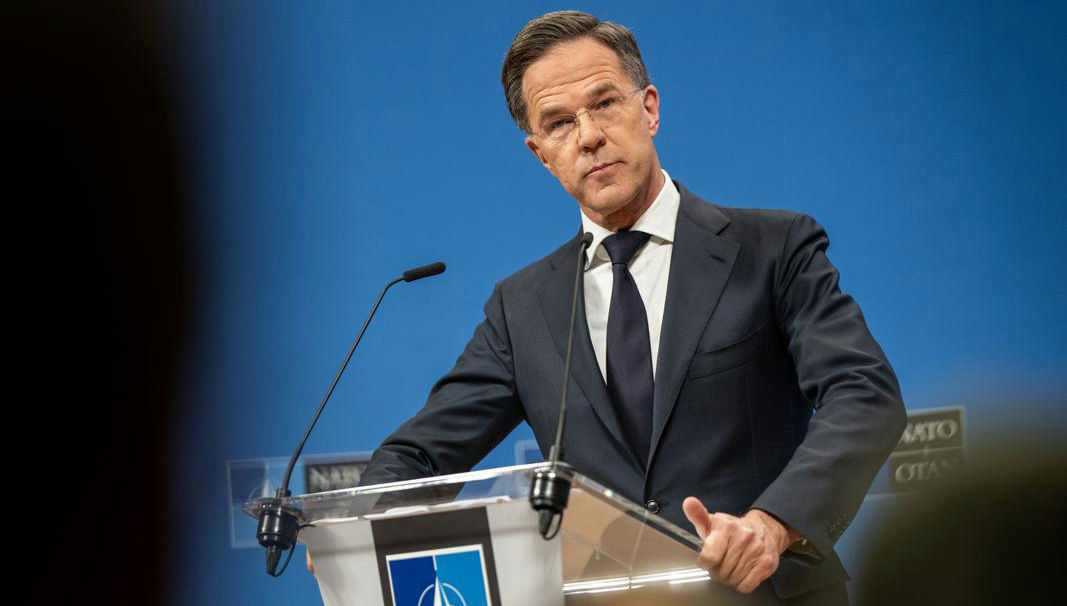
NATO Secretary General Mark Rutte briefs the press ahead of the meeting of NATO Ministers of Foreign Affairs
NATO Secretary General Mark Rutte briefs the press ahead of the meeting of NATO Ministers of Foreign Affairs
NATO Secretary General Mark Rutte briefs the press ahead of the meeting of NATO Ministers of Foreign Affairs
NATO Secretary General Mark Rutte briefs the press ahead of the meeting of NATO Ministers of Foreign Affairs
NATO Secretary General Mark Rutte briefs the press ahead of the meeting of NATO Ministers of Foreign Affairs
Pre-ministerial press conference of the NATO Secretary General