Fermer
Retour
Accédez aux ressources médiatiques officielles de l'OTAN. Un contenu de qualité professionnelle, diffusé sur les dernières actualités. La référence pour les professionnels des médias.
Accédez aux ressources médiatiques officielles de l'OTAN. Un contenu de qualité professionnelle, diffusé sur les dernières actualités. La référence pour les professionnels des médias.
Désormais, vous pouvez télécharger des versions complètes ou partielles de nos vidéos depuis notre site Web.
Si vous souhaitez également vous abonner à la newsletter et recevoir nos dernières mises à jour, cliquez sur le bouton ci-dessous.
Entrez l'adresse e-mail avec laquelle vous vous êtes inscrit et nous vous enverrons un code pour réinitialiser votre mot de passe.
Le mot de passe doit comporter au moins 12 caractères, sans espaces, inclure des lettres majuscules/minuscules, des chiffres et des symboles.
Cliquez sur le bouton pour revenir à la page sur laquelle vous étiez et connectez-vous avec votre nouveau mot de passe.
13 février 2016
4 MIN DE LECTURE
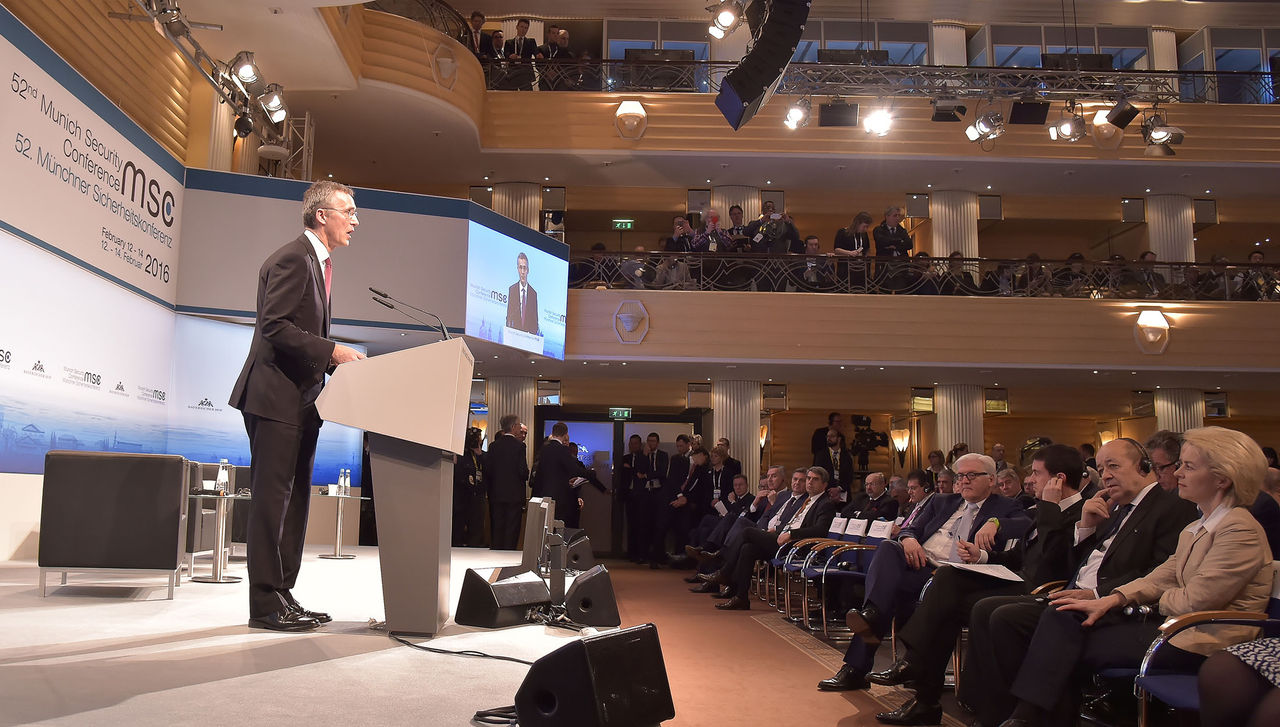
Thank you, Wolfgang, for that kind introduction.
And for making Munich such a vibrant forum for debate.
This is even more important at a time of such turmoil and uncertainty, stemming from both the east and the south.
This week, NATO defence ministers took important decisions to address challenges from the south.
We agreed to deploy a Standing Maritime Group to the Aegean to assist in tackling the refugee and migrant crisis in Europe.We decided to intensify intelligence, surveillance and reconnaissance at the Turkish-Syrian border.
And we agreed to step up our support for the international coalition to counter ISIL.
I´m happy to take questions on these issues afterwards
But now, I want to focus on the challenges from the East.
Russia is our largest neighbour and an international power.We have seen a more assertive Russia.A Russia which is destabilising the European security order.
NATO does not seek confrontation.We do not want a new Cold War.At the same time our response has to be firm.
So how do we square this circle?
I strongly believe that the answer lies with both more defence and more dialogue.
Pursued together, they can help us to achieve greater stability in Europe.
Let me start with defence.
Russia’s actions in Ukraine have triggered a robust response from the international community.Involving sanctions, suspension from the G-8, and increased support for our eastern partners.
And NATO is undertaking the biggest strengthening of our collective defence in decades.To send a powerful signal to deter any aggression or intimidation.Not to wage war, but to prevent war.
And this is why deterrence is a key part of our overall strategy.
Modern deterrence must deter today’s threats, not yesterday’s.
Whether they come from the east or the south.from state or non-state actors.hybrid, conventional or nuclear.
Deterrence starts with resolve.
It’s not enough to feel it.You also have to show it.
This week, NATO Defence Ministers took important decisions in that respect.We agreed to enhance our forward presence in the eastern part of the Alliance.
This presence will be multinational.
To make clear that an attack against one Ally will not just be met by national forces, but by forces from across the Alliance.
It will be rotational and supported by a programme of exercises.With the right infrastructure andpre-positioning of equipment to facilitate rapid reinforcement.
In a clear sign of Allied solidarity, theUnited States has set out plans to significantly increase their military presence in Europe.With more troops,more exercisesmore pre-positioned equipment.
At our summit in Warsaw in July, I expect NATO Heads of State to decide to further strengthen the Alliance's defence and deterrence.
Our deterrence also has a nuclear component.
Russia’s rhetoric, posture and exercises of its nuclear forces are aimed at intimidating its neighbours.Undermining trust and stability in Europe.
For NATO, the circumstances in which any use of nuclear weapons might have to be contemplated are extremely remote.But no one should think that nuclear weapons can be used as part of a conventional conflict.It would change the nature of any conflict fundamentally.
NATO has continued to reduce the number of our nuclear weapons.We keep them safe, secure and effective.For deterrence and to preserve the peace.Not for coercion or intimidation.
Our policy on ballistic missile defence has also been clear all along.
It is purely defensive.Designed to defend our territory, our people and our forces against threats from outside the Euro-Atlantic area.
NATO’s missile defence is neither designed nor directed against Russia.It does not – and cannot – undermine Russian strategic deterrence.
Moreover, we have offered Russia cooperation on missile defence.We remain transparent as we continue to develop our programme.
In response to Russia’s actions, we are significantly strengthening our defence and deterrence.
Some are concerned that we are sleepwalking towards escalation with Russia.
I understand those concerns,but I do not share them.
We strive for a more constructive and cooperative relationship with Russia.
We see defence and dialogue as complementary.
Dialogue has many dimensions.Russia is a permanent member of the United Nations Security Council.
And Russia played a constructive role in the Iran nuclear deal.
Allies engage with Russia bilaterally and in multilateral organisations such as the OSCE.
The NATO-Russia Council is another important forum for dialogue with Russia.
We need dialogue for a number of reasons.
It is important to promote strategic stability.To clearly communicate our intentions, our posture and our expectations to Russia.Dialogue is important to increase transparency and predictability, and to reduce the risk of incidents and accidents.And if they do happen, to avoid escalation between our forces.The downing of the Russian fighter plane over Turkey underlines how urgent this is.
I believe we should update our mutual inspection regime.And the reporting of our military exercises.Including those held at short notice.
We publish a schedule of Allied exercises on our website.I invite Russia to do the same.
And finally, dialogue is important for those issues where our differences run deep, like Ukraine.
Especially when times are as difficult as they are now.
We have clear principles.Borders must not be violated.Sovereign nations have the right to chart their own course.These principles are fundamental for European security.It is essential that we engage with Russia.The NATO-Russia Council is a good place to have a more substantive engagement.
Yesterday I met with Minister Lavrov, and we agreed to explore the possibility for convening a meeting of the NATO-Russia Council.
Ladies and Gentlemen,there can be no choice between defence and dialogue.To ensure long-term stability in Europe, we need both.
And given the complex security environment we face today, I believe we need more defence and more dialogue.
Political engagement does not mean a return to business as usual.We are in a new reality with Russia.
But we do need a constructive dialogue.
And that begins when we stop talking past each other, and start talking with each other.