Close
Back

From now on you can download videos from our website
If you would also like to subscribe to the newsletter and receive our latest updates, click on the button below.
Enter the email address you registered with and we will send you a code to reset your password.
The password must be at least 12 characters long, no spaces, include upper/lowercase letters, numbers and symbols.
Click the button to return to the page you were on and log in with your new password.
Thank you so much for that, and good morning to all of you.
And good morning, Ambassadors. I see so many here, so many friends. Matt Whitaker is here, Ambassador to United States to NATO, my good friend, and so many other faces I know so well. So, we are really among friends this morning.
And it is a pleasure to be back in the United States, and particularly to be back here in Washington D.C.
And yes, I am such an admirer of the 40th President of the United States, Ronald Reagan, and I am particularly honoured to be with you today – at the Reagan Institute.
“…if peace is to have a chance, if the hope for freedom is to be kept alive, the United States must play a powerful and active role in world affairs.”
When President Reagan offered those words at a gathering of the Reserve Officers Association on January 27, 1988, the world was a very different place.
The Berlin Wall still held people’s hopes and dreams captive. More than 100 million men, women, and children lived in European countries behind an Iron Curtain.
Those differences notwithstanding, what President Reagan knew then, and what I know today, is quite simple: American leadership is absolutely essential if freedom is to be the rule and not the exception.
As Prime Minister of the Netherlands and now as Secretary General of NATO, I have developed an unflinching appreciation for the value of American leadership.
And yes, I was raised with Ronald Reagan. He was my youth time President. And I still remember how important he was for so many people in Europe, because in the end under Bush, his successor, the Cold War ended. It ended by winning it. And it was won by Reagan and, can I add, Maggie Thatcher. And the two of them working in conjunction, making the whole world safer and ending the Cold War. And I think everybody in Europe and everybody in the world should be eternally grateful to that leadership.
But I have also had the opportunity to reflect on what happens when America’s Allies take that leadership, that US leadership, for granted.
In the years following President Reagan’s address to those reserve officers, as we entered the so-called “end of history.” While those newly free sought a path into NATO and began to build their own capacities to contribute to our shared security, other European Allies shifted away from decades of investing in conventional military partnership with the United States during the Cold War, in favour of an unhealthy co-dependence.
So convinced that peace was permanent and didn’t demand the investment we now know is essential, Western European forces shrank and defence budgets shrivelled into irrelevance. Overreliance on the notion that security was just the new norm, and the United States would take care of any threats further afield, caused us Europeans to imagine that hard power was something to be embarrassed by. A relic of a bellicose past that humankind had now outgrown.
But recent years have made abundantly clear that history is alive and kicking. That while Europe may not think in spheres of influence, countries like Russia certainly do. And we have seen that Putin is all too willing to use force to press the point.
Thankfully, though, the same American leadership that set the conditions for staring down an evil empire has helped keep an Alliance that ensured freedom and security during the Cold War, that Alliance going. Retaining the foundations and tools we need, even while many of its Allies underinvested.
President Trump’s commitment to progress reversed more than a generation of stagnation and atrophy by reminding Europe that values must be backed by hard power. Hard power provided not only by the United States, but through the collective effort of countries who are part of the most successful military alliance ever built.
The President drove Allies toward a historic decision at NATO’s Summit in The Hague last summer – to invest 5% of GDP into defence. And this will help to ensure that the NATO of the future is not an Alliance in which Allies are unhealthily dependent on the United States. And in which the United States knows that it has capable partners who are ready, willing, and able to defend our freedom and security.
Those investments are already laying the foundation for a stronger Europe in a stronger NATO. For a genuine partnership. And the security that our freedom deserves.
These investments are crucial. And Allies are moving quickly to secure the budgets, grow their armed forces and field the capabilities we know we need. But even with this progress, it is clear we will need more.
More high-end, exquisite capabilities to defend against the modern missiles our adversaries are employing against Kyiv and Tel Aviv.
More scalable, adaptable drone interceptor technology.
And here, Ukraine’s hard-earned battlefield lessons are saving lives beyond its own borders.
At this moment, Allies on NATO’s eastern flank and our dear friends in the Gulf are defending against Russian and Iranian drones – thanks in part to Ukrainian technology that did not exist even one year ago.
So, business as usual will not meet this moment.
And allow me, here, to applaud President Trump for his bold leadership and vision. The United States, and this is just an example from last week, just announced a framework agreement to triple production of certain types of Patriot missiles. And this is absolutely crucial.
And it is another example of American leadership, and it is essential to refilling our magazines and building the arsenal of freedom.
As I look toward the Ankara Summit, I am confident NATO collectively and Allies individually will similarly act to break down barriers and unleash the potential of defence industry on both sides of the Atlantic.
So, the money is flowing. Industry and government will cooperate to ensure that money translates into the capabilities we need.
Why, then, does everyone in this room have a knot in their stomach about the future of the transatlantic Alliance?
Why, when we turn on our televisions or scroll on our phones, do we see eager early drafts of NATO’s obituary?
Let me be clear: this Alliance is not “whistling past the graveyard,” as you would say in the United States. Allies recognise, and I recognise, we are in a period of profound change in the transatlantic Alliance.
Europe is assuming a greater and fairer share of the task of providing for its conventional defence. And from that, there will be no going back, and nor should there be.
This is a move from unhealthy co-dependence to a transatlantic Alliance grounded in true partnership.
For increased investments and improved production to matter, they must be accompanied by a mindset shift. That mindset shift is well underway. But such shifts are often only fully appreciated with the benefit of time. And the space between can be precarious.
Let’s consider the most recent events.
When it came time to provide the logistical and other support the United States needed in Iran, some Allies were a bit slow.
In fairness, they were also a bit surprised. To maintain the element of surprise for the initial strikes, President Trump opted not to inform Allies ahead of time. And I understand that.
But what I see, when I look across Europe today, is Allies providing a massive amount of support. Basing, logistics, and other measures – to ensure the powerful US military succeeds in denying Iran a nuclear weapon and degrading its capacity to export chaos.
Nearly without exception, Allies are doing everything the United States is asking. They have heard and are responding to President Trump’s requests.
The United Kingdom is leading a coalition of countries that are aligning the military, the political, and the economic tools that will be required to ensure free passage through the Strait of Hormuz. This is evidence of a mindset shift.
And, right now, European Allies play leading roles in NATO’s operations to secure our eastern flank, the Baltic Sea, and the Arctic – acting rapidly to field personnel, aircraft, naval vessels and more to bolster our security in the face of emerging threats in these regions.
When Russian MIG-31s crossed into Estonian airspace last fall, it was European aircraft – Italians in the lead, backed up by Finns and Swedes – that turned them back.
When a flock of Russian drones wandered recklessly into Poland around the same time, I’m proud to say that it was a Dutch F-35 that fired the shot that took down the danger.
In my estimation, Secretary Rubio is spot on when he says that an alliance cannot be a one-way street. It was not a one-way Alliance when US, European, and Canadian troops fought and sacrificed shoulder-to-shoulder in Afghanistan.
And I am heartened by the knowledge that, every day, US, European, and Canadian troops continue to train and deploy in support of our shared security.
I am confident that a stronger Europe in a stronger NATO will not take US leadership for granted.
On the 40th anniversary of D-Day in 1984, standing atop the cliffs at Point du Hoc, where the US 2nd Ranger Battalion had fought to carve out a toe-hold on the continent, President Reagan offered an apt reflection.
“It is good and fitting to renew our commitment to each other, to our freedom, and to the alliance that protects it.”
NATO is changing.
Thanks to American leadership, and the collective commitment to ensuring continued freedom and security, NATO is growing stronger.
Thanks to the mindset shift that is happening, I see a true partnership on the transatlantic horizon.
“The future doesn’t belong to the fainthearted,” Reagan famously said.
As we brave this new path before us, I am confident that together – the United States and its Allies in NATO – will deliver on our shared commitment to securing our freedom today, tomorrow, and well beyond.
Thank you.
Rachel Hoff, Reagan Institute
Your remarks have given us a lot to talk about. And in particular, you've already addressed, as we say in the US, the elephant in the room, about the knot in the stomach, about the future of the transatlantic relationship and the NATO Alliance. Understanding, of course, that with your visit to the White House yesterday, your meetings with President Trump, Secretary Rubio, Secretary Hegseth, of course, in many ways, diplomatic conversations must remain private in a certain extent in order to work. But what can you share with us from those conversations as we think about the future of the Alliance?
NATO Secretary General Mark Rutte
Well, I mean, as they would say in diplomatic circles, these conversations were frank and open, which is good. They even were candid. But that's good because we are amongst friends here. I mean, the President and myself, we like each other. We are good friends for many years now, and I'd rather have the conversation on the table instead of tip-toeing around it.
And I sensed his disappointment about the fact that he felt that too many Allies were not with him. And I explained to him yesterday, I said “Hey, Mr. President, clearly, the overwhelming majority of Europeans have done what US asked of them and what was previously agreed in these circumstances.” And yes, sometimes it takes a bit of time. And then guess what? We have coalitions in Europe. We have sometimes the political home front to take care of. Sometimes it takes a couple of days, but then we pull together. And almost the whole of Europe did, for the US to project power on the world stage through its partners in Europe.
And NATO is there, of course, to protect the Europeans, but also to protect the United States. As Jonas Støre, the Norwegian Prime Minister said, these huge nuclear submarines from Russia are not there to attack Norway, they are there to attack the United States. And thanks to the Alliance, we are able to make sure that they are not able to get in a position to do that. And this is just an example where both the US mainland and Europe stay stronger and safer because of the Alliance. So it was a good conversation. It was open and candid, and I clearly felt his disappointment, which, again, to a certain extent, I understand.
Rachel Hoff, Reagan Institute
The President certainly made his disappointment clear. He has invoked renewed calls for the US to potentially withdraw from NATO. It is important to remember, though, that the challenge of America's participation in NATO itself is not necessarily something new. I'm always reminded of your earliest predecessor, the very first Secretary General of NATO, who said that the challenge of the Alliance, maybe the purpose of NATO, is keeping the Russians out and the Americans in. What case did you make to the President about keeping the Americans in and what case would you make to the American people about why NATO matters? What's the value proposition to the Americans?
NATO Secretary General Mark Rutte
Well, let's start with sometimes the wrong value proposition, the wrong view on this, I feel – I mean, I'm an audience of one. But let's have that debate – that NATO was founded because United States didn't want to repeat the mistake after the Second World War of isolationism, which was the case after the First World War. And a famous speech by Churchill late December [1941] in the US Congress, where he said, again, for the second time in the 20th century, the long arm of history reaches out to the New World to come to the defense of the old. And let's not repeat that mistake.
That was one reason to create NATO. But the main reason to create NATO is because there is a case to be built for the Europeans, for the transatlantic community as a whole, including the United States and Canada, to stay safe. And for the United States to stay safe, you need a secure Europe, yes. But you also need a secure Arctic. You need a secure Atlantic. Because otherwise the Russians and others might pose a threat. And we know by now, hey, let’s not be naive about this, that you cannot separate what happens in the Pacific from what happens in the Atlantic. It is China and North Korea and the Russians working together with Iran when it comes to, for example the unprovoked war of aggression of Russia against Ukraine.
They are working together. So this is worldwide, and we have to work together. I'm not pleading for NATO to expand to the Indo Pacific. But the fact that we have that close cooperation now with Japan, with Korea - South Korea - with obviously Australia and New Zealand, I think, is evidence of that. So for all these reasons, if I… my family lives here in the United States, and they are partly Americans anyway, by birth. And others have moved here after the Second World War. They deeply sense that - that for the US to stay safe, we have to stick together, and we need this transatlantic partnership.
Rachel Hoff, Reagan Institute
One of the things that we do at the Reagan Institute is, is public opinion polling among the American people and our latest data before a couple months ago, before, sort of the current moment with Iran especially, a majority of Americans have a favorable view of NATO. 70% in our latest poll, which is actually about 10 points above its usual number in the US. And a majority of Americans also oppose withdrawing the US from NATO. And so some of those messages I think are resonating with the American people.
Let's turn to Iran and talk about the state of play there. You said in your remarks that it's good that that the Iranian nuclear capability has been degraded. Their ability to export chaos has been degraded. The President, of course, has been very critical of NATO Allies, in particular, for failing to support efforts in Iran sufficiently. We're now two days into what hopes to be a two week ceasefire. The Strait of Hormuz remains, activity remains very limited, even with the ceasefire. But this coalition of European nations that's now signed on to lead freedom of navigation in the Strait of Hormuz. Share with us, if you can, some specifics as you understand them. What countries? You've said, some countries are stepping up. Others, not so much. Which countries are stepping up? What are they going to deliver in the Strait of Hormuz? And what can we do about the countries that are not yet at the table?
NATO Secretary General Mark Rutte
Yeah. So, I think two elements to my reaction, to my answer. One is it has always been a long-standing position of NATO that Iran should not get its hands on a nuclear capability, but also not on a ballistic missile capability. And the fact that under US leadership, those capabilities have been severely degraded is good news. Existential news for Israel, existential news for the Middle East, but also for Europe and for the whole world. And I know there are those who pleaded to continue the negotiating track, but hey, listen, we know what happened with North Korea. There can be a moment where you have negotiated so long that guess what, North Korea got its hands on the nuclear capability, then it is too late.
So NATO always being clear that Iran should not be able to get his hands on those capabilities. So then, when the US started the campaign late February, on that last Saturday in February, there are long-standing arrangements and agreements with European Allies on overflight, on basing, on there are examples of a European country which had to shut down their commercial airports because they had to host tanker planes from the US. Fine. I mean, this is the deals they made before. This is exactly what we need. This is the US also being able to make use, as I said, for Europe to be a power projection platform for the United States. And this is part of the deal. Not all European nations, but most did. Sometimes with a little bit of delay. And there, I think part of the explanation is the fact that the President wanted to maintain the element of surprise, which I totally understand. But that also meant that there was not a lot of prior consultation, so then they had to scramble to understand what was happening and then to step up. When it comes to the Strait of Hormuz, it was Keir Starmer, the UK Prime Minister, who took the leadership role here, and he said: we have to bring together a coalition of countries which is able collectively to make sure that the principle of free shipping or free travel on our seas, UNCLOS, is upheld. And obviously that means with the United States together discussing the what, the where and the when of the mission.
But this is about practical support. It is about whether to take my country, the Netherlands, announcing yesterday, it will probably be about minehunters. It will be frigates. It will be about radar technology. And so each country is now looking for what they can do to contribute to this, to make sure that the Strait of Hormuz stays open. Of course, it is early days, there's only, as you said, rightly two days into the ceasefire. So we have to see what happens with the shipping lanes as we now go forward day by day. And I know the President is very keen on making sure that the sea lanes are open as soon as possible. But this is practical support, one, with the campaign itself, and now in the next stage, to make sure that this principle of free shipping is maintained. And this is why we have Allies, coalitions. This is not only NATO nations. This is including Japan, Korea, Australia being part of this. Countries like Bahrain and the UAE, in the Gulf are part of this. But of course, the overwhelming amount of countries is from NATO.
Rachel Hoff, Reagan Institute
There are reports that the President's considering pulling US troops out of specific NATO countries as punishment for those that have not stepped up to support US efforts in Iran. Traditionally, US force presence in Europe is thought of as a deterrence asset. What is your assessment of what the impact would be if US troops are repositioned?
NATO Secretary General Mark Rutte
Well again, as I said, he was disappointed yesterday, but we also had a very frank and open discussion amongst friends. But generally, I mean, I totally understand that over time, the US wants more and more to pivot towards the Indo Pacific. This is one of the reasons why in Europe, we have to step up, end that period of codependence and become more interdependent with the United States within the Alliance. A stronger Europe and a stronger NATO, as I said. What is important, of course, over time, when you achieve that point, is to make sure that, whilst the Europeans are stepping up and the US is, over time, making sure that they can also take care of the threats in the Indo Pacific and of course, here in their own hemisphere, that it's done in a way where, when it comes to the essential capabilities and essential support, that we stay strong as an alliance, but everybody agrees with that. There's no debate on that.
Rachel Hoff, Reagan Institute
You've just published your new annual report, and it contains, unlike many annual reports, some genuinely historic news that now all, and I don't mean NATO criticism, NATO annual reports, every organization… Annual report are often, are not real page turners. But this one has real news that every member of the Alliance is now meeting the 2% defense spending target. European Allies and Canada increased defense spending by 20% in a single year. But as you said in your remarks, what matters most is translating that capital into capabilities. What's the path forward? What are you watching out for in terms of whether that spending surge actually produces the stronger Alliance we need?
NATO Secretary General Mark Rutte
And these are striking numbers. You have to imagine that countries like Belgium, like Spain, Italy and Canada, big economies were not at 2%. They all reached the 2% in one go. And I would argue, without President Trump, I'm not sure they would have done that in only nine to 12 months. This is billions and billions extra. For Italy, it is an increase of defense spending of 10 billion in one year. And then the whole of the Alliance having committed to the 5% at the Summit in the Hague. We need the credible path to get there, so not just simmering around the 2% and then in 2034 all of a sudden, we go from two to five. No, it has to be a credible path.
This is one of the things we will look for in Ankara. Ankara will focus primarily on industry, industrial production. But of course, we will also celebrate these good numbers, but also make sure that as an alliance, collectively, we reach that credible, that credible path. The good thing is, and this was under my predecessor, Jens Stoltenberg, that when you had the Wales defence pledge of 2% this was a bit taken from the air.
The 2% now this 5% including the 3.5% core defense spending, the 1.5% defense related spending, is deeply rooted in the plans which are there. It is basically saying when Article Five will be triggered, hopefully never, but if it would ever be triggered and there is an attack on NATO territory, who will do what, when and where and what is needed.
So every country, my country, the Netherlands, Germany, everybody knows this is the list of requirements from NATO. And that list of requirements, when you add it all up together in the core defense spending, the 3.5, overall spending 5%, that's about the number you need. A little bit more in some cases, a little bit less in some, but it is hovering around to 3.5 when it comes to the core defence, and 5% for the overall defence.
So everybody, every country, knows what they need to do. So it's not just spending more. The problem is the defence industrial production, and that is a problem here in the United States. It is a problem in Europe. Look at ship building in the United States, but also in Europe, an issue the Chinese have now more ships sailing than the United States has sailing, and we know that the Chinese are heavily investing in their defence. And of course, we look for Russia when it comes to our adversaries. But let's also be watchful what China is doing. So for all these reasons, there is this big issue of the defence industrial production. I predict that over time, you will see parts of our industry, maybe in the US, but maybe sooner, even, in Europe, will move into more of a wartime mindset, not to prepare for war, but to make sure that you are able to refill the stockpiles, also making use of the traditional industrial base, not only of a defence industrial base, because we are really in a tight race here, and we have to get this right very soon.
Rachel Hoff, Reagan Institute
When it comes to that industrial cooperation across the Transatlantic Alliance moving, as you said in your remarks, from unhealthy codependency to partnership. What does that look like? What in particular, speaking to an American audience primarily, we have lots of defense industry CEOs and executives in the room as well, what do you need to see from the American industrial base in order to build that, that healthy partnership that you're looking for? Either from, from industry partners or from the US government side?
NATO Secretary General Mark Rutte
Well, first of all, produce more, put in the extra shifts, put in the extra production lines where necessary, build the new factories. Please don't talk about 10-year contracts, because, you know, in the US system, you have a one-year cycle. In the European system, you have an election cycle of three or four years. But the money is there. I mean, you just mentioned the 20% increase. Look what Europeans are spending in the US. It was 10 billion in 2020 it was already 43 billion in 2024. Buying from Europe into the US industrial base. And that will massively increase. Let alone what the US will need for itself to buy, given the huge increase of the defence budget here in the United States under Trump's leadership. So do this.
And then secondly, work together. And I know there are many examples of US companies investing in Europe, setting up factories. For example, factories in the southern part of Bavaria to produce interceptors. And there are many of these examples, but also European companies like Thales, like Leonardo, so many cases. I mean many companies from Türkiye, for example, investing in the US working together. So there is this transatlantic defence industrial base, and there is no way you can separate that. There's absolutely no way, because the only one who will benefit from that is Russia in the short term, and China in the longer term, and we cannot have it.
Rachel Hoff, Reagan Institute
I'm going to come to questions from our audience here in the next couple of minutes, but to round out my questions, to start, let's turn to Ukraine. Two questions on Ukraine. Number one, General Petraeus, retired US General Petraeus, has said in an interview earlier this week that he thinks Russia no longer has the upper hand. That over the last several months, the Ukrainians have made greater incremental gains than the Russians. Do you agree with that assessment? Is Ukraine winning the war? And number two, you've been engaged with President Zelensky, President Trump, on the peace process in Ukraine. Again, without betraying confidences, what gives you hope and where are you worried about, about the future of the war in Ukraine?
NATO Secretary General Mark Rutte
Well, on the first question, I'm afraid my view will be a bit more nuanced. It's true that Russia is losing massive amounts of people each month, up to months with 30,000 with 35,000 people dead or seriously wounded. Can you imagine? I mean, the Soviets in the 1980s lost under 20,000 in 10 years in Afghanistan, and now they are losing this in three weeks. So this is massive, and this cannot, and this has to reach somehow Moscow and St Petersburg. You cannot try to contain this to the parts of Russia which will not be reached by the general media. So that will have an impact on Russia, no doubt. But on the other hand, still, overall, the front line is moving in the wrong direction, extremely slowly, again against extreme costs. And the Ukrainians are staunchly defending themselves, and they are using the latest technology. I mentioned in my introduction, the drone technology. And this gives them immense power, of course. And also when it comes to drones and anti-drones, they really have the upper hand on that part.
But more generally, you still see very slowly that the movement is in the wrong direction. If you are pro-Ukraine, like I am anti-Russian. But if it comes to the second question, I still think we need a settlement for this, a peace deal, and this is what President Trump is driving. He broke the deadlock with Putin last year by engaging with him. He, Steve Witkoff and Jared Kushner are working around the clock together with Marco Rubio to get this done.
And we all understand that the key to unlock this is for Ukraine to know that, after a peace deal, NATO membership not being on the table for now, that there will be security guarantees in place so strong that they know that the Russians will not try to attack again.
And early January in Paris, under President Macron’s leadership, we had a meeting with all the countries part of the Coalition of the Willing, including the key interlocutors with the United States, we agreed on the three layer approach. Layer one is the Ukrainian armed forces. They have to be the strongest possible with great and huge investments from Europe and the US to make sure they can they can defend themselves.
Second layer being the Coalition of the Willing, so that's primarily Europe, but also some non European nations.
And the third layer being the United States, providing the backstop to that coalition. And that is a very strong package of security guarantees. And this is key to unlock the debate on what is somehow the landing ground for a peace. But of course, you need two to play/tango. Also Putin has to play ball. And of course, this is also testing him how serious he is in getting this done.
Rachel Hoff, Reagan Institute
There's an argument that the US military footprint in Europe is misaligned to the to the current threat thinking beyond Ukraine as well. We have with us today, Washington Post columnist Marc Thiessen, who has argued in columns for years that the threat from Moscow is moving east and US force presence should move with it. What's your view? Is NATO's eastern flank vulnerable? And should we have more Allied forces positioned in places like Romania?
NATO Secretary General Mark Rutte
Well, of course, what, again under my predecessor Jens Stoltenberg, happened is that in all the countries of the eastern flank, we have now what we in NATO parlance, now call the Forward Land Forces. And these are multi-country forces helping to defend, for example, Latvia, where it is Canada taking the lead, Estonia where the UK is taking the lead, Poland where the US is taking the lead. And Lithuania, where my country, the Netherlands, is active under the leadership of Germany. So, this is one way to make sure that all these countries on the eastern flank have, in addition to their own national armed forces, and of course, the overall NATO Article Five protection that they have what they need to defend themselves. And of course, you always have to make use of your resources, which are always limited, in the best possible way.
So, this is a debate we constantly are having. ‘Where should you deploy? What is the best way to do that?’ I leave that primarily to the military, and we have, by the way, with Alexus Grynkewich, call sign ‘Grynch’ the new Supreme Allied Commander Europe, and also Commander of the US forces in Europe. We have an amazing senior commander, a four-star General who is constantly, with his team, assessing what is the best way to make use of all the resources available from the US, from Europe, to protect the continent.
Rachel Hoff, Reagan Institute
Last question for me before we go to the audience. Let's end by talking about our namesake. You invoked President Reagan in your remarks. You've done so in Europe. You've done so in your meetings with President Trump. You said you were raised with Ronald Reagan, in a sense. What does President Reagan's legacy mean to you? And in particular, with all of the challenges facing NATO, what principle or what idea from President Reagan should we remember? What's most important?
NATO Secretary General Mark Rutte
The total clarity of focus, from the day he entered into office till he left the presidency in 1988 and handed over to Bush, to Herbert Walker Bush, who then took that legacy and in the end, saw the Berlin Wall coming down. That leadership, first of all, total clarity of focus, which is we have to win the Cold War, end it by winning it. There's no other way. And he knew that in and Maggie Thatcher he had the best possible Ally, in Europe, in the United Kingdom, that special relationship, which is so important to the Alliance and to the whole transatlantic community. And it was Maggie Thatcher at that time, who was rebuilding her country. Don't forget that in the 1970’s the UK was run by the trade unions, more or less. And she was able, fighting the Coal Miners’ Union, getting the Falklands back from the Argentine junta in 1982. She was a staunch leader, and these two leaders, deeply understanding the value of democracy, of freedom. That power, I think, has brought us so far.
But also there is the legacy of the diplomacy when the Berlin Wall came down, it was Bush who understood that he could not celebrate that. And he got criticised for that here in the United States. ‘Why don't you celebrate the fact that you, thanks to your leadership and the president preceding you, President Reagan’s leadership, you brought down the Berlin Wall?’ He understood that for Gorbachev to survive at that important moment, he could not celebrate that too overtly. And it is also that type of leadership, and I really admire also Bush, but first of all, Ronald Reagan.
And of course, there are so many funny stories about that relationship, but I will make use of that in the lunch. But how Maggie Thatcher would handbag herself into the Oval Office, and the whole of the American administration telling the President, ‘you've got to say no to the Prime Minister.’ ‘Yes, I will.’ ‘You've got to say no.’ ‘Hello, Ronny. Let's first have a meeting, one on one.’ And then she went to the Oval Office, sat for an hour. They came out, and of course, he had agreed with everything the Prime Minister wanted. And his staff said, ‘but you would say no to the Prime Minister.’ ‘You cannot say no to Maggie.’ And this is also the sweet part of that relationship. And we are all better off for the fact that these two remarkable leaders were taking charge of the world in the 1980s.
Rachel Hoff, Reagan Institute
Let's turn to our audience. We have some microphones here for those that have questions. Let's start in the back here, and then we'll come up here.
Question
Elina Shirazi from Daily Mail. So based on your conversation with the President yesterday, do you think that he is still going to stay in NATO since you know him so well? And second of all, do you still consider him ‘Daddy’ after yesterday?
NATO Secretary General Mark Rutte
Well, on the ‘Daddy’ thing, this is a language problem. What happened is the following, I have to explain to you, because it follows me a little bit, I can assure you. Now, we had a sort of pre-summit meeting, the President and I, in June in The Hague. And he had been very angry that day with Iran and with Israel. This was in June last year, and in Dutch, the translation of your ‘father’ is ‘daddy.’ And I would say, I said, ‘hey, yeah, sometimes Daddy has to be angry.’ So I was not calling him my ‘Daddy,’ but saying, but of course, ‘Daddy’ has also a special connotation. And I now have to live with this the rest of my life. And I own it, and the President owns it because he brought out t-shirts. He made a movie, ‘Daddy is home’ when he returned to the United States. This was so funny, and this is why I like him so much. But hey, you make mistakes, and this is when you are not a native speaker. Sorry for that.
No, again as I said, the conversation was really open. It was really between friends, but it's really also clearly his disappointment.
Question
Thank you for your remarks. And you mentioned the UK initiative to bring together European forces and other forces to ensure the safety of the Strait. And as Secretary General of NATO, considering that NATO has important presences in in the Middle East, from Jordan to Kuwait to even Iraq, do you think, do you see there could be a role that NATO can play, as you know, coordinating force also to show the added value to President Trump that he’s asking for that? And considering also that the next summit will be in Ankara, which is clearly a strategic player in that region, how do you see that playing out? Thank you.
NATO Secretary General Mark Rutte
I would argue, let's do it step by step. But with speed. And the step now being taken is for this coalition of now 34 countries who gather together at the military level last Tuesday to start doing the detailed planning for what this Hormuz mission could be.
I think that's step one. If NATO can help, obviously NATO is then there. There's no reason not to be helpful. Obviously, we will if that is helpful. But I think let’s do it step by step, because also in NATO, that requires then an agreement between all the Allies to do that. And I think here, the exact structure is less important than the speed. Here, I would say it’s speed over perfection. And but again, if NATO can play a role, would be great.
Question
Mr Secretary General, thank you for your remarks and your leadership. Really appreciate it. At our think tank, The Foundation for Defense of Democracies, our centre of military and political power, we've been researching how China, Russia, Iran and North Korea are cooperating. Based on your role, I'm wondering if you could speak in more depth about how Russia and Iran are cooperating, and how that's increasing the capabilities of both Russia with respect to Eastern Europe and Ukraine and also Iran in the Middle East. Thank you, sir.
NATO Secretary General Mark Rutte
They're absolutely cooperating. I mean North Korea, China, Iran, Belarus and Russia are working together when it comes to this war of aggression against Ukraine. And particularly when it comes to Iran and Russia, it’s drone technology, it is other military technology, and the Russians are returning with money, and the money is being spent for Iran to create the utter chaos. They are the main export of chaos in the Middle East, through their proxies, but also directly trying to build this ballistic missile capability and the nuclear capability. We have seen these missiles going into the UK, US property about 4,000 kilometres, so 2,500 miles away from Iran. So that is quite a distance which shows you that Iran is close to really having operationalised that technology. And again, that's the reason why I think it is so important that US has degraded those two capabilities, both nuclear and ballistic missiles. But it is technology into Russia, money from Russia to Iran.
Question
Thank you. Former Ukraine's Ambassador. Thank you, Mark for your excellent leadership and in NATO and before. But thank you Brett for excellent question. Given that our enemies really cooperate together, and they work together hand-in-hand, not just on Ukraine, but elsewhere. Do you think Ukraine's capabilities, and there is no doubt that Ukraine's drone capabilities and others is the answer to so many problems, not just in Ukraine. Is - and the need to build this transatlantic bridge; Ukraine, Europe, the US - actually cause for renewed discussions on Ukraine's membership in NATO? And, I know it's not on the table right now, but the preparation and everything that we actually can be strong and Ukraine can contribute to NATO, as it can.
Mark Rutte, NATO Secretary General
Yes, okay, so at the NATO Summit in Washington, when NATO was celebrating the 75 years, there was an agreement on the irreversible path of Ukraine into NATO. But also, the fact of the matter is that a couple of countries are holding back, including Germany and Slovakia, Hungary and the United States. So I don't think it is on the table right now, and that is being a practical guy. But also President Zelenskyy, being a practical man, we had to shift from NATO to ‘what then’? To make sure that the Russians will not attack after a long-term ceasefire, or, even better, the peace deal. And that is this concept of the security guarantees, which are now being discussed. Because I don't think it will be able, I will be able, or we will be able, collectively, to solve that NATO membership in the short term. I don't think it will happen politically.
So, I think that's the fair assessment. And when it comes to Ukraine's capabilities, we have a Joint Centre in Poland – JATEC, where we take all the lessons from you guys learning through this terrible war. And we are so looking up with a steep angle to what you are doing. We're really, really impressed, but we are trying to capture all those lessons, also to figure them into our NATO defence plans going forward, and particularly when it comes to drones and anti-drone technology, of course you are the masters. Zelenskyy wisely travelled to the Middle East to help Middle Eastern, Gulf countries now with dealing with the drone threat from Iran. So, this is evidence of Ukraine really stepping up and also making use of its capacities now and capabilities also when it comes to the region in the Middle East.
Rachel Hoff, Reagan Institute Policy Director
Let's go back to this side of the room in the back row.
Paul McLeary, POLITICO
Hi Paul McLeary, with Politico thanks for doing this.
NATO Secretary General, Mark Rutte
Hi, Good morning.
Paul McLeary, POLITICO
Good morning. The Trump administration has spent the past year kind of telling NATO to stay out of the Middle East, stay out of the Indo Pacific, focus on Europe, focus on Russia. Now it's demanding, as you said, that NATO help in the Strait of Hormuz in the Middle East. Is that creating some whiplash there among Allies about what exactly the administration is asking and how you can move quickly enough to meet their needs?
Mark Rutte, NATO Secretary General
Well, I think the thinking also on the US side is constantly evolving when it comes, for example, to the Indo Pacific. It is true that for some time there was an idea that you should focus more on your own area. And of course, it is always focus above synergy - first deal with your own issues, and NATO not being on 2% and now have to move to the 5% and before all these decisions were taken, I totally accepted the US view that focus above synergy, first focus on your own problems. But now that we have solved some of those issues in the NATO Summit, and now that the all of Alliance has reached this 2% threshold, so the foundation is now laid. What I also hear back in US circles and European circles is that most likely, if China would move against Taiwan, why not first call your junior partner in all of this, which is one Vladimir Vladimirovich Putin residing in Moscow, and ask him to keep us busy here?
So most likely, it will not be limited - something in the Indo Pacific - to the Indo Pacific. It will be a multi-theatre issue. And that means that my Chief of Staff was in Japan just last week, carrying messages, and I'm constantly in contact with the four partners in the Indo Pacific. By the way, the distance between Japan and Australia is longer than between Japan and Brussels, but still, we see it as one theatre, the Indo Pacific, which tells you something about the size of the globe. But hey, this is important, because we cannot look at these two theatres separately. They are all interconnected.
Rachel Hoff, Reagan Institute Policy Director
We have time for a couple more questions. Let's go in the back middle there.
Morgan Philips, Fox News
Morgan Phillips with Fox News.
NATO Secretary General, Mark Rutte
Hi, good morning.
Morgan Philips, Fox News
Good morning. There seems to be some differing views between the US and Europe on what NATO's obligations are as it relates to the Iran conflict. After your meeting with President Trump, do you think the US and Europe are on the same page about what NATO's obligations are?
NATO Secretary General, Mark Rutte
Yeah, and it's not so much NATO, it is the Allies. So first of all, it might be that NATO plays a role like the Italian Ambassador was just referring to, but I think it is what Allies can expect from each other. And I think rightly, the US was expecting that if you have deals with European countries on making use of your own bases and other infrastructure in those countries in case you need it, that then, of course, countries should live up to those commitments. And the good news is, guess what? The most of them did - not all of them, but most of them - and sometimes took a little bit of time, but most of them did.
Now, when it comes to the Strait of Hormuz, what we are seeing under the leadership of Keir Starmer and these 34 countries working closely with the US, is of course, a shared commitment and agreement that we cannot accept the Strait to be closed. It has to be opening up, and when it is opened up, we have to keep it open. Because this is about free shipping. It's about the Law of the Sea, it is about free trade, etc. So big maritime nations like the UK, but also my own country, which is not that big, but it is a maritime nation, relevant in the Netherlands, but also, I spoke to the Norwegian Prime Minister this morning on the phone which is the fifth biggest maritime nation on earth, so that these nations come together, work together in this coalition to support this endeavour, I think is only logical.
Rachel Hoff, Reagan Institute Policy Director
And a final question we'll go right there in the back.
Olivia Renaldi, CBS News
Olivia Renaldi, CBS News, thank you for being here.
NATO Secretary General, Mark Rutte
Good morning, hi.
Olivia Renaldi, CBS News
Can you shed any light on conversations you might have had with President Trump about Greenland, and would NATO be willing to give up Greenland to President Trump?
NATO Secretary General, Mark Rutte
Well, here the President and I discussed very thoroughly the whole issue in Davos. And first of all, I share his view that there is a big risk that the Russians and the Chinese will become even more involved in the Arctic. Of course, the Arctic, is at the moment, eight countries. Seven are part of NATO. One Russia, not and then there is China, which is a sort of honorary ninth Arctic country, because they are more and more involved there, through Russia. So, I think the President is right that we have to defend ourselves.
So, what we agreed in Davos is one - that when it comes to the Arctic, NATO has to play a role here. And under General Grynkewich’s leadership, we started Arctic Sentry, which is bringing together five of the NATO countries in the Arctic, plus, of course, all the other Allies, making sure that the Arctic stays safe, working closely with Canada and the US through NORAD, through NORTHCOM, and this whole endeavour started late January, and will help us to defend the Arctic, including Greenland, from this Russian and Chinese influence. So that's one part.
The other part, of course, is that Denmark, Greenland and the US continue their bilateral, trilateral talks, focusing on one - what happens if Greenland would in future, ‘maybe, yes, no’, change its constitutional position within the Kingdom of Denmark. Would agreements then still be valid? I think a fair question to ask and to answer and to get an answer to, I think that's solvable. And secondly, how to prevent when it comes to the Greenland economy, Russia and China getting access. So those conversations are ongoing.
Rachel Hoff, Reagan Institute Policy Director
Mr Secretary General, as we wind down our conversation today, I want to close by finishing a quote that Dave began in his introductory remarks. It's from President Reagan from the 1988 address that he gave to the citizens of Western Europe. He began, as Dave said; “The Atlantic Alliance is the core of America's foreign policy and America's own security.” But he went on, “preservation of a peaceful, free and democratic Europe, is essential to the preservation of a free, peaceful and democratic United States. If our fellow democracies are not secure, we cannot be secure.
That is not simply a matter of treaty language, as important as treaty language is, it is an enduring reality.” “As enduring”, President Reagan said, “as the reality that a threat to the security of the state of Maine or New York or California is a threat to the security of all 50 American states.” And then he said this, “simply put, an attack on Munich is the same as an attack on Chicago.” That's how President Reagan saw the NATO alliance, Mr. Secretary General, thank you for your work to preserve that Alliance, and thank you for being with us here today.
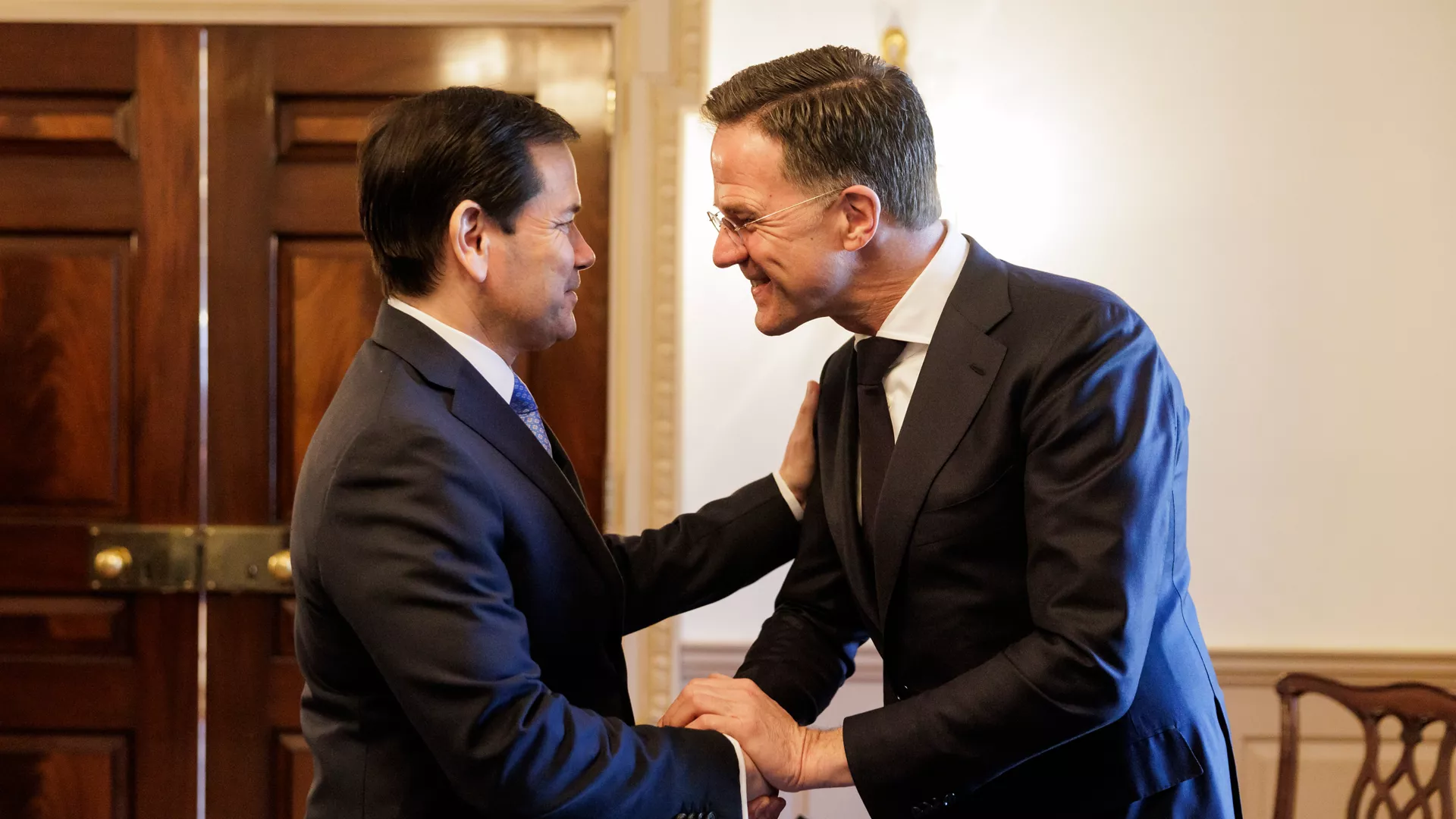




NATO Secretary General Mark Rutte meets with Marco Rubio, U.S. Secretary of State
NATO Secretary General Mark Rutte meets with Marco Rubio, U.S. Secretary of State
NATO Secretary General Mark Rutte meets with Marco Rubio, U.S. Secretary of State
NATO Secretary General Mark Rutte meets with Marco Rubio, U.S. Secretary of State
NATO Secretary General Mark Rutte meets with General Dan Caine, Chairman of the US Joint Chiefs of Staff
NATO Secretary General Mark Rutte meets with Pete Hegseth, US Secretary of War
NATO Secretary General Mark Rutte meets with Pete Hegseth, US Secretary of War
NATO Secretary General Mark Rutte meets with Pete Hegseth, US Secretary of War
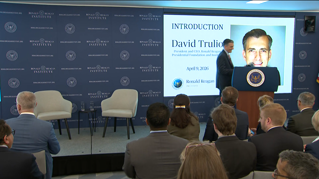
NATO Secretary General Mark Rutte and David Trulio, President and CEO of the Ronald Reagan Presidential Foundation and Institute
NATO Secretary General Mark Rutte and David Trulio, President and CEO of the Ronald Reagan Presidential Foundation and Institute
NATO Secretary General Mark Rutte with David Trulio, President and CEO of the Ronald Reagan Presidential Foundation and Institute and Rachel Hoff, Reagan Institute Policy Director
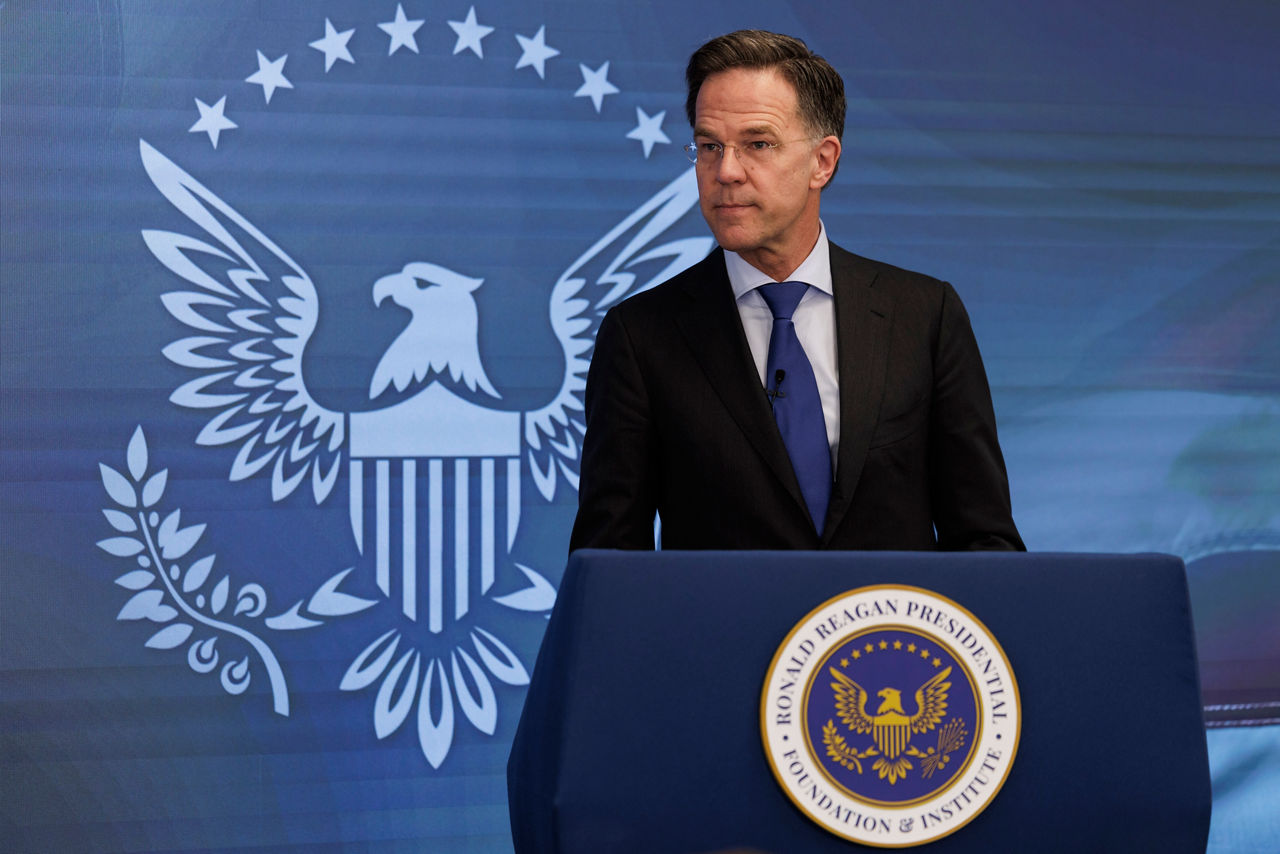
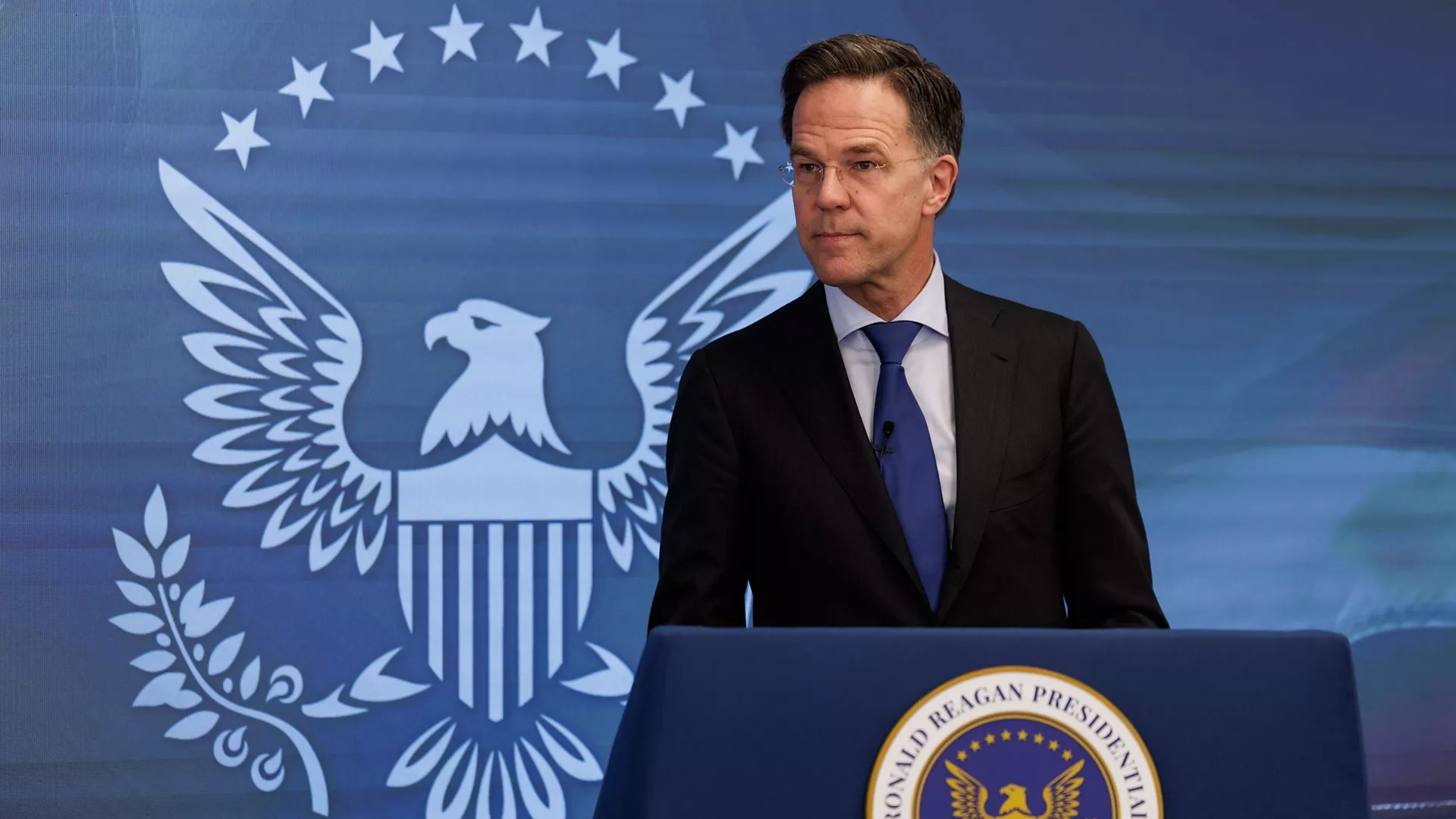
NATO Secretary General Mark Rutte speaks at the Reagan Institute’s Center for Peace Through Strength
NATO Secretary General Mark Rutte speaks at the Reagan Institute’s Center for Peace Through Strength
NATO Secretary General Mark Rutte speaks at the Reagan Institute’s Center for Peace Through Strength
Moderated conversation with NATO Secretary General Mark Rutte at the Reagan Institute’s Center for Peace Through Strength moderated by Rachel Hoff, Reagan Institute Policy Director
Moderated conversation with NATO Secretary General Mark Rutte at the Reagan Institute’s Center for Peace Through Strength moderated by Rachel Hoff, Reagan Institute Policy Director
NATO Secretary General visits the United States