Fermer
Retour
Accédez aux ressources médiatiques officielles de l'OTAN. Un contenu de qualité professionnelle, diffusé sur les dernières actualités. La référence pour les professionnels des médias.
Accédez aux ressources médiatiques officielles de l'OTAN. Un contenu de qualité professionnelle, diffusé sur les dernières actualités. La référence pour les professionnels des médias.
Désormais, vous pouvez télécharger des versions complètes ou partielles de nos vidéos depuis notre site Web.
Si vous souhaitez également vous abonner à la newsletter et recevoir nos dernières mises à jour, cliquez sur le bouton ci-dessous.
Entrez l'adresse e-mail avec laquelle vous vous êtes inscrit et nous vous enverrons un code pour réinitialiser votre mot de passe.
Le mot de passe doit comporter au moins 12 caractères, sans espaces, inclure des lettres majuscules/minuscules, des chiffres et des symboles.
Cliquez sur le bouton pour revenir à la page sur laquelle vous étiez et connectez-vous avec votre nouveau mot de passe.
Thank you so much, and welcome. Good afternoon.
Tomorrow indeed, NATO Defence Ministers will meet here at NATO Headquarters as we prepare for the Summit in Ankara which is now less than five months from now.
When leaders gather in Türkiye in July, we will build on the historic decisions made at the Summit in The Hague last year.
It was there that Allies agreed to ensure that NATO is a stronger, fairer Alliance - including by increasing defence spending to 5% of GDP by 2035 and substantially boosting our defence industries.
Tomorrow, I look forward to hearing from Ministers on how Allies are implementing these decisions; how each is delivering to ensure our common security.
Investment is up by tens of billions. Take Germany for example. Germany, by 2029, will spend 152 billion euros on defence. That is more than double what they were spending in 2021. So, in eight years, they will double their defence spending, going up to 152 billion euros. Just one example – of course a very big Ally – but still one example from many.
We will talk, of course, tomorrow about how Allies are planning further increases to their defence spending ensuring that there is a credible path to our common goal.
As Allies invest more, it is crucial that the capabilities we need are available to buy. So we are building our defence industrial base. We need to produce more. This means more air defence, more ammunition, and stronger supply chains across the Alliance. We need to move faster – adopting new technologies, accelerating procurement, and ensuring our defence industry can deliver at speed and can deliver at scale.
We need this on both sides of the Atlantic, and we need to work together across the Atlantic. And yes, we are seeing progress.
We are also seeing progress when it comes to sharing responsibility for leadership in our NATO Command Structure. Just last week, Allies agreed a new distribution of senior officer posts, with European Allies taking on greater responsibility – including the newest NATO members. And this is good news, we are doing this together. Re-distributing roles in ways that make sense for all involved.
Tomorrow we will also discuss our support for Ukraine. I was there last week and saw the impact of Russia’s relentless attacks, including on critical civilian infrastructure, and once again, President Putin is trying to break the people of Ukraine, hoping to weaken their resolve.
But Ukraine, and the Ukrainian people, have shown, time and again, that they will not be broken. Still, Ukraine cannot sustain this fight or secure the peace alone. And this is why Allies have backed Ukraine with action – not just words – since the first day of Russia’s full-scale invasion nearly four years ago.
99 percent of all military support to Ukraine has come from NATO Allies and partners, and NATO continues to strengthen the coordination and the delivery of that support.
Coordination through our command in Wiesbaden, training and lessons-learned at our centre in Bydgoszcz. Political consultation in the NATO-Ukraine Council, and practical support through the Comprehensive Assistance Package.
Our PURL initiative continues to deliver vital US equipment for Ukraine, with funding provided by Allies and partners. The support delivered through PURL saves lives in Ukraine every single day.
Tomorrow, NATO Ministers will be joined by Ukraine’s new Defence Minister, Mykhailo Fedorov and we will discuss how Allies can enhance their support and also how they can make it more effective.
We will also be joined by the European Union. European Union is an essential partner for NATO. Our cooperation – including on support for Ukraine – is crucial for our shared security.
Throughout 2025, Allies continued to strengthen deterrence and defence across the Alliance. Including through Baltic Sentry, to enhance the protection of critical undersea infrastructure in the Baltic Sea. And Eastern Sentry, which reinforces vigilance along the eastern flank of the Alliance.
Which brings me to the Arctic. The Arctic and the High North are increasingly important for our collective security. NATO and Allies have been sharpening our focus on the region.
We regularly conduct exercises in the Arctic, ensuring that we are ready to fight and operate in all conditions. Finland and Sweden’s membership greatly enhances NATO’s posture in the region, and our Arctic capabilities.
Still, in the face of Russia’s increased military activity and China’s growing interest in the High North, it was crucial that we do more. Which is why we have, just two hours ago, launched Arctic Sentry.
Arctic Sentry leverages the strength of the Alliance by bringing together NATO and Allied activities in the High North into one, overarching operational approach to the region.
Initially it will bring together exercises like Denmark’s Arctic Endurance and Norway’s Cold Response – activities involving tens of thousands of personnel and the equipment they need to operate successfully in Arctic conditions. Making clear our commitment to ensuring Arctic security – and indeed the security of the whole Alliance – together.
And we continue to synchronise these and other efforts under NATO. We’ll not only build our posture in the region alone, but we’ll also build a more cohesive picture of potential challenges in the Arctic, so that any gaps can be quickly and effectively addressed.
So, tomorrow’s meeting is about making NATO stronger by delivering on our defence investment and defence industrial commitments, strengthening our deterrence and defence, and sustaining our support for Ukraine.
Of course, I look very much forward to the discussions, and with that, for now, I am ready to take your questions.
NATO Spokesperson Allison Hart
Okay, let's start with Reuters, fourth row.
Andrew Gray, Reuters
Thank you, Secretary General. Andrew Gray from Reuters.
NATO Secretary General Mark Rutte
Hello, good to see you.
Andrew Gray, Reuters
Hi. Can you tell us some more about Arctic Sentry? I mean, what you just mentioned, there are a couple of exercises which are already being planned. So, is this just a rebranding exercise of existing efforts? Or, if not, what is new about it?
NATO Secretary General Mark Rutte
What is really new about it is that, for the first time now, we will bring everything we do in the Arctic together under one command. And by doing that, and we have seen the same in the Baltic region, we are seeing the same when it comes to Eastern Sentry, we will not only be able to leverage what we are doing much more effectively and having a bigger impact. We will also be able to assess which gaps there are, which we have to fill, and of course we will fill them, but it will also bring into this whole equation the help of our Allied Command Transformation. There is the latest technologies.
We have seen this in the Baltic Sea when it comes to securing our critical undersea infrastructure, but also when it comes to Eastern Sentry, where not only the aim was to bring together in a much more effective, and in a leveraging way what we are doing on the eastern flank, but also to make sure that we are better in countering the drones, but also becoming more effective in using the latest drone technologies ourselves, learning from Ukraine.
This is what we will do, in a sense, bringing not the drone technology necessarily, but bringing together the latest technological insights from Admiral Pierre Vandier and his team from ACT, Allied Command Transformation. So this is really big. This is a huge thing. It has never happened before, under the command, of course, by our Supreme Allied Commander, delegated to Joint Force Command Norfolk.
NATO Spokesperson Allison Hart
Okay, coming over here, fourth row. Wall Street Journal.
Dan Michaels, Wall Street Journal
Hello, thank you very much. Dan Michaels, with the Wall Street Journal.
NATO Secretary General Mark Rutte
Good to see you.
Dan Michaels, Wall Street Journal
Good to see you. Thanks. About the defence ministers tomorrow, US Defence Secretary Hegseth won't be coming. Instead, he's sending his Deputy Elbridge Colby. Colby has been quite outspoken on Europe needing to step up more on conventional deterrence, defence. He has also said that Ukraine is not significant for the US, it's a European issue. First off, have you gotten any indications from the US about what anything in particular on his agenda for the ministerial? And also, this is now the second ministerial where the US hasn't sent a cabinet secretary. Does that send a message to NATO from the US? Thank you.
NATO Secretary General Mark Rutte
Well, on the second question, no, I don't believe that at all. I must say, my discussions, my engagements with the senior US leadership, be it in the White House, the Pentagon, State Department, is as intensive as ever. And these guys are working around the globe. Of course, NATO is important, but they also have to work on the Western hemisphere. They have to work on the Indo-Pacific. So, I totally accept that not always the most senior ministers can be here. And Bridge Colby is a very important guy. He is the Under Secretary of War. He is very much responsible for policy. We have become close friends, good friends, over the last 18 months. So, I'm very happy he's here, and we have the opportunity to engage with him. And I think that is very positive.
And on your first question, I'm really proud of what the Europeans are doing. I'm a European myself. I'm proud, because when you look at the numbers, only a year ago, Pete Hegseth was here really giving a speech, and rightly so, saying, ‘Hey guys, you have to do more here in Europe’. And who look what happened, not only because the US asking this, but also because collectively, we made the analysis that the Russian threat is there, that we need to do much more, not only today to be able to counter the Russians, but also longer term, in ‘27, ‘29, ‘31 and therefore we have to spend more. We have to build the defence industrial base, keep Ukraine strong in the fight. And look what has happened since then, the whole of NATO on 2%, all NATO Allies on 2% ultimately in ’25.
But also when it comes to the support for Ukraine, where the US is still delivering essential defence industrial gear into Ukraine, but now paid for by Allies and partners. Look at what's happening with what the Germans are doing in Lithuania, building this up to a full brigade. Look at the flags to post, as I just mentioned, where Europe is now taking the Command of the, let’s say, the commands which will really do the actual war fighting, where the US will still be heavily involved, of course, in the Component Commands. So, this is all evidence of, I think, Europe stepping up. And this is exactly what the US wanted, Europe becoming stronger in his own defence, but also still with a very strong US presence, both nuclear and conventional.
NATO Spokesperson
Staying on this side of the room, just in front of him. This gentleman on the aisle.
Daniel Tkiie, First Western, Channel 24
Daniel Tkiie, First Western, Channel 24. I would like to ask you about security guarantees for Ukraine based on your most recent interactions with US President Donald Trump. Should Ukraine trust President Trump's promise on so-called Article Five-like guarantee and if Russia violates future possible deal, do you believe that US would really be ready to fight Russia in Ukraine; commit any kind of air power, troops on the ground?
NATO Secretary General Mark Rutte
I think the great progress being made over the last six months has to do with the security guarantees. And there are three elements to that. One element of, obviously, the first element, the most important element, is Ukrainian armed forces. They will be the first line of defence for Ukraine post a peace deal or a long-term ceasefire, and let's pray that we get to that peace deal or long-term ceasefire as soon as possible. And then we have the Coalition of Winning, led by the French and the Brits, who came together with many Allies and partners, discussing how collectively we can support Ukraine post a peace deal/long-term ceasefire. And then in August last year, it was indeed, as you rightly say, the American President saying ‘we will get involved’. And that has been detailed and worked through over the last four or five months. And we had a very successful meeting. I was myself participating in that meeting in Paris in December. But obviously we need a peace deal before security guarantees can kick into gear. And here the big question is whether the Russians are willing to play ball, and what we are testing at the moment, collectively, under the leadership of the American President and his team and his engagement with the Russians and the Ukrainians, is whether the Russians are willing to play ball, so that we can bring this terrible war to a lasting end. Where they will never, ever try again to attack Ukraine. This is why we need security guarantees.
NATO Spokesperson Allison Hart
Here in the centre, the woman with the red jacket.
Charlie Hancock, The Moscow Times
Thank you. Charlie Hancock, The Moscow Times. Hi. Independent Russian news in exile in the Netherlands. Would you encourage European countries to reopen dialogue with Moscow on any level, as President Macron has said it could be useful for them to do so?
NATO Secretary General Mark Rutte
Well, it's not up to me to advise Allies, but I think, of course, every Ally is open and can do what the French have been doing. And I know that they closely coordinate with other Allies, with the US, with European Allies, there's complete transparency what they are doing. And I would encourage every initiative which will bring this terrible war faster to an end. We all agree that US leadership is key here. It was the American President breaking the deadlock. But I think every initiative which will bring this war to an end and will bring that faster to an end, can be encouraged.
NATO Spokesperson Allison Hart
All right, we'll go behind the cameras now. AFP, second row there.
Max Delany, AFP
Thanks a lot. Max Delaney, AFP. You were recently in Kyiv, and you saw the country under heavy bombardment and the huge toll that that’s taking. Do you think now is the right time for Ukraine to focus on holding elections? Did you receive any indication from them that they were planning to hold elections? And do you think President Zelenskyy should be under pressure to hold elections?
NATO Secretary General Mark Rutte
We always took the position that it's up to the Ukrainians to decide what ultimately they can accept in terms of a peace deal, particularly when it comes to the very sensitive issue of territory, but also what that would mean in terms of how they will bring a ultimate peace deal, or a long-term ceasefire deal to the Ukrainian population. Really up to them. So, I leave that really with Ukrainians. I have full trust in the Ukrainian leadership and Ukrainian democracy. So that's ultimately up to them, in line with their constitution and how they are used to organise these sorts of very important events.
NATO Spokesperson Allison Hart
Okay, we'll stay in that neighbourhood. The woman there with the black sweater, yes.
Maria Stenroos, Yle
Hello, I'm Maria Stenroos from Finland, from Yle. A few weeks ago, you were talking about if Europe can defend itself or not without United States. Could you describe what is missing from Europe if we can't defend ourselves? And do you think that it's so important that United States and Europe are together, that this is the reason why you said like you did?
NATO Secretary General Mark Rutte
Well, I think most of us in Europe and in the US agree – and Canada – that there is a lot of value in sticking together. Because NATO is there not only to protect Europe and Canada, but also the United States. I mean, for the US to stay safe going forward, they need a secure Arctic, a secure Europe and a secure Atlantic. And for Europe to stay safe, of course, we need, of course, this close cooperation, transatlantic. But at the same time, let me, as I said before, tell you, as a European, I'm really proud of what Europe is doing. It is really stepping up. It is ramping up. It is the defence investments are at a staggering pace now ramping up, and we will see much more this year and next year, when we start to see coming on stream all the extra investments coming out of the The Hague Summit, which was very successful. We see Europe taking more responsibility when it comes to arms delivery into Ukraine paid for by European and Canadian Allies and partners. We see it when, as I said, when it comes to the command structure within NATO, where Europeans are taking a bigger responsibility. We see Canada. Canada is back in NATO, on the 2%, leading the charge when it comes to the support for Ukraine. So, I'm really proud there. And we also all agree that there is a clear division of labour between the EU and NATO. There is no debate there. So, I think we can be really comfortable with how things are going.
NATO Spokesperson Allison Hart
Just behind her, the man with the beard.
NATO Secretary General Mark Rutte
The man with the beard.
Bjorn Malmquist, RUV
With the beard. Thank you very much. Bjorn Malmquist, Icelandic National Broadcasting Service. Can you be a little bit more specific on…
NATO Secretary General Mark Rutte
Where are you?
Bjorn Malmquist, RUV
Over here. With the beard.
NATO Secretary General Mark Rutte
Yes, now we have more with a beard, I was watching a beard guy there.
Bjorn Malmquist, RUV
Let me start again. Bjorn Malmquist, Icelandic National Broadcasting Service. Can you be a little bit more specific on the Arctic Sentry? How that will take off in the coming weeks and months, and what role will countries such as Iceland and Norway, which are obviously, you know, closest to the area, play in this mission? Thank you.
NATO Secretary General Mark Rutte
Yes. You will accept that I cannot tell you everything. We do this because we have a clear sense that the Russians and the Chinese are becoming more and more active there. So, this is also to make sure that this vital part of NATO territory is safe and secure. So that means that there is a limit to what I can share with you here. But I already mentioned Denmark’s Arctic Endurance. I already mentioned Norway's Cold Response. Let me add that ACO, that's here in Mons, but also JFC Norfolk will collaborate, as I said, with ACT, Allied Command Transformation, and coordinate activities with NORAD and as well with the US Northern Command and US European Command. So, I can give you that as an extra. This is an enhanced vigilance activity like Baltic Sentry, like Eastern Sentry, that is directly under the authority of the Supreme Allied Commander. But there I have to stop, because whatever I tell you more would inform the people in Moscow and Beijing a bit too much.
NATO Spokesperson Allison Hart
All right. Second row near the centre, the man with the blue shirt.
Stephan Israel, Table Media
Thank you very much. Stephan Israel, Table Media. On Arctic Sentry, my question is, did you talk about this with President Trump? Are you sure that he's on board, that he's satisfied? Is it that what he actually wanted at the beginning, when he said he wants to have Greenland? Are you sure that he will not come up with new requests later on, and will the Americans participate in this activity? Is it a permanent one? Will there be troops also in Greenland, or are you just shipping around Greenland, actually? Thank you.
NATO Secretary General Mark Rutte
Well, as I mentioned talking to the media coming out of my meeting in Davos with the American President, basically it's important that that we collectively understand that he has a big point here, and that he is very clear on Arctic security and risks of the opening sea lanes we see there. And that means that the Russians and the Chinese will become increasingly more active there, and therefore we have to be very watchful and not naive. That's basically what he's saying. And as I mentioned to the media coming out of that meeting, there will be a few workstreams, and this is one, making sure that NATO collectively will take more responsibility for the protection of the Arctic. And Arctic Sentry is a clear result of that. But also, you know that, the talks are ongoing between the Danes and Greenlanders and US, so I think that's all very important, and that's particularly focusing on making sure that whatever investments that are being made in Greenland, that they are long-term secure, but also that the Russians and the Chinese do not get access to the Greenland economy. But this is old news. I already told you this, not you personally, but to the media after my Davos meetings.
NATO Spokesperson Allison Hart
All right, and then just next to him, thank you.
Xenia Polska, Deutsch Welle
Thank you very much for the question. Xenia Polska, Deutsch Welle. Hi, I would also like to ask about the understanding of the American President, but about a different issue. My colleague here already mentioned your visit to Ukraine, which took place several days ago under tragic conditions for all Ukrainians. You were able to witness the level of suffering and destruction yourself. So, do you believe the US administration fully understands the pressure that Ukraine is being put under right now? And also, did you have a chance to talk about this and share your perception and your assessment of the situation with Donald Trump. Thank you.
NATO Secretary General Mark Rutte
Twice, yes, I’ll be very brief. I never will disclose what we discuss. But I mean, the American President, the American administration, is totally aware of the dreadful situation in Ukraine. In my regular contacts with the American president, of course, we update each other on what's happening, what we are seeing. That's part of our regular conversation. So, to your questions, yes, absolute clarity in the US on what's happening in Ukraine. There's no doubt. But also, of course, when we are in discussions, we update each other of course,
NATO Spokesperson Allison Hart
Fourth row NTV.
Gul Sonumut, NTV
Secretary General, Gul from NTV Türkiye. Two quick questions, US has published its National Defense Security document, and it's a pity that Hegseth is not here, the Secretary of War. However, they announced that they will reduce the US footprint in Europe, but didn't say when and how much? Do you know how much and how many troops they will reduce, and when? And whether they will it will put into danger all the Sentries you have announced so far? And my second question is, you have said that we're five months to Ankara, what are the clear deliverables that one should expect for the Summit in Ankara? Thank you.
NATO Secretary General Mark Rutte
On the first question. And this is not only because of the present American administration, we know that the United States has to take care, being the most powerful nation on earth with the most powerful military, has to take care of multiple theatres at the same time. That's of course, NATO, but also the Western Hemisphere, also when it comes to of course, the Indo-Pacific. And we see the rapid build-up of the Chinese armed forces and the challenges that presents when it comes to the to the Indo-Pacific. I was yesterday on the phone with the Republic of Korea, the President, discussing our cooperation between NATO and the Republic of Korea, but also Japan, Australia, New Zealand, when it comes, for example, to the defence industrial base.
So we know that. And Europe is stepping up, step by step, doing more to make sure that we are able in Europe here and together with Canada and the US to take care of our defence will ultimately mean that US over time will pivot more towards the Indo-Pacific. It's totally clear, it's totally acceptable. It's not new. And we have to do this step by step, knowing that longer term, there will still be a strong US presence in Europe. And not only nuclear as the ultimate guarantor of our freedom — the nuclear umbrella here in Europe from the US — but also when it comes to the conventional forces.
So, it's five months before Ankara. I have, of course, in my head what I think the deliverables could be. But we will discuss tomorrow with defence ministers. We will have more meetings coming up also with foreign ministers. I will have my regular bilateral visits with Allies to discuss how we can make maximum use of Ankara. But you can be assured, a main issue in Ankara will be the implementation of what we decided in The Hague and celebrating collectively the fact that as NATO — and we are seeing it now today, clearly coming in, coming on stream, the fact that so much more is being spent on defence. We still have a challenge when it comes to the defence industrial base. That is not only in Europe, its also in the United States. We have seen the American President engaging with some of the biggest US defence industrial corporations very forcefully. And I was very happy to see him doing that, because we need the defence industrial base in Europe and in the US and in Canada to produce more, more production lines, more shifts. Not higher prices, more output. Working together with the innovative sectors to make sure that we figure in the latest technologies in our defence.
NATO Spokesperson Allison Hart
All right, immediately in front of him, the woman in yellow.
Aleksandra Filippenko, The Breakfast Show
Hello. Aleksandra Filippenko, The Breakfast Show, Russian media-in-exile in Lithuania. Being from Lithuania, currently, recent wargames that were reported by Die Welt, they highlighted the concerns about NATO's decision making if Russia with only 15,000 soldiers, decides to block the Suwałki corridor. How sure are you that NATO today can respond rapidly?
NATO Secretary General Mark Rutte
Very sure. And when it comes to the Die Welt exercise, we do not know all the specifics of the wargame. NATO obviously was not involved. What I can assure you is that NATO itself is regularly exercising for a range of scenarios. And we do that with all the relevant intelligence, as well as facts related to our posture, to our capabilities. And I can assure you, we are well prepared to respond to any threat against the Alliance. So let nobody think that he can attack us. But because our reaction will be devastating.
What we need to do and make sure of is that in a couple of years, we can still react in a devastating way if anyone tries to attack this defensive Alliance. And therefore, it's so important what you're doing along the eastern flank and strengthening what you're doing there with real plans to make sure we can defend ourselves should the need arise. We are a defensive Alliance, but our reaction will be lethal if they try to attack us.
NATO Spokesperson Allison Hart
Going to the fourth row towards the centre.
Matiushenko Ievgen, UKRInform
Thank you again. Matiushenko Ievgen, UKRInform. Moscow has been repeatedly saying that security guarantees for Russia should be part of the peaceful settlement in Ukraine. How does NATO see these claims that security guarantees for the aggressor state should be part of the settlement. Or maybe NATO sees that as part of political blackmail on part of Russia? Thank you.
NATO Secretary General Mark Rutte
Well, I stopped some time ago to react on every piece of information coming out of Lavrov/Russia. I see Lavrov becoming increasingly active again. But no, it's not up to me to react to anything, everything they are saying. Fundamentally what we are doing under American leadership, bringing together Ukrainians, the Russians, the US, very clearly closely coordinating with Allies to make sure we can bring the war to an end. And that involves what is needed to rebuild Ukraine after the war. That's one element. A second element, obviously is the peace settlement itself, including sensitive issues, for example, around territory. And thirdly, I think very important, the issue of how do we make sure that it is not a repeat of Budapest or of the Minsk agreement, that there is a deal struck and the security guarantees in place, which are so strong that Putin will never ever try again to attack your beautiful country.
NATO Spokesperson Allison Hart
All right, and the woman just two seats down from him.
Leonora Marienlund Klint, Børsen
My question to you. According to you, will the Arctic Sentry be enough to accommodate the worries that the American president has about the security in Greenland? Or do you expect that more military, somehow, assistance, or other deals, will be, do you have to make more to actually accommodate all of the worries that the American president has? Or is this enough?
NATO Secretary General Mark Rutte
Coming from my talks with the American President, one workstream is what is now Arctic Sentry. And that is a step-by-step approach, where we bring together what we have, leverage what we have, assess where the gaps are, get Allied Command Transformation involved, so that the latest technologies will be part of it. And then, based on the assessment of the gaps, decide where we need to do more over time; exactly as we did with Baltic Sentry and Eastern Sentry. And then, of course, there's also the talks ongoing between Denmark, Greenland, and the United States. I'm not involved in those. That's really up to the Danish government, the government of Greenland and the government of the United States. And of course, they are also ongoing.
NATO Spokesperson Allison Hart
All right, just a couple more questions now, second row on the aisle,
Sachiyo Sugita, NHK
Sachiyo from NHK, the public TV station of Japan. Thank you. My question is about Arctic Sentry. It's said that there aren't much Chinese ships actually around Greenland. But could you elaborate a bit more on what kind of indications from the Chinese side NATO has spotted on their intentions to be more active in this region?
NATO Secretary General Mark Rutte
Obviously, I cannot go into all the intelligence we are getting, but I can assure you that, look at the facts. And the facts are that you have seven countries bordering on the Arctic, the High North, all in NATO. And there is one big country, Russia, which is also in that region, obviously not in NATO. And then we have China, which is step-by-step becoming more active when it comes to getting access to the Arctic. So, they are not geographically bordering, of course, on the Arctic, but they are practically very much involved. And what we are assessing is that there is a real threat, that from today onwards, knowing what we have seen in the past, the sea lanes opening up, that this will increase and that, therefore there is every need to make sure that we protect this vital part of NATO territory.
NATO Spokesperson Allison Hart
Fourth row, centre.
Pavle Knežević , Tanjug News Agency
Hello, Mr. Rutte, Pavle Knežević from Tanjug news agency. I would like to ask you about the situation in the Western Balkans. How do you see it? Are there any risks for stability of the region? Thank you.
NATO Secretary General Mark Rutte
That's a very general question. So let me say, first of all, we wish the new Kosovar government, of course, of the new authorities in Kosovo, I should say, we wish them well going forward, the Prime Minister. Then we have, of course, we are closely following what is happening there. We have five Allies on the Western Balkans who are constantly updating the collective Alliance, including Albania, Montenegro, North Macedonia, but also of course Slovenia and Croatia. As I said before, we will never accept a security vacuum in Bosnia and Herzegovina. So, we are closely following events over there, I myself, but also as an Alliance, in close contact with the Serb president. We are still waiting for his accountability for what happened in 2023 in Banjska and the other events in 2023. So basically, not a lot of new things to report, but making the point that we follow events closely and through KFOR and our other activities on the Western Balkans, in Bosnia and Herzegovina, but also, of course, in Kosovo, we are very much involved and follow things closely.
NATO Spokesperson Allison Hart
Okay, final question for today, the woman just in front of him in the dark top.
Zoriana Stepanenko, RFE
Thank you so much for giving me the floor. Zoriana Stepanenko, Radio Free Europe's Ukrainian service. Secretary General. Probably you heard yesterday HRVP Kaja Kallas said that she would propose a list of concessions that Europe should demand from Russia in terms of possible peace settlement. She also suggests to add to those lists of concessions the limitation of Russian Armed Forces. We heard that limitation of Ukrainian Armed Forces is discussed, but speaking of limitation for Russian Armed Forces. Do you find this idea in total feasible, and do you find it timely, given that Russia seems not be willing to negotiate seriously, as we hear from plenty of European leaders?
NATO Secretary General Mark Rutte
Obviously, Kaja Kallas and myself, we have different roles, so I need to chair the Alliance and make sure that we do everything to protect Allied territory. But also to be as helpful to Ukraine through what we are doing with the command in Wiesbaden, all the other activities and our joint initiative in Poland, where we capture all the lessons in JATEC — NATO and Ukraine together – from the war. So, making sure that we do the max there, and making sure that when it comes to the weapons deliveries into Ukraine, where the NATO command is involved, the training, which is of course, very much organised through the NATO command in Wiesbaden, that that all happens. And following closely what's happening in the peace process, I can assure you. But my role is different, in a sense, from Kaja Kallas’s role, that I don't feel at liberty to comment too much on the day to day, because I'm not always sure that from my position that's helpful. Her position is different. So, I totally respect that. But of course, from my position, I think I should be a little bit careful here.
NATO Spokesperson Allison Hart
All right, that's all we have time for today, but we hope to see you back tomorrow. Opportunities at the doorstep and then back here tomorrow afternoon. Thank you so much.
NATO Secretary General Mark Rutte
Have a great evening. Thank you so much.


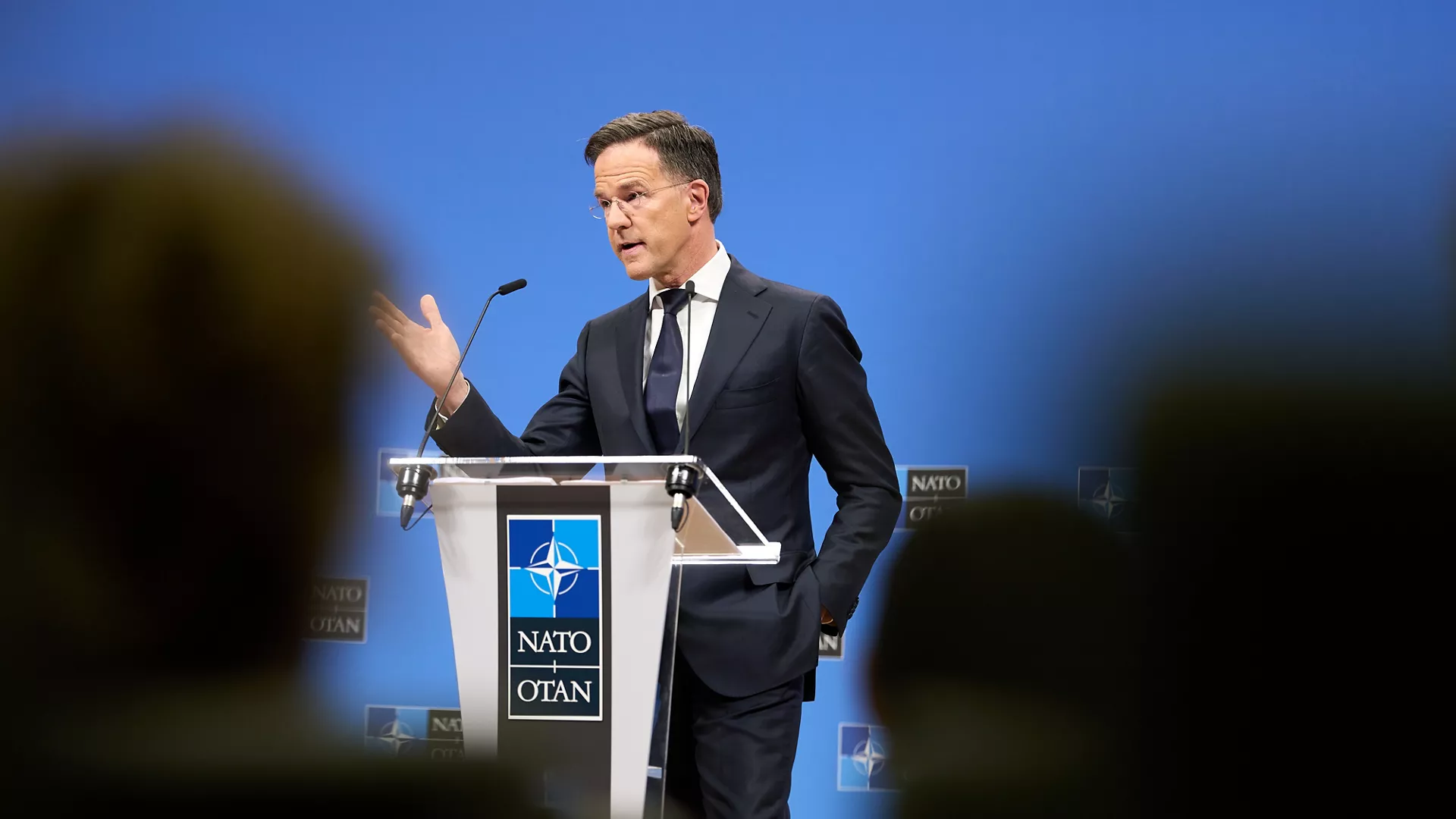


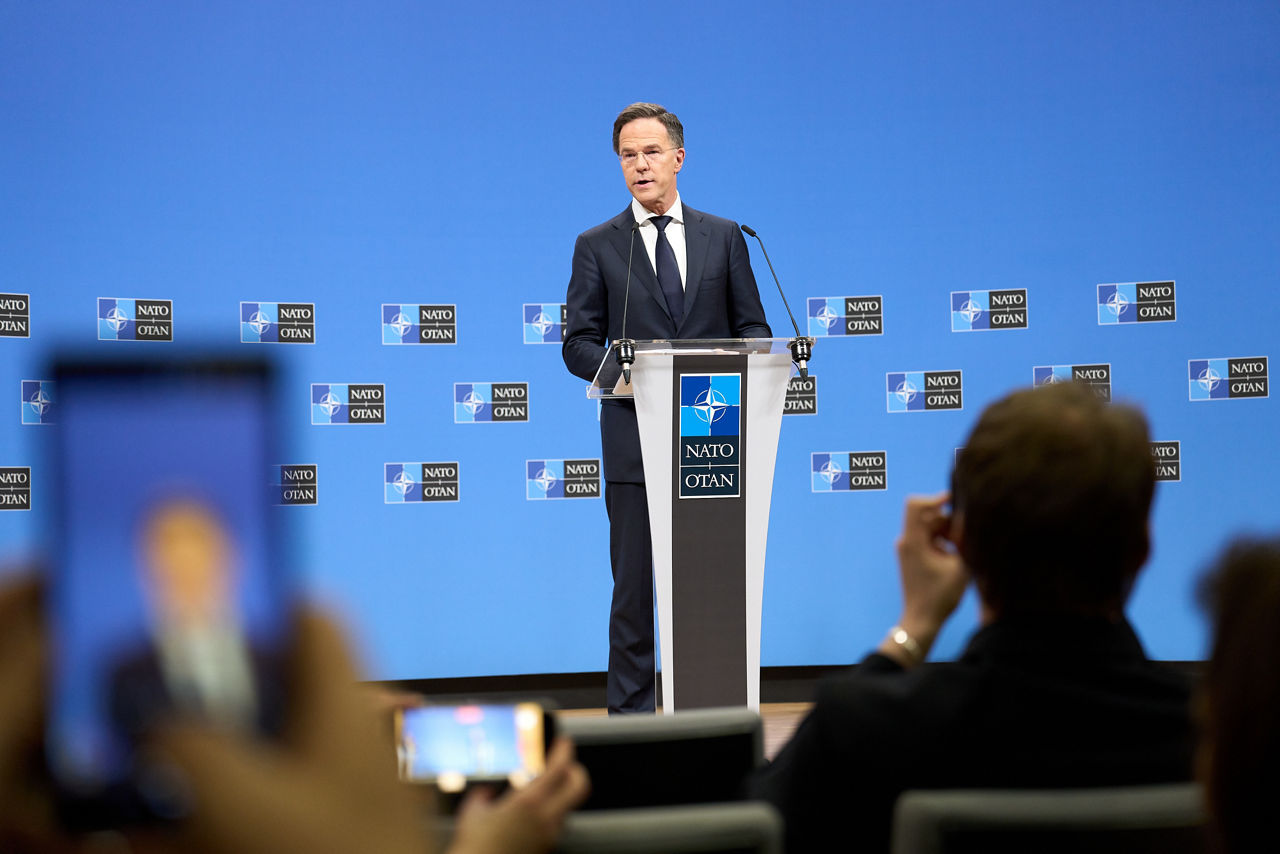
NATO Secretary General Mark Rutte press conference ahead of the meeting of NATO Ministers of Defence
NATO Secretary General Mark Rutte press conference ahead of the meeting of NATO Ministers of Defence
NATO Secretary General Mark Rutte press conference ahead of the meeting of NATO Ministers of Defence
NATO Secretary General Mark Rutte press conference ahead of the meeting of NATO Ministers of Defence
NATO Secretary General Mark Rutte press conference ahead of the meeting of NATO Ministers of Defence
NATO Secretary General Mark Rutte press conference ahead of the meeting of NATO Ministers of Defence
Pre-ministerial press conference by the NATO Secretary General