Close
Back

From now on you can download videos from our website
If you would also like to subscribe to the newsletter and receive our latest updates, click on the button below.
Enter the email address you registered with and we will send you a code to reset your password.
The password must be at least 12 characters long, no spaces, include upper/lowercase letters, numbers and symbols.
Click the button to return to the page you were on and log in with your new password.
Thank you very much Prime Minister Plenković, dear Andrej. Let me also acknowledge the presence of the two ministers, good that you are here, and the Chief of Defence. And thank you for hosting me here in beautiful Zagreb. It is always a pleasure to be here.
Since joining the Alliance in 2009, Croatia has been a valued member of NATO. It contributes significantly to our collective security – not only on our eastern flank and in the Western Balkans, but across the entire Alliance.
Just before the holidays, I met Croatian troops in Poland, as part of NATO’s Forward Land Forces in Bemowo Piskie. It was inspiring to meet so many servicemen and women spending Christmas away from their families – standing watch, keeping us all safe.
Croatia also contributes personnel to our Forward Land Forces in Bulgaria and Hungary.
And I welcome your efforts to modernise the capabilities of the Croatian Armed Forces, and the way Croatia’s defence industry indeed is stepping up – particularly in driving innovation in the field of uncrewed systems. I am looking forward to the meeting, and you already announced it, this afternoon, with representatives from the defence industry. And I was really impressed this morning to see how you have revamped Croatia’s Air Force in just a couple of years.
You are already spending more than 2% of GDP on defence, and are working to reach the 5% benchmark by 2035, as all Allies agreed at the Summit in The Hague.
I also welcome that, as of the 1st of January this year, the Croatian Air Force officially assumed full responsibility for protecting Croatian airspace.
Croatia is also making good on the commitment Allies made to sustain our unwavering support for Ukraine.
Since the start of Russia’s full-scale invasion in 2022, Croatia has been a strong and reliable supporter of Ukraine.
In addition to your recent 15 million euro contribution to indeed, you already mentioned it, the Prioritised Ukraine Requirements List – PURL – Croatia has provided now over 300 million euros in military aid since 2022.
You have supplied helicopters, transport aircraft, artillery systems, ammunition, protective equipment, and much more.
Russia’s brutal war of aggression continues. And we saw just last week, the use of the Oreshnik missile on Lviv and continued attacks on civilian and energy infrastructure. Russia is trying to deter us from supporting Ukraine, but we will not be deterred.
As Ukraine faces immense pressure during the harsh winter, your support, and support of all NATO Allies, is more important than ever.
Ukraine’s security is our security.
And under your leadership, Prime Minister Plenković, Croatia has truly been a vital partner to our Ukrainian friends.
Croatia also plays an important role in sustaining stability in the Western Balkans. You are a longstanding contributor to KFOR, with more than 150 troops on the ground in Kosovo.
The Western Balkans remain high on NATO’s agenda, and our commitment to the region’s stability is steadfast. With your support, we will not allow a security vacuum to emerge, and NATO will continue to strengthen political dialogue and practical cooperation across the region.
Prime Minister Plenković, dear Andrej,
Thank you for your warm hospitality, and again, for Croatia’s steadfast support to our Alliance, and everything we collectively stand for. Thank you.
Question
Secretary General, hi, good afternoon. So, a group of European countries, led by the UK and Germany, are apparently planning to increase actually, to have some military presence on the Arctic, on Greenland. Could you tell us more about these plans? Would it be like the Baltic Sentry of the last year initiative? How would it look and how far the plans have gone? Thank you.
NATO Secretary General Mark Rutte
Thank you very much for that question. And let me first of all stress that all Allies agree on the importance of the Arctic and Arctic security, because we know that with sea lanes opening up, there is a risk that the Russians and the Chinese will be more active. And as you know, there are eight Arctic countries. Seven are within NATO, including United States and Canada, and five countries in Europe, including Denmark through Greenland, and Iceland and Norway, Finland and Sweden. And then there is one Arctic country outside NATO, and that is Russia. But you could also argue that by now, China has almost become a sort of Arctic country, and not geographically, but at least by the sheer amount of their activities and interest in the region. So that has led last year already to some debates, very successfully concluded debates in NATO on how, as an Alliance together with our seven Arctic Allies, we have to work together to make sure that the Arctic stays safe. And currently we are discussing the next step to that, how to make sure that we give practical follow up on those discussions to make sure that as an Alliance we do everything, collectively and through our individual Allies, to make sure that the Arctic stays safe, as we all agree that that has to be a priority.
Question
Hi, also, a question for you, Secretary General. My name is Ana-Bella Leikauff from the Croatian Radio. You have repeatedly stated that Russia is the main threat to NATO and to Europe of course, understandably. We all understand why. What is your comment, approximation on latest statements from Donald Trump, who said that, if necessary, he will take military action on Greenland? And I'm just going to read it. Commissioner Kubilius from European Commission has said that EU members are obliged to come to Denmark's assistance under EU treaty if faced with military aggression. And as we know, 23 countries of EU are also members of NATO including Croatia. [inaudible]
NATO Secretary General Mark Rutte
Yes, on that question, and it is a little bit, I think, repeating my previous reaction. But thank you very much for this important question. And I think what is at core here, and to the core of this question is that we all make that same analysis, and there is no debate or discussion about that. The analysis is sound, and when it comes to the High North, the Arctic region, I was myself visiting Iceland only, I think, six or eight weeks ago, and we also extensively discussed this. And I was in in Norway and visiting other Allies, discussing with the US and with Canada. I was with Prime Minister Carney last week in Paris, discussing the importance of the Arctic. So collectively as an Alliance, and particularly, of course, the seven countries who are bordering on the region, we do make this analysis that the collective defence is crucial. We all see that through changes in weather patterns that sea lanes are opening up. And we have to make sure that we do everything to protect that region. It is a vital part of NATO territory. And that is exactly why, where in the past NATO was not so much involved when it came to the Arctic, that since 2025 on the request by the seven High North Allies who are bordering on the Arctic, that NATO has become more involved. This has led to a few, as I said, very successful discussions within the NATO Alliance with our ambassadors in Brussels and our ministers. We discussed this importance, and currently we are working on the next steps to make sure that indeed we collectively protect what is at stake here.
Question
For Secretary General, so the new peace plan for Ukraine, the 20-point peace plan, mentions security guarantees similar to Article Five from NATO. So, my question is, if those guarantees resemble Article Five, why not give Ukraine the real deal? The real Article Five and NATO membership. Are the doors of NATO closed for Ukraine?
NATO Secretary General Mark Rutte
NATO membership of Ukraine, there was a Summit in Washington in 2024 which was very clear. And we stated in the specific words of that Summit statement, the “irreversible path” of Ukraine into NATO. So that was the political commitment in 2024 and that still stands. At the same time, we know that several Allies, including Hungary in the United States and some others, are either against or very much doubtful about full NATO membership for Ukraine. That is a given. That is a fact. And at the moment, we have to deal with the situation in Ukraine, between Ukraine and Russia, particularly since the brutal, unprovoked onslaught of Russia against Ukraine starting in February ’22. And what is being discussed now with the United States, with all NATO Allies within the Coalition of the Willing, originally organised and led by the French and the Brits, is after a full peace deal/a long-term ceasefire, how to make sure that Russia will never ever attack again. And if it is then not NATO, what then? And that's exactly the debate which is now currently taking place. The US is very important here. Steve Witkoff and Jared Kushner are playing a very positive role here, together with Marco Rubio, under the guidance of President Trump, who has broken the deadlock with Putin by starting to dialogue with him. And he had to do it. He was the only one who could do this, and I was very happy he did, starting in February last year.
And last week in Paris, and we were both there (referring to Prime Minister Plenković), I think we made big progress on nailing as much as possible what those security guarantee will be in three levels. Level one being Ukrainian armed forces. Level two, a Coalition of the Willing organising itself in such a way that it will help to build up to Ukrainian Armed Forces, but also functioning clearly, collectively, in addition to the Ukrainian Armed Forces, protecting at least preventing the Russians from getting into a position where they want to attack again. But also, the US being heavily involved in various ways, as we discussed last week in Paris. So, we have these three layers. That was very successful. That's now being finalised, next to everything which is needed when it comes to the reconstruction of Ukraine. And obviously that still leaves the very sensitive issue of territory, very sensitive where, in the end, it has to be the Ukrainian government taking the decisions on what they want to do, yes or no, when it comes to territory. But they need to know that whenever that moment comes, when they have to decide on territory that they have the full backing, not only of their own Armed Forces, but also of this Coalition of the Willing, the United States, to collectively make sure that indeed, the Russians will not repeat what they did after 2014/2015 with the Minsk agreement(s), which is attacking Ukraine again.
Question
Question for both. Four years ago, a drone was shot down in Zagreb. It went through three NATO members. What is the level of security of NATO airspace?
NATO Secretary General Mark Rutte
That's a very good question. And by the way, let me first of all commend Croatia for now taking over the control of its own airspace with the latest investments. And I was really impressed this morning to see with my own eyes the people operating that system, and of course, the gear you have bought from the French and from Türkiye and from the US, for you to be able to control the Croatian airspace, but also to provide your help and, when necessary, your support to other NATO Allies, wherever necessary, and where you can do that.
When it comes to drones, we have seen, of course, drone incursions last year in September, in Poland. We have seen MiGs entering the airspace of Estonia a couple of weeks later in September, and whatever exactly, was it intentional or not, at least it was reckless. And this is the reason why our new – relatively new, he started in July, but still relatively new – Supreme Allied Commander Alexus Grynkewich, the General who is now leading NATO's military side, has decided to start, with full support of the rest of NATO and all the Allies, Eastern Sentry. And Eastern Sentry is making sure that we bring together, when it comes to, for example, drones and airspace incursions and protecting Allied territory, brings together all our Allies, all our capabilities, from the Black Sea up to the High North, to make sure, mirroring what we have done with Baltic Sentry, making sure that we are much more effective to control our airspace, to protect our territory on land, sea and air, but also to become better and better and better in implementing the latest drone technologies.
We are learning here, by the way, from Ukraine. We have a Joint NATO-Ukraine Centre in Poland, JATEC, where we analyse and train when it comes to all the insights from the war in Ukraine. And unfortunately, of course, this is taking place in Ukraine, but Ukraine is helping us to learn. When, in Copenhagen in October, there were two big meetings taking place, the European Council, informal, and the European Political Community, and there were big worries about drones over Copenhagen, that was Ukraine, with support from Allies and NATO, to help Denmark to be better in terms of understanding and also fending off those threats. So here we are learning from Ukraine, working with Ukraine also to become better ourselves when it comes to drones. And I was really impressed this morning again when I saw what you were buying from Türkiye in terms of drone technology. And of course, you have your own – when it comes to drones – your own industry here in Croatia, which is commendable.
Question
Secretary General, can you recall a larger internal crisis that NATO has faced than the one the Alliance is facing now, with Donald Trump saying we should go to Greenland and, you know, take it? Or do you even see that as an internal crisis, or is it not a crisis at all? And is the best way of communicating with Mr. Trump and trying to maybe smooth the relationship, is the way that you have been using communication so far, which was basically flooding him with compliments and calling him “daddy?” Thank you.
NATO Secretary General Mark Rutte
Let me start with challenging you a bit on the second part of your question. What I always do is when people are helpful for the Alliance and are doing good stuff, and I believe that Donald Trump is doing the right things for NATO by encouraging us all to spend more, to equalise with what the US is spending. We had a very successful Summit in The Hague, where we decided on the 5% defence spending, including 3.5% on core defence. I'm absolutely convinced without Donald Trump we would never have had that result at the Summit in The Hague. We have now the whole of the Alliance on this famous 2%, which we announced in 2014 in Wales. I'm absolutely convinced without Donald Trump we would not have the whole Alliance at this moment on the 2% and are working towards the 3.5%, incredible steps. So, when I praise somebody, it is based on facts, and I believe the facts are there. We might disagree, but that is how I see this.
As NATO’s Secretary General, it is my role to make sure that the whole of the Alliance is as secure and safe as possible. And I applaud the fact that our colleagues who are bordering on the Arctic have come together, have worked together and have decided to get NATO more and more involved. This was the discussion in Brussels I refer to in answering a few people's questions earlier last year, in September, and other moments last year when they discussed the High North. And we are now building on that. You've seen some announcements by the Brits and the Germans today. We are working now together to see how we can basically together, as an Alliance, including our seven members, our Allies bordering on the High North, on the Arctic, to work together to, indeed, build that next step, which is crucial. That's United States, that's Canada, that's Iceland, Denmark and the other European countries bordering on the High North, all seven. But of course, with the whole of the Alliance. By the way, as we speak, we see Denmark, at the moment, already speeding up their investments when it comes to defence, not only generally, but also when it comes to unique capabilities to defend territories like Greenland. So, they are buying more F-35s, they are working on air-to-air refueling. They have bought these P-8 Boeings, the long-range drones, billions invested there in American equipment necessary to defend Denmark, NATO, but also territories like Greenland. So, we are really working together here. And my only worry is, how do we stay safe, against the Russians, against any other adversary? Look at what China is doing in rapidly building up its own armed forces, but also North Koreans and others who might wish us ill – not well, at least. And therefore, that's my role, and I think we will get there.
Question
So no crisis whatsoever?
NATO Secretary General Mark Rutte
No, not at all. And I think we are really working in the right direction.


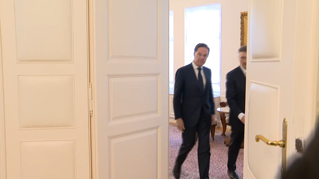
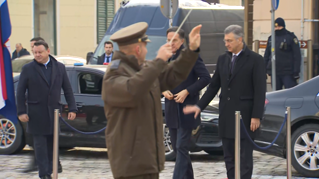
NATO Secretary General Mark Rutte meets with Andrej Plenković, Prime Minister of Croatia
NATO Secretary General Mark Rutte meets with Andrej Plenković, Prime Minister of Croatia
NATO Secretary General Mark Rutte meets with Andrej Plenković, Prime Minister of Croatia
NATO Secretary General Mark Rutte meets with Andrej Plenković, Prime Minister of Croatia
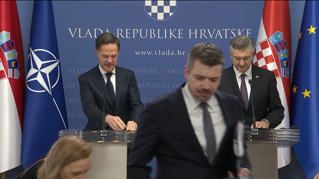
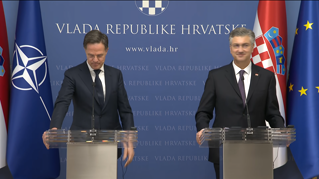
Joint press conference by the NATO Secretary General Mark Rutte and Andrej Plenković, Prime Minister of Croatia
Joint press conference by the NATO Secretary General Mark Rutte and Andrej Plenković, Prime Minister of Croatia
NATO Secretary General Mark Rutte at the presentation of the Croatian Defence Industry in the field of unmanned systems
NATO Secretary General Mark Rutte at the presentation of the Croatian Defence Industry in the field of unmanned systems
NATO Secretary General Mark Rutte meets with Zoran Milanović, President of Croatia
NATO Secretary General Mark Rutte meets with Zoran Milanović, President of Croatia
NATO Secretary General Mark Rutte meets with Zoran Milanović, President of Croatia
NATO Secretary General Mark Rutte meets with Gordan Jandroković, Speaker of Parliament of Croatia
NATO Secretary General Mark Rutte meets with Gordan Jandroković, Speaker of Parliament of Croatia
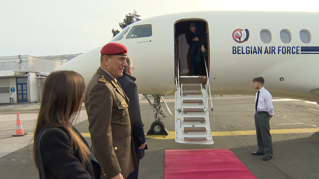
NATO Secretary General visits Croatia